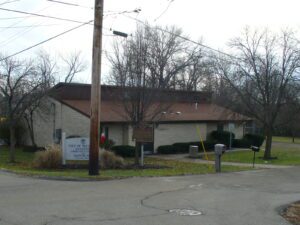
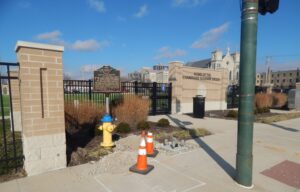
Civic organizations played pivotal roles in the development of the residential community of Hazelwood, founded as a subdivision of Blue Ash in 1888. The Hazelwood Civic Association, initially established as the Brothers Civic Society in 1941, addressed community needs by working for public improvements and promoting civic relations through social events and educational programs. Efforts by the HCA led to the construction of a new civic center and the introduction of the Boy and Girl Scouts and other programs that were previously unavailable to African-American children. Hazelwood’s deterioration and the threat of encroaching industrial development led to the formation of the Hazelwood Improvement Corporation in 1968. The HIC, acting as an agent of the city of Blue Ash, helped to upgrade housing, pave roads, build new homes to ensure a residential nature, install water and sewage systems, and erect streetlights. In 1997, the Hazelwood Community Association was organized to assist residents during Hazelwood’s transition to a racially integrated community.
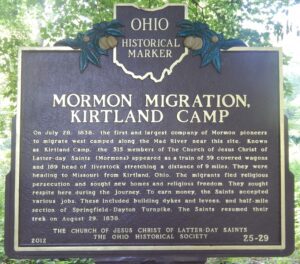
On July 28, 1838, the first and largest company of Mormon pioneers to migrate west camped along the Mad River near this site. Known as Kirtland Camp, the 515 members of The Church of Jesus Christ of Latter-day Saints (Mormons) appeared as a train of 59 covered wagons and 189 head of livestock stretching a distance of 9 miles. They were heading to Missouri from Kirtland, Ohio. The migrants fled religious persecution and sought new homes and religious freedom. They sought respite here during the journey. To earn money, the Saints accepted various jobs. These included building dykes and levees, and half-mile section of Springfield-Dayton Turnpike. The Saints resumed their trek on August 29, 1838.
As Oxford Township was developing in the mid-1800s, a cluster of farmsteads near its northern border developed and was designated the “Doty Settlement.” As was the custom, the community took its name from a prominent family in the area. In or near the settlement were a church and cemetery, a school, a blacksmith shop, a sawmill, a distillery, a furniture shop, and a fulling mill for cleansing, shrinking, and thickening cloth. With the frontier spirit of self-reliance, it was seldom necessary to travel several miles into Oxford village for additional goods or services. Working together, the community farmed local fields and bartered for other items. Men, women, and children worked long, hard hours in the fields harvesting corn and wheat. It is evident that these families, living in an agricultural society, possessed many useful skills for surviving in the Ohio country.
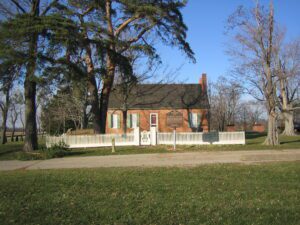
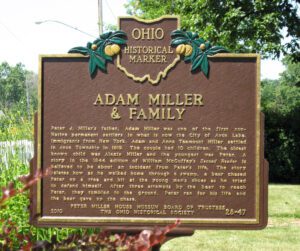
The Peter J. Miller House was constructed around 1830 and is one of the last remaining pre-Civil War lakefront houses in Lorain County. The architecture is Greek Revival. Peter Miller married Ruth Houseworth in 1828. They had five children. In 1851 Peter Miller died and it’s believed that his family continued to reside on the property until 1925. The City of Avon Lake purchased the property in 1962. The house was opened for tours, and restoration proceeded, as funds were available. In 1975 the water heating system burst and caused extensive damage. In 1985 a new committee took over and was successful in restoring the house. Volunteer trustees have overseen the operation of the house as a museum since September 1989.
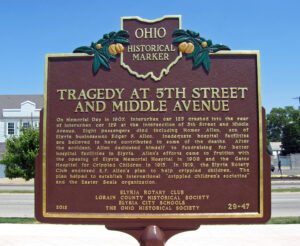
On Memorial Day in 1907, interurban car 123 crashed into the rear of interurban car 129 at the intersection of 5th Street and Middle Avenue. Eight passengers died including Homer Allen, son of Elyria businessman Edgar F. Allen. Inadequate hospital facilities are believed to have contributed to some of the deaths. After the accident, Allen dedicated himself to fundraising for better hospital facilities in Elyria. Allen’s efforts came to fruition with the opening of Elyria Memorial Hospital in 1908 and the Gates Hospital for Crippled Children in 1915. In 1919, the Elyria Rotary Club endorsed E.F. Allen’s plan to help crippled children. The plan helped to establish international “crippled children’s societies” and the Easter Seals organization.
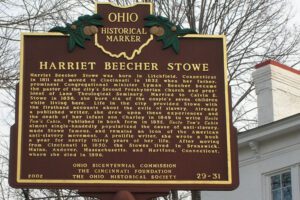
Harriet Beecher Stowe was born in Litchfield Connecticut in 1811 and moved to Cincinnati in 1832 when her father, prominent Congregational minister Lyman Beecher became the pastor of the city’s Second Presbyterian Church and president of Lane Theological Seminary. Married to Calvin E. Stowe in 1836, she bore six of the couple’s seven children while living here. Life in the city provided Stowe with the firsthand accounts about the evils of slavery. Already a published writer, she drew upon these experiences and the death of her infant son Charley in 1849 to write Uncle Tom’s Cabin. Published in book form in 1852, Uncle Tom’s Cabin almost single-handedly popularized the cause of anti-slavery, made Stowe famous, and remains an icon of the American anti-slavery movement. A prolific writer, she wrote a book a year for nearly thirty years of her life. After moving from Cincinnati in 1850, the Stowes lived in Brunswick, Maine, Andover, Massachusetts, and Hartford, Connecticut, where she died in 1896.
Known by the trade name Henderson’s Printing, the business was a mainstay of Dayton’s African American community for almost 60 years and became a printer of choice for everything from advertising materials, office forms, and a community publications called “housewife savers.” John William Henderson Sr. (1913–1991) purchased his first printing press and founded the business in 1941, bringing to it experience as an instructor of journalism and printing at Wilberforce University. The business’s first location was the family home at 421 Kearney St. After several moves, the business settled at 301 Washington Street in 1958.
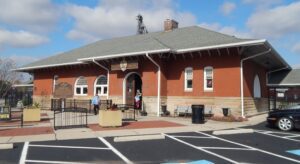
Construction of the Columbus, Piqua, and Indiana Central Railroad started in 1850 and was finished in 1854. Later referred to as the “Panhandle Railroad,” it ran from Columbus to Bradford. During the Civil War, the line carried supplies and troops and it was extended from Bradford to Richmond, Indiana. President Lincoln’s funeral train traveled the route on April 29, 1865. Eventually, three railway lines crossed Urbana: the Big Four, the Pennsylvania, and the Erie. “Corn brooms,” woolen cloth, horse carriages, and tinware were shipped by railroad to national markets and regular passenger service carried residents to destinations across the country, including Chicago, St. Louis, New York, and Washington, D.C. (Continued on other side)