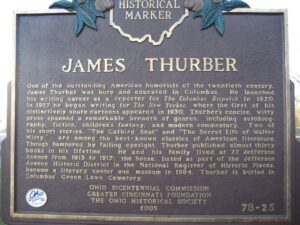
One of the outstanding American humorists of the twentieth century, James Thurber was born and educated in Columbus. He launched his writing career as a reporter for The Columbus Dispatch in 1920. In 1927 he began writing for The New Yorker, where the first of his distinctively spare cartoons appeared in 1930. Thurber’s concise, witty prose spanned a remarkable breadth of genres, including autobiography, fiction, children’s fantasy, and modern commentary. Two of his short stories, “The Catbird Seat” and “The Secret Life of Walter Mitty,” are among the best-known classics of American literature. Though hampered by failing eyesight, Thurber published almost thirty books in his lifetime. He and his family lived at 77 Jefferson Avenue from 1913 to 1917; the house, listed as part of the Jefferson Avenue Historic District in the National Register of Historic Places, became a literary center and museum in 1984. Thurber is buried in Columbus’ Green Lawn Cemetery.
Camp Joy was born at the site of Seven Hills Neighborhood House and original location of St. Barnabas Episcopal Mission Church. Displacement and loss caused by Ohio River flood of 1937 inspired St. Barnabas’ rector and his wife, Laurence “Cap” and Sadie Hall, to act on behalf of the children of Cincinnati’s West End. The Halls conceived of Camp Joy as a haven where kids could find a respite from impoverished surroundings in the city and its sweltering summer heat. The camp was a success and continued after the Halls’ assignment to another parish. From 1940-1944, Rev J. Brooke and Mrs. Betty Mosley continued to nurture the people of the West End through St. Barnabas and Camp Joy. (Continued on other side)
Fr. John Henni founded St. Aloysius Orphanage in 1837 to care for German-speaking Catholic children who were left abandoned by the cholera epidemics of the 1830s. The orphanage has occupied its main building since 1856. All of the orphanage’s other buildings were constructed by 1930. In 1864, additional land was purchased, making the orphanage a self-sufficient farm growing fruits and vegetables as well as livestock.
Reverend Richard E. Scully, founder of the Cincinnati Goodwill operated a Fresh Air Camp for women and children in the 1930s and 40s. The camp was part of a 100-acre site with vegetable fields, a swimming pool, tennis courts and horseshoe pits. The farm house on site was used as lodging for visitors. Men who worked at the camp received food and other forms of relief for their families. Vegetables produced on site were distributed at the Goodwill location at Ninth Street and Freeman Avenue in Cicinnati. According to family stories, Ruth Ann Eldridge, the frist child of Edison and Anna Eldridge, was buried on the site of the camp in 1933. Rev. Scully had officiated at Edison and Anna’s wedding and was a friend of the family.
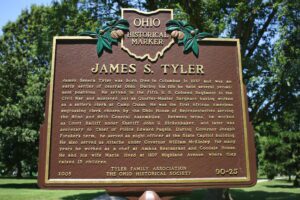
James Seneca Tyler was born free in Columbus in 1837 and was an early settler of central Ohio. During his life he held several prominent positions. He served in the Fifth U.S. Colored Regiment in the Civil War and mustered out as Quarter-Master Sergeant having worked as a sutler’s clerk at Camp Chase. He was the first African American engrossing clerk chosen by the Ohio House of Representatives serving the 62nd and 66th General Assemblies. Between terms, he worked as Court Bailiff under Sheriff John U. Rickenbaker, and later was secretary to Chief of Police Edward Pagels. During Governor Joseph Foraker’s term, he served as night officer at the State Capitol building. He also served as Attache under Governor William McKinley. For many years he worked as a chef at Ambos Restaurant and Goodale House. He and his wife Maria lived at 1107 Highland Avenue where they raised 13 children.
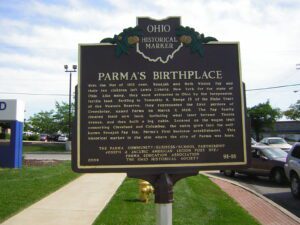
With the War of 1812 over, Benajah and Ruth Wilcox Fay and their ten children left Lewis County, New York for the state of Ohio. Like many, they were attracted to Ohio by the inexpensive, fertile land. Settling in Township 6, Range 13 of the Blake Tract of the Western Reserve, they represented the first settlers of Greenbriar, named Parma on March 7, 1826. The Fay family cleared their new land, including what later became Theota Avenue, and then built a log cabin. Located on the wagon trail connecting Cleveland and Columbus, the cabin grew into the well-known Benajah Fay Inn, Parma’s first business establishment. This historical marker is the site where the city of Parma was born.
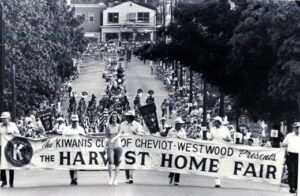
In 1804, Enoch (1764-1817) and Achsah (c.1767-1839) Carson and their seven children journeyd from New Jersey to Cincinnati. In 1805, they settled in the western hills in a large grove near Beech Flats, in what would become Green Township in 1809 and Cheviot in 1818. Game was plentiful and fertile soil yielded abundant crops. By 1806, Carson had cleared and cultivated nearly 20 acres of his land. That fall, he began a tradition that has continued into the 21st century. Echoing the ancient custom of harvest home, Carson brought together a fledging community to celebrate its good fortune and abundant harvests. Each passing year the community gathered in Carson’s grove to give thanks, rejoice, and uphold the tradition of harvest home. (Continued on other side)
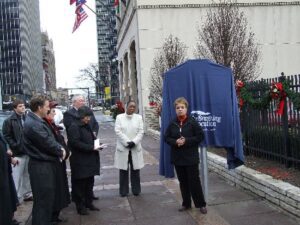
The Breathing Association was founded in 1906 as the Tuberculosis Society under the leadership of public health advocate Carrie Nelson Black. The society provided nutrition, medical care, and sanitorium services to people who could not afford proper medical care. A tuberculosis dispensary was operated at 40 South Third Street in Columbus for Ohioans needing consultation and treatment. Tuberculosis, known as the White Plague, killed one out of nine persons in Columbus during the early 1900s. An Open Air School was established on Neil Avenue in 1913 for children in homes where there were one or more cases of tuberculosis. In 1931, the Nightingale Cottage was opened on Brice Road as a tuberculosis preventorium for children. As tuberculosis became controllable, the agency became focused on emerging lung health issues. Today, The Breathing Association continues as a leading resource on lung health issues and preventing lung disease.