The Mustill house and store are survivors of Akron’s canal era and date to the 1840s. Joseph and Sarah Mustill moved their family from England to Akron in 1833 and owned the store and Greek Revival house at Lock 15 on the Ohio & Erie Canal. Three generations of Mustills lived and worked the grocery business at Lock 15, first Joseph and Sarah, then their son Fred with his wife Emma, and their children Maria, Frederick, Edwin and Franklin. A popular place to buy or barter goods, the store served canallers, farmers, craftsmen, and neighbors for many years.
The Black community of Gallipolis pooled their resources and expertise to open Gallipolis Union Colored School in 1868. Located on the northwest corner of Third Avenue and Olive Street, the public school offered primary education until, around 1877, a high school curriculum was added. In 1882, the first four students to graduate high school were W.H. Haskins, Minnie Battles, Idella Black, and Mary Nease. By 1890, the school had been renamed for President Abraham Lincoln. Valuing their public education, many Lincoln School graduates became teachers; of 33 high school graduates in the first 8 classes, 11 would become schoolteachers. Dr. Edward Alexander Bouchet (Principal 1908-1913) added an intellectual rigor to Lincoln’s curriculum. The nation’s first Black Ph.D., Bouchet earned a doctorate in physics from Yale University in 1876. (Continued on other side)
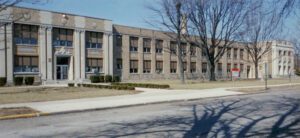
The North Baltimore Elementary and High School stood at 124 S. Second St. and was dedicated November 11, 1927. The tan and brown brick building replaced a school (built 1884) that a fire destroyed on January 26, 1926. The new school building, for children in grades 1-12, also included classrooms for home economics and business courses, as well as a 900-seat auditorium (including balcony), second floor cafeteria, gymnasium, administrative offices, and a public library. E.E. Leidy was the school’s superintendent and R. Vern Northup was the high school principal. The members of the board of education were Dr. E.A. Powell, President, D.B. Bushey, Vice President, C.G. Nigh, Clerk, and Nellie Roberts and R.E. Simon. Previously known as the “Independents,” the school’s sports teams became the “Tigers” in 1931. (Continued on other side)
On this site the Lyceum Village and the Berea Seminary were established in 1837 by John Baldwin, James Gilruth, Henry O. Sheldon, and Josiah Holbrook. Their vision was to create the first in a connected series of Lyceum Villages. The Villages were designed especially to assist in the education of teachers, promote “scientific” exchanges over the world and thus encourage the study of the works and word of God, and cultivate the spirit of “peace on earth and good will to men.” The community, however, declined and in 1842, John Baldwin assumed the indebtedness of $15,000. James Wallace acquired the area. It was owned by the Methodist Children’s Home in the 1860s and then sold to German Wallace College in 1866, becoming the original German Wallace College campus.
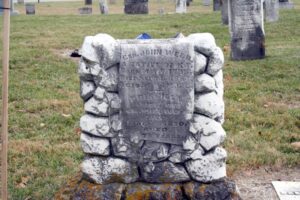
Born in Kentucky in 1793, his family moved to the Ohio country in 1797. Taught by his mother and in a log-cabin school near Dayton, he began teaching here by 1809. Purchasing land here in 1811, he served at Fort Greenville in the War of 1812. He married Priscilla Knight in 1815 and fathered eleven children. He held offices of assessor, appraiser, constable, trustee, justice of the peace, and attained the rank of Brigadier General in the Ohio Militia. He died in 1883 and is buried here in Lostcreek Cemetery.
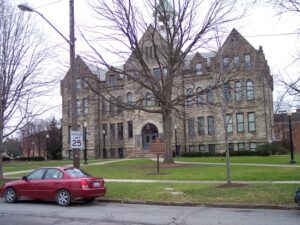
The first school in what is now Pataskala was a “subscription school” operated by Amariah Cubberly on the nearby banks of the South Fork of the Licking River in the 1820s. Subscription schools, which charged fees, were the forerunners of rural public schools in many parts of Ohio. By the 1830s several one-room public schools served the children of the area, but in 1870 the civic minded citizens of Pataskala provided a centralized building for grades one through twelve on Main Street, where the old Town Hall now stands. This school was moved to the new building on this site in 1908. When the Southwest Licking Local School District was established in 1953, Pataskala Elementary School continued in the building. Additions in 1968 and 2000 enhanced its educational capabilities. This 1908 Queen Anne architectural style building was listed on the National Register of Historical Places in 1983.
Dayton natives Hermene (1902-1986) and Josephine Schwarz (1908-2004) were pioneers of dance who founded one of the first regional ballet companies in the country. In 1927, they opened the Schwarz School of Dance, which eventually became the Dayton Ballet in 1978. Josephine’s choreography blended classical ballet traditions and contemporary dance, creating a fusion of styles that through her students and other companies shaped the development of dance in the United States. The sisters are credited with introducing organized dance to African-American and underserved children in the Dayton area. As part of the sisters’ legacy, Josephine created a fund at the Dayton Foundation in memory of Hermene to support Dayton arts and artists.
North side of 300 block of West Broadway between Cherry and S Plum streets.
Granville
, OH
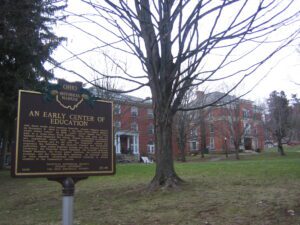
Just three weeks after reaching Granville, pioneer villagers decided on December 9, 1805 to build a log cabin where eighty children would attend school. By 1820, public school classes were being held in a three-story brick building. When rail lines and the National Road bypassed the village, dreams of becoming an industrial and commercial center were dashed. Educational institutions, however, thrived and by the Civil War Granville’s citizens had organized the following: the Granville Literary and Theological Institution, later called Granville College and then renamed Denison University; the Granville Female Seminary, the Granville Episcopal Female Seminary, the Young Ladies’ Institute, the Granville Female Academy, and the Granville Male Academy. As Granville enters its third century, educational excellence continues to attract students to the community’s schools.