On this site stood the home of Elisha and Polly Mygatt Whittlesey and their ten children. Also here was his law office and a records office that was moved in 1965 to Pioneer Village at the Canfield Fairgrounds. Already an attorney in his home state, Elisha (1783-1863) with Polly (1787-1855) emigrated from Danbury, Connecticut in June 1806 to Canfield in the Western Reserve where he was admitted to the Ohio bar and was prosecuting attorney from 1807 to 1823. During the War of 1812, Whittlesey was adjutant to Maj. Gen. Elijah Wadsworth and later a secretary to Gen. William Henry Harrison. Whittlesey opened a law office in Canfield in 1813, specialized in land cases, and was one of the founders of Norwalk, Ohio in 1815. In 1820, he was elected to the first of two terms in the Ohio General Assembly. (Continued on other side)
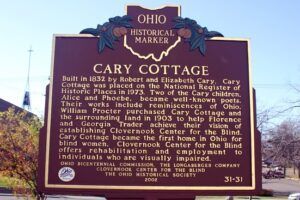
Built in 1832 by Robert and Elizabeth Cary, Cary Cottage was placed on the National Register of Historic Places in 1973. Two of the Cary children, Alice and Phoebe, became well-known poets. Their works include reminiscences of Ohio. William Procter purchased Cary Cottage and the surrounding land in 1903 to help Florence and Georgia Trader achieve their vision of establishing Clovernook Center for the Blind. Cary Cottage became the first home in Ohio for blind women. Clovernook Center for the Blind offers rehabilitation and employment to individuals who are visually impaired.
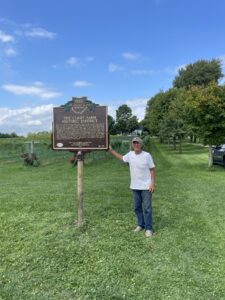
George Curry (1819-1885) was one of seven children born to a tenant sheepherder in the Cheviot Hills of Scotland. He immigrated to Ohio during the 1840s and married Scottish immigrant Agnes Milligan (1830-1893) in 1855. The couple moved to Licking County in 1865, and purchased 160-acres of farmland in 1873 to establish a sheep farm. They soon became known for their fine Spanish Merino herd. In the late nineteenth century, Ohio was a leader in the wool trade, with Licking County leading the state’s wool production by 1870. At the time of his death, George Curry was “a well-known stock dealer, and was greatly esteemed” in the community. Five generations of George and Agnes Curry’s family lived and farmed their Licking County land, until it was divided into parcels and sold in 1979.
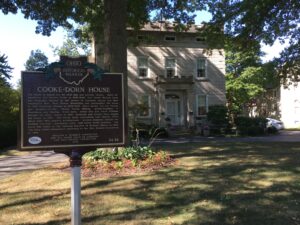
Eleutheros Cooke. The Cooke-Dorn house was the last home of attorney Eleutheros Cooke (1787-1864) who served four years in the Ohio legislature and one term in the 22nd Congress of the United States. An early proponent of railroads, Cooke received one of the first charters granted to a railroad west of the Alleghany Mountains, for the Mad River & Lake Erie line. He and wife Martha had six children, four of whom lived to adulthood. Two rose to prominence in the Civil War era. Jay was a successful banker and became known as the “financier of the Civil War” for his efforts to secure loans from Northern banks to support the Union’s war effort. Henry was appointed as the first governor of the short-lived Territory of the District of Columbia in 1871 (which was replaced in 1874).
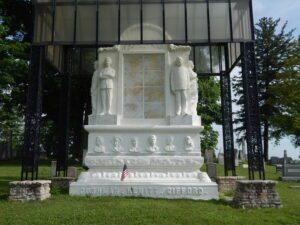
Warren Cushman was a respected painter, sculptor, photographer, musician, and inventor. He created the towering Cushman monument in Woodstock’s Rush Township cemetery and is believed to have shown his painting “Spanish Dancing Girls” at the 1893 World’s Columbian Exposition in Chicago. Warren was born to Franklin and Susan (Gifford) Cushman on January 17, 1845 in Woodstock and had three siblings, Julius, Charles and Lucy. (Continued on other side)
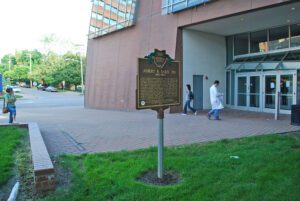
Albert B. Sabin developed the oral, live-virus polio vaccine at the University of Cincinnati College of Medicine and Children’s Hospital Research Foundation, where between 1939 and 1969, he conducted his most significant research. His vaccine has nearly eradicated the dreaded “infantile paralysis” that killed or maimed millions of children. Dr. Sabin, who considered Cincinnati his home, made many other significant medical discoveries here, particularly in the area of tropical diseases. Presidents and royalty worldwide honored him, including President Bill Clinton who said he was “one of the great heroes of American medicine.” His numerous awards include the U.S. National Medal of Medicine (1970), Presidential Medal of Freedom (1986), Medal of Liberty (1986), and Order of Friendship among Peoples awarded by the President of the Supreme Soviet of the U.S.S.R.
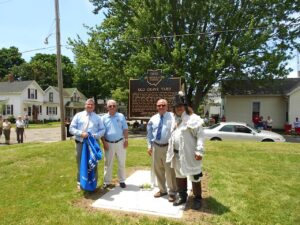
In 1805, a burial ground was dedicated to Champaign County at the intersection of Ward and Kenton Streets, which was then at Urbana’s town limits. It remained open until 1856. Among those interred there was Elizabeth Kenton, eight-year-old daughter of Simon Kenton. When she died in 1810, Kenton, the county jailer, was forbidden from crossing out of the town limits due to his unpaid debts. After following the funeral procession as far as he could, he watched Elizabeth’s burial from across the street. Also buried there were unknown soldiers from the War of 1812; Captain Arthur Thomas and son, who were killed by Native Americans in August 1813; four Bell children, who died in the tornado of March 22, 1830; and numerous early settlers of Champaign County. Many, but not all, were reinterred and rest in Oak Dale Cemetery.
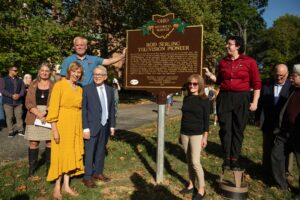
Rodman Edward Serling (1924-1975) enrolled at Antioch College in 1946 following military service in World War II. He began college as a physical education major, but soon discovered writing as a way of working through his war experiences. As a student, he contributed short fiction to The Antiochian literary magazine, managed the student-run Antioch Broadcasting System, and wrote and produced award-winning radio dramas. In July 1948, Serling married classmate Carolyn “Carol” Kramer. Shortly after earning his degree in 1950, he took a copy writer job at Cincinnati’s WLW radio. Serling quickly focused on selling scripts to national television networks. After eight years in Ohio, he and his wife moved to Connecticut. He returned to Antioch after the third season of The Twilight Zone to teach writing, drama, and media during the 1962-1963 academic year.