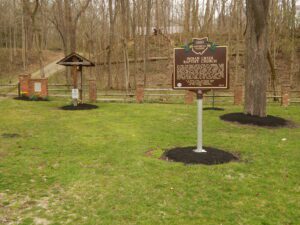
The Indian Creek Regular Baptist Church was established in 1810 as an arm of the Little Cedar Creek Church of Brookville, Indiana. The congregation purchased three acres of land for a burial ground and church and built a log structure here in 1811. Members voted in 1812 that they would receive no person who believed in the principles of slavery. By 1829, membership had reached 150 and the present brick meeting house was built. In the 1840s, membership declined due to conflict over mission activity The congregation dissolved in 1879 and the land was deeded to the Indian Creek Cemetery Association in 1880. The county park system received the property in 1960 through and with the cooperation of the Butler County Historical Society and the Cemetery Association.
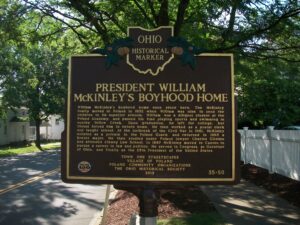
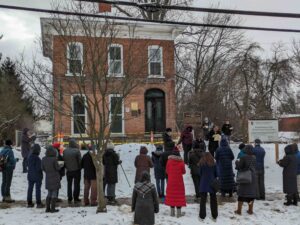
William McKinley’s boyhood home once stood here. The McKinley family moved to Poland in 1852 when William was nine to send the children to its superior schools. William was a diligent student at the Poland Academy, and passed his time playing sports and swimming in nearby Yellow Creek. Upon graduation, he left for college, but illness forced him to return home. He then worked as a postal clerk and taught school. At the outbreak of the Civil War in 1861, McKinley enlisted as a private in the Poland Guard, and returned in 1865 a brevet major. He then studied under Poland lawyer Charles Glidden and attended Albany Law School. In 1867 McKinley moved to Canton to pursue a career in law and politics. He served in Congress, as Governor of Ohio, and finally as the 25th President of the United States.
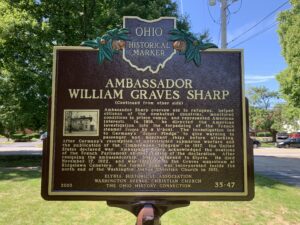
William Graves Sharp lived at this location before and after his tenure as Ambassador to France during World War I. He was born to George Sharp and Mahala Graves Sharp in Mount Gilead, Ohio, on March 14, 1859. As children, Sharp and his twin brother George moved to Elyria with their mother and grandparents, William and Ephra Graves. An Elyria High School graduate, Sharp earned a law degree from the University of Michigan in 1881. He was a journalist, lawyer, industrialist, and Lorain County Prosecutor. Serving three terms in the U.S. House of Representatives, Sharp introduced the first legislation providing for airmail service. Shortly before the outbreak of World War I, President Woodrow Wilson named Sharp as ambassador to France. He served from December 4, 1914, to April 14, 1919. (Continued on other side)
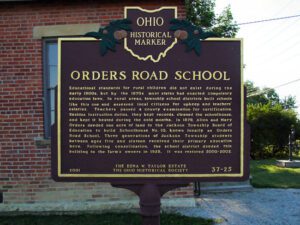
Educational standards for rural children did not exist during the early 1800s, but by the 1870s most states had enacted compulsory education laws. In rural areas, township school districts built schools like this one and assessed local citizens for upkeep and teacher’s salaries. Teachers passed a county examination for certification. Besides instruction duties, they kept records, cleaned the schoolhouse, and kept it heated during the cold months. In 1879, Allen and Mary Orders deeded one acre of land to the Jackson Township Board of Education to build Schoolhouse No. 10, known locally as Orders Road School. Three generations of Jackson Township students between ages five and sixteen received their primary education here. Following consolidation, the school district deeded this building to the farm’s owners in 1928. It was restored in 2000-2002.
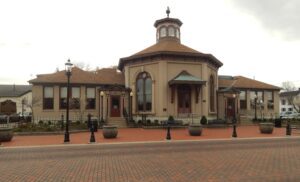
Clark Lane (1823-1907), industrialist and philanthropist, was a son of John Lane (1793-1880) and Rosanah Crum (1795-1877). John came with his family to the Ohio Country when it was still part of the Northwest Territory. As a young man, Clark worked in his family’s blacksmith shop, and eventually helped found Owens, Lane & Dyer Machine Company in 1854. It built agricultural machinery, sawmills, papermaking machines, and other products, initiating Hamilton’s prominence in metals manufacturing. Lane funded the Butler County Children’s Home, an orphanage for over a century, and constructed an octagon house as his residence on Third Street. He built this library in 1866, also as an octagon, and donated it to the people of Hamilton. A 19th century admirer wrote, “The name and generous deeds of Clark Lane will never fade from the memories of a grateful people who have been recipients of his favor.”
The Wilson Bruce Evans House, 33 East Vine Street, is a rare example of a residence built and occupied by an African American abolitionist and Underground Railroad operative. Free-born in North Carolina, Wilson Bruce Evans (1824-1898) moved to Oberlin in 1854. A skilled cabinetmaker, he opened a carpentry shop with his brother, Henry (1817-1886). Together they completed the original house by 1856. At the center of Oberlin’s interracial antislavery politics, Evans defied the Fugitive Slave Act of 1850, and was indicted for his part in the 1858 Oberlin-Wellington Rescue. During the Civil War, Evans enlisted in the predominantly white 178th O.V.I., serving August 1864-June 1865. The Wilson Bruce Evans House was added to the National Register of Historic Places in 1980, and named a National Historic Landmark in 1997. (Continued on the other side)
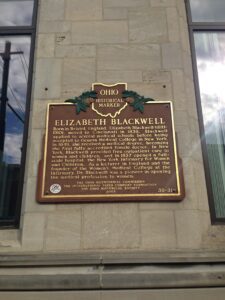
Born in Bristol, England, Elizabeth Blackwell (1821-1910), moved to Cincinnati in 1838. Blackwell applied to several medical schools before being accepted to Geneva Medical College in New York. In 1849, she received a medical degree, becoming the first fully accredited female doctor. In New York, Blackwell provided free outpatient care to women and children, and in 1857 opened a full-scale hospital, the New York Infirmary for Women and Children. As a lecturer in England and the founder of the Women’s Medical College at the Infirmary, Dr. Blackwell was a pioneer in opening the medical profession to women.
Born in Rhode Island, John Pray (1783-1872) moved to the Maumee River Valley from New York shortly after serving in the War of 1812 and completing a prospecting tour in Ohio. He built a dam across the river to Granger Island and in 1821 constructed a water-powered gristmill, the first on the lower Maumee. In 1831, he laid out the Village of Waterville with the first 50 lots. The Columbian House, a stagecoach inn constructed by Pray in 1828 and expanded in 1837, was for years the commercial and social center of Waterville and accommodated travelers from cities such as Detroit and Cincinnati. From this building, he operated the village’s post office. When Wood County was organized in 1820, Pray became a commissioner until Lucas County was formed from part of Wood in 1835. For nine years he served as Justice of the Peace in Waterville. He and his wife Lucy raised eleven children to adulthood. Circa 1854 he constructed his home, which today overlooks Pray Park.