

, OH
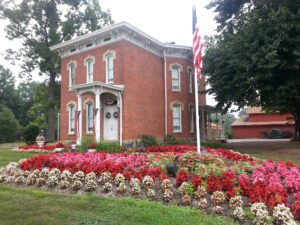
The Clague House and barn serve the community as a museum, history library, and a community theater. It is also a reminder of the area’s agrarian past and is a memorial to the philanthropic generosity of the Clagues. Robert Clague first came to Dover Township from the Isle of Man in 1829. Clague briefly returned to his native land; in 1837 he arrived back in Dover with his wife and infant. The couple raised nine children on the 78 acre farm. The Italianate structure, built in 1876, is the third home constructed on the Clague property. In 1926, surviving children Walter and Sophronia donated the farm to Dover Township for the creation of Clague Memorial Park.
, OH
The Clague House and barn serve the community as a museum, history library, and a community theater. It is also a reminder of the area’s agrarian past and is a memorial to the philanthropic generosity of the Clagues. Robert Clague first came to Dover Township from the Isle of Man in 1829. Clague briefly returned to his native land; in 1837 he arrived back in Dover with his wife and infant. The couple raised nine children on the 78 acre farm. The Italianate structure, built in 1876, is the third home constructed on the Clague property. In 1926, surviving children Walter and Sophronia donated the farm to Dover Township for the creation of Clague Memorial Park.
, OH
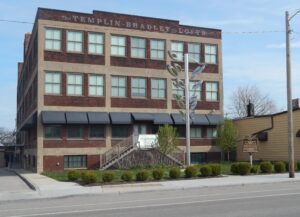
In 1907, the Templin-Bradley Company’s Children’s Flower Mission was developed in response to the Cleveland Public Schools Horticulture Program, supplying seed packets for 1 cent each–commonly referred to as Penny Packet Seeds. This earned the company a reputation for being the nation’s largest distributor of seeds for school garden programs. Although only nine varieties of plants were offered, interest was so great that nearly 50,000 packages were sold during the first year with no expense to the public-school teachers. With great success realized in the local school gardening program, interest grew exponentially across the nation and programs began in other cities. For fifty years, the Templin-Bradley Company sold flower and vegetable seeds at low costs to student members of garden groups throughout the country, cultivating many generations of gardeners.
, OH
In 1907, the Templin-Bradley Company’s Children’s Flower Mission was developed in response to the Cleveland Public Schools Horticulture Program, supplying seed packets for 1 cent each–commonly referred to as Penny Packet Seeds. This earned the company a reputation for being the nation’s largest distributor of seeds for school garden programs. Although only nine varieties of plants were offered, interest was so great that nearly 50,000 packages were sold during the first year with no expense to the public-school teachers. With great success realized in the local school gardening program, interest grew exponentially across the nation and programs began in other cities. For fifty years, the Templin-Bradley Company sold flower and vegetable seeds at low costs to student members of garden groups throughout the country, cultivating many generations of gardeners.
, OH
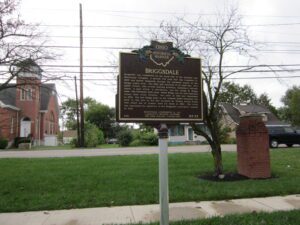
Briggsdale was established on the north side of the Columbus and Harrisburg Turnpike, a private toll road that was completed in 1849 and passed diagonally through the southeast corner of the Briggs family farm. The 1893 plat consisted of 97 small lots, five public streets, and several existing buildings, including a railroad depot, a post office, a schoolhouse, and the Joseph M. Briggs home. The Italianate style home, where Briggs and his wife Louisiana raised their seven children, was built in 1881 and demolished in 1958. The last Briggs home on the original family farmstead was built on this site in 1911 and occupied by William Irving Briggs (the eldest son of Joseph) until his death in 1964. The house was demolished for expansion of the Briggsdale Apartments complex in 2018.
, OH
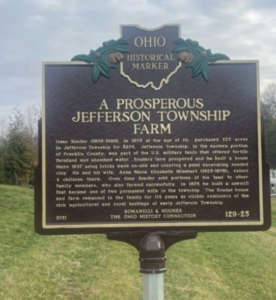
Isaac Souder (1809-1889), in 1835 at the age of 26, purchased 225 acres in Jefferson Township for $674. Jefferson Township, in the eastern portion of Franklin County, was part of the U.S. military lands that offered fertile farmland and abundant water. Souder’s farm prospered and he built a house there 1837 using bricks made on-site and creating a pond excavating needed clay. He and his wife, Anna Maria Elizabeth Minehart (1825-1878), raised 4 children there. Over time Souder sold portions of his land to other family members, who also farmed successfully. In 1874 he built a sawmill that became one of two permanent mills in the township. The Souder house and farm remained in the family for 114 years as visible reminders of the rich agricultural and rural heritage of early Jefferson Township.

, OH
Iuka Ravine, developed on land from the “Indianola Farm” that belonged to the Neil Family, is significant for its early 20th century architecture. The ravine’s natural beauty influenced architects to design homes for the upper middle class that incorporated “features of the old oak forest and glacial boulders.” Several ravine homes were designed by Frank Packard and Charles Inscho. Two classically-designed bridges built in 1912 insulated the area from traffic to create what became known during the 1920s-1950s as a “quiet professor enclave.” Iuka’s curvilinear street, one of the first in Columbus, as well as its stone walls, glacial erratics, and mature hardwoods created a “unique urban experience.” The Iuka Ravine Historic District was listed in The National Register of Historic Places in 1986 and added to the Columbus Register of Historic Properties in 1985.
, OH
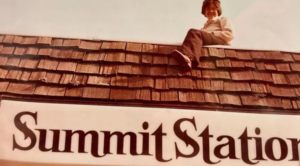
2210 Summit Street once housed one of Ohio’s longest-running lesbian bars. In 1970, a lesbian bartender at Jack’s A Go Go recognized that while Columbus had bars for gay men, it needed one geared toward lesbian clientele. Patrons knew the bar as “Jack’s,” Logan’s Off Broadway, and Summit Station. Staff welcomed women from small towns, women working in trades, women of color, butch/femme lesbians, and transgender people. Regulars recall that stepping through the door felt like finally entering a place of true belonging. Women could dance, “get together,” break up, sing karaoke, party with friends, and celebrate birthdays and holidays. Summit Station remained a safe public space, despite ongoing police harassment of its gender non-conforming regulars. A sign posted outside declared: “Ladies Night, Every Night. Men $5.” (Continued on other side)