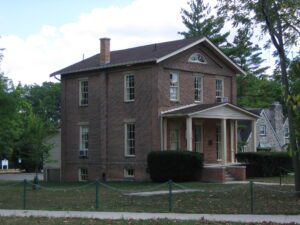
Reverend Lorenzo Langstroth, renowned as “The Father of American Beekeeping,” lived in this simple two-story, eight-room house with his wife, Anne, and their three children from 1858 to 1887. Unchanged externally, the Greek Revival cottage features brick pilasters and pediments and a fan-shaped front window. In his garden workshop, Langstroth made experimental beehives, established an apiary, and on the ten acres that surrounded his home, grew buckwheat, clover, an apple orchard, and a “honey garden” of flowers. He imported Italian queen bees in efforts to improve native bees and shipped his queens to keepers across the United States and around the world. The Langstroth Cottage was placed on the National Register of Historic Places in 1976 and designated a National Historic Landmark in 1982. (Continued from other side)
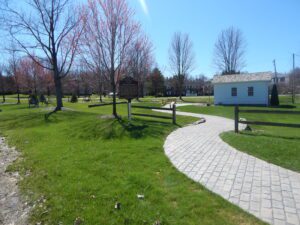
Ebenezer Sheldon (1754-1825) was born in Suffield, Connecticut. On April 19, 1775, he answered the “Lexington Alarm,” fought in the Revolution, and, in 1789, was appointed a captain in Connecticut’s militia. Following the Revolution, Sheldon, like many others, suffered financial hardships and sought a new beginning in the Western Reserve. In 1799, he established a homestead in Aurora and returned to Connecticut the following year to bring his wife Lovee and their six children to the area. A family legend relates that when Lovee saw the family’s home she “shed a few tears over the cheerless prospects” of her new life in the wilderness.
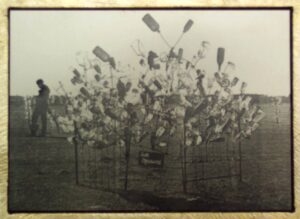
A direct descendent of original settlers in Jackson Township, Winter Zellar (Zero) Swartsel was born in 1876. Throughout his life he was a natural born showman, teacher, eccentric, anarchist, and “possibly the grandfather of American Pop Culture.” At a young age and tired of the routines of Farmersville, he declared that, “He would live by his wits while his brothers lived by the sweat of their brows.” He and a friend bicycled first to New York City and then turned around to head west and eventually the world. Later his home would overflow with items collected while traveling the world. Outside was a similar story. While chiding the American people for their wastefulness and abusing their environment, his 22 acres of farmland became his artist’s canvas filled with the thousands of items he collected from the “wasteful.” [continued on other side]
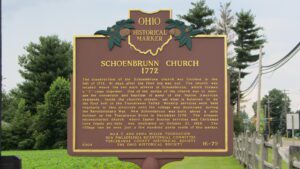
In December 1772, Brother David Zeisberger and his followers began the construction of Schoenbrunn schoolhouse. The school was built in the Tuscarawas Valley on land given to Zeisberger in the spring of 1771 by the Delaware Native Americans as a Moravian mission to the Delaware. With the land, Zeisberger laid out the town of Schoenbrunn or “Beautiful Spring.” The school served Delaware Indian children, who were taught from special textbooks prepared in the Delaware and German languages by Zeisberger. John Heckewelder, who taught at the school, is recognized as the first schoolteacher in Tuscarawas County. The present reconstructed schoolhouse was dedicated on July 29, 1928 on the 155th anniversary of the completion of the school’s construction. The village can be seen just a few hundred yards south of this marker.
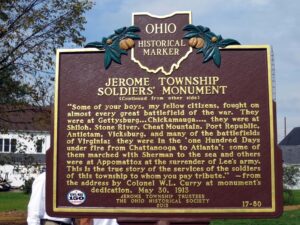
This monument was dedicated on Memorial Day of 1913 to honor the Union soldiers of the Civil War from Jerome Township. Many citizens, school children, and Civil War veterans attended the dedication as Col. W.L. Curry, who fought at Chickamauga, spoke to the crowd. The zinc monument contains the names of 400 soldiers of the township. The shaft is just over 21 feet high. Placed inside was a time capsule containing a number of historical documents including 60 photographs of Civil War veterans. Donations from a grateful community and a bequest from R.L. Woodburn, a Civil War veteran and Ohio legislator funded the monument.
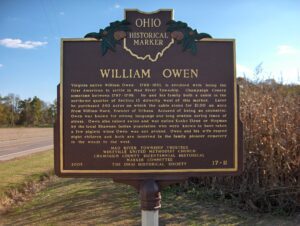
Virginia native William Owen, 1769-1821, is credited with being the first American to settle in Mad River Township, Champaign County sometime between 1797-1799. He and his family built a cabin in the northeast quarter of Section 15 directly west of this marker. Later he purchased 240 acres on which the cabin stood for $1.00 an acre from William Ward, founder of Urbana. Accused of being an eccentric, Owen was known for strong language and long oration during times of stress. Owen also raised swine and was called Kosko Elene or Hogman by the local Shawnee Indian population who were known to have taken a few piglets when Owen was not around. Owen and his wife reared eight children and both are interred in the family pioneer cemetery in the woods to the west.
The Snowden Family Band was an acclaimed African-American stringband who performed in and around Knox County for nearly seventy years, from the 1850s into the 1920s. Buried in Morris Chapel Cemetery are Thomas Snowden (1803-1856), his wife Ellen Cooper Snowden (1817-1894), and their nine children: Oliver, Sophia, Mary, Ben, Lew, Phebe, Martha, Elsie, and Annie. Born into slavery in Maryland, Thomas and Ellen separately relocated to Knox County and to freedom during the 1820s. They married in 1834. In the 1850s, the six surviving children formed a band under Ellen’s direction. Talented musicians, the Snowden Family performed banjo and fiddle music for public events and at their homestead near Mount Vernon. Many believe that the song “Dixie,” attributed to minstrel Daniel Decatur Emmett (1815-1904), originated with the Snowden Family Band.
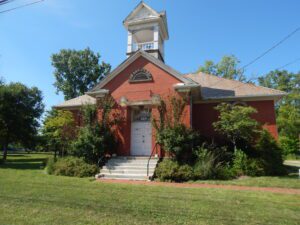
A fine example of the district school building common to Ohio in the early years of the twentieth century, this two-room, red-brick schoolhouse was completed in 1913. Accommodating elementary school children in east Berea and adjacent areas of Middleburg Township, the Berea “Little Red Schoolhouse” replaced an original wood-frame, one-room school built in the late nineteenth century on the same site. No longer active as a school, the building was used by the Berea Fine Arts Club from 1935 to 1980, and subsequently by the Berea Jaycees for meetings and community projects. This historic structure has been carefully restored and opened to public gatherings by the Berea Little Red Schoolhouse Foundation, Inc. It was placed on the National Register of Historic Places in 1975.