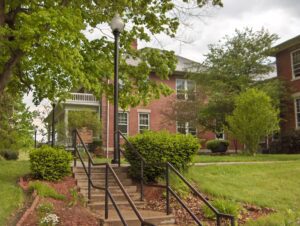
In the first quarter of the nineteenth century, when the general public believed that the insane and paupers could be rehabilitated into productive citizens, the Ohio Legislature gave authorization to county commissioners to establish county “poor houses.” The Athens County Home, formerly known as the Athens County Infirmary, opened on this site in 1857 to provide care for indigent citizens of Athens County. When fire destroyed the original building in 1903, a new building was constructed from 1904-1905, designed with the capacity to house up to one hundred people. When it was built, it was considered to be one of the finest and most modern charitable institutions of its time. The facility continued to provide housing for indigent and elderly residents until 1997 when the County Commissioners closed the home and it became a primary location for the delivery of social services in Athens County. (continued on the other side)
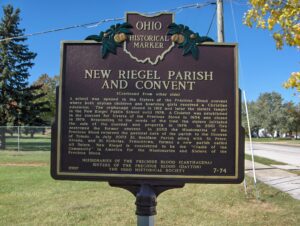
St. Boniface Catholic Church began in 1834 as a mission of several area churches and in 1836, the parish built its first church. In 1844 Bishop John Purcell commissioned Swiss born, Father Francis de Sales Brunner, a Missionary of the Precious Blood, to take pastoral charge of St. Boniface. Under the leadership of Father Brunner, the Missionaries of the Precious Blood, established in Italy in 1815, and the Sisters of the Precious Blood, founded in Switzerland in 1834, began ministry here in New Riegel (Wolfscreek) in 1844. Over two hundred acres of land were purchased for the priests, brothers, and sisters. The Missionaries brought spiritual support, farm labor, and education to the German immigrants of New Riegel. The sisters began their ministry of prayer in the convent, Mary at the Crib, on December 22, 1844. (Continued on other side)
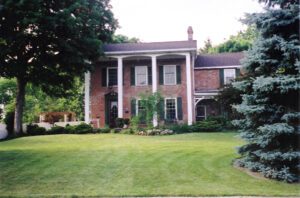
Jonathan Wright (1782-1855) and his wife Mary Bateman Wright (1787-1866) moved with their five children from Menallen, Adams County, Pennsylvania, in 1814 and built this Federal style house. Using skills acquired from his father, Joel Wright, a surveyor who platted the city of Columbus, Jonathan platted the village of “Springborough,” named for the many springs in the vicinity. The Wright family established and operated a woolen factory, two flour mills, a general store, and a 320-acre farm in the Springboro area. The Wrights were active members of the Society of Friends (Quakers) and strongly opposed slavery. The house was a station on the Underground Railroad, offering assistance to runaway slaves during their flight to freedom. Many members of the Wright family, including Jonathan, Mary, and four of their children, are buried in the Friends Cemetery on nearby Factory Road.
Archibald Worthington (1818-1895) was a freed slave from Virginia, a Civil War veteran, and prominent landowner in Highland Township. Census records indicate he was manumitted prior to 1850, and by 1860 owned land in northwest Ohio. Worthington also farmed, boarded freed slaves, and owned apple orchards and livestock. April 1866 township records show that he supported the local school for Black families. He and his wife Elizabeth raised three children: Henry, Mathilda, and James. Henry enlisted in the Massachusetts 54th Volunteer infantry, one of the first Black regiments formed in the Civil War. He died January 8, 1865, in a prison camp and is buried in North Carolina’s Salisbury National Cemetery. Mathilda and James both met partners and married, had children, and left the area. Archibald Worthington died in 1895 and is buried in Wilmington’s Sugar Grove Cemetery.
The Wyandot called the Grand Reserve home nearly a century before Ohio statehood. They built houses, cultivated the land, and grew bountiful groves of fruit trees. They governed from the nearby Wyandot Council House and operated a productive saw and grist mill. Many sent their children to school and worshiped at the limestone church, built in 1824, and recognized as the first Methodist mission in the country. But Ohioans set their sights on Wyandot lands in the fertile Sandusky River Valley. State and federal governments were unwilling to allow the Wyandot to remain on their chosen homelands, despite their participation in American society and friendly relations with neighboring settlers. Following the Indian Removal Act of 1830, the Wyandot were the last tribe removed from the State of Ohio in 1843.
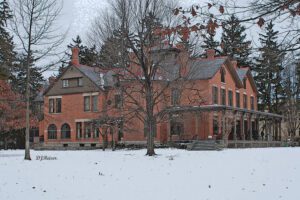
The twenty-five acre estate Spiegel Grove was the home of Rutherford Birchard Hayes, the 19th president of the United States. Spiegel Grove received its name from the German word “spiegel,” meaning mirror, describing pools that collect beneath the trees after a rainstorm. Hayes’s uncle, Sardis Birchard, a Fremont merchant, built the home on this site in 1863. The Hayeses moved to Spiegel Grove after Hayes’s second term as Ohio governor ended in 1873. They inherited the estate in 1874. The family left Fremont after Hayes’s election as Ohio governor in 1875, and U.S. president in 1876. They returned to Spiegel Grove in 1881. The Hayeses expanded the home in 1880 and 1889. Lucy and Rutherford Hayes died at Spiegel Grove in 1889 and 1893 respectively. They were reburied at Spiegel Grove in 1915. Their children donated the property to the state of Ohio in 1909 in order to establish the nation’s first presidential library.
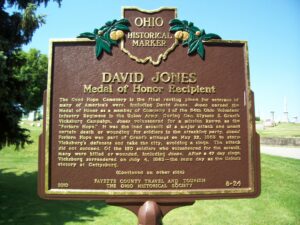
The Good Hope Cemetery is the final resting place for veterans of many of America’s wars, including David Jones. Jones earned the Medal of Honor as a member of Company I of the 54th Ohio Volunteer Infantry Regiment in the Union Army. During Gen. Ulysses S. Grant’s Vicksburg Campaign, Jones volunteered for a mission known as the “Forlorn Hope.” It was the lead assault of a major attack and meant certain death or wounding for soldiers in the attacking party. Jones’ Forlorn Hope was part of Grant’s attempt on May 22, 1863 to storm Vicksburg’s defenses and take the city, avoiding a siege. The attack did not succeed. Of the 150 soldiers who volunteered for the assault, many were killed or wounded, including Jones. After a 47 day siege, Vicksburg surrendered on July 4, 1863—the same day as the Union’s victory at Gettysburg.
Saints Peter and Paul Church, Petersburg (1835), was the mother church for St. Joseph, Wapakoneta; St. John the Evangelist, Fryburg; St. Lawrence, Rhine; and Our Lady of the Immaculate Conception, Botkins. All were founded by German-Catholic immigrants to west-central Ohio. After the removal of the Wapakoneta Shawnee in 1832, the land became available for purchase. The 1830s and ’40s saw a wave of devout German settlers who wished to practice their faith in their new home, a desire served by missionary priests such as Father Wilhelm Horstman. Father Horstman first visited the settlement at Petersburg on May 8, 1835, presiding at Mass, baptizing, and blessing a marriage. In April 1836, immigrants John and Anna Mary Ruppert sold 40 acres of land in Pusheta Township to the trustees of the Catholic Church and a log church was built at the Petersburg site. (Continued on other side