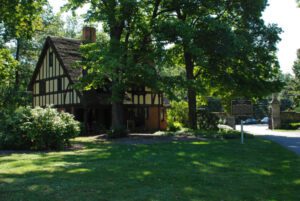
Completed in 1915, the Gate Lodge is one of several service buildings located at Stan Hywet Hall dedicated to the operations of the estate. Located at the front entrance gates, this two-story Tudor Revival structure was designed by the Seiberlings’ architect Charles S. Schneider. Originally, the Gate Lodge served as a residence for the estate’s superintendent. The first to fill this role was William Dennis who moved in with his family to the Gate Lodge after its completion and resided there until his death in 1923. Between 1923 and 1944, Fred, the eldest child of F.A. and Gertrude Seiberling, lived in the Gate Lodge with his wife Henrietta and their three children. In 1935, Henrietta brought here the two men who would formally found Alcoholics Anonymous, Bill Wilson of New York and Dr. Bob Smith of Akron.
The Civil War created orphaned and impoverished children across the nation. To establish a home for area children, a group of Hamilton women met with Reverends Thane Miller and Benjamin W. Chidlaw in January 1869. By May, the women had rented a house on North C Street. Five years later, a new house was needed. Local businessmen Clark Lane and Elbridge G. Dyer pledged a combined $10,000 to purchase the property at 425 South D Street. One condition of the gift was that home’s operators had to raise an additional $2,000 to cover expenses. The newer, larger home opened in September 1875. In 1902, Robert and Eleanor Beckett McKinney donated funds to build a hospital on the property, named Ruth Hospital, to honor their deceased infant daughter. Mrs. McKinney and her mother, Martha Beckett, had long supported the home’s work. (Continued on other side)
Poland Township Historical Society, 4515 Center Road
Lowellville
, OH
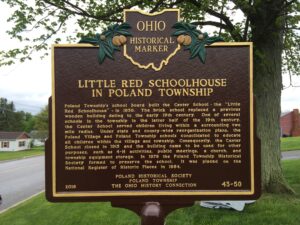
Poland Township’s school board built the Center School- the “Little Red Schoolhouse”- in 1858. The brick school replaced a previous wooden building dating to the early 19th century. One of several schools in the township in the latter half of the 19th century, the Center School served children living within a surrounding two mile radius. Under state and county-wide reorganization plans, the Poland Village and Poland Township schools consolidated to educate all children within the village and township. Consequently, the Center School closed in 1915 and the building came to be used for other purposes, such as 4-H activities, public meetings, a church, and township equipment storage. In 1979 the Poland Township Historical Society formed to preserve the school. It was placed on the National Register of Historic Places in 1984.
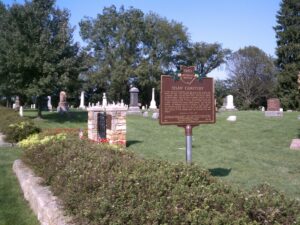
In 1829, Samuel and Charlotte Hale Shaw came to Bath Township from Bristol, New York. They purchased 145 acres of land where Samuel, a carpenter, built a two-story frame house. They had six children; two died in infancy. Their two year old daughter, Charlotte, was the first to be buried in Shaw Cemetery. They conveyed one half acre of land to the township for a “burying ground” in 1836. Samuel died in 1836; Charlotte then married Lyman Doolittle. They had five children; two daughters survived to adulthood. In 1892, Virgil E and Genevieve Doolittle Shaw sold one acre to Bath Township to expand Shaw Cemetery. Samuel’s parents, Constant and Mercy Pitts Shaw, migrated to Bath Township along with his brothers and their families.
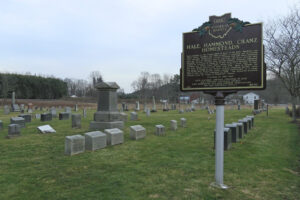
This cemetery is the resting place of many of the Hale, Hammond, and Cranz family members who were integral in founding and developing Bath Township. Connecticut natives Jonathan Hale and Jason Hammond were the first to purchase land in the area that would become Bath Township. In 1810, Jonathan Hale and his nephew, Theodore Hammond, arrived at Township 3, Range 12 of the Connecticut Western Reserve. Jonathan and Mercy Piper Hale’s family built a brick home in 1827. The Hale family lived in this home until 1956, when it became the Hale Farm & Village of the Western Reserve Historical Society. Jason and Rachel Hale Hammond’s family started construction on a frame home in 1818 that was completed in 1836. The Hammond property extended from the valley to Hammond’s Corners. (Continued on other side)
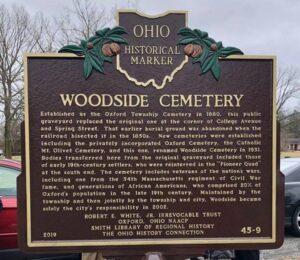
Established as the Oxford Township Cemetery in 1880, this public graveyard replaced the original one at the corner of College Avenue and Spring Street. That earlier burial ground was abandoned when the railroad bisected it in the 1850s. New cemeteries were established including the privately incorporated Oxford Cemetery, the Catholic Mt. Olivet Cemetery, and this one, renamed Woodside Cemetery in 1931. Bodies transferred here from the original graveyard included those of early 19th-century settlers, who were reinterred in the “Pioneer Quad” at the south end. The cemetery includes veterans of the nation’s wars, including one from the 54th Massachusetts regiment of Civil War fame, and generations of African Americans, who comprised 20% of Oxford’s population in the late 19th century. Maintained by the township and then jointly by the township and city, Woodside became solely the city’s responsibility in 2002.
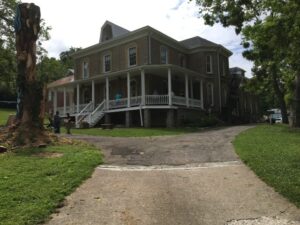
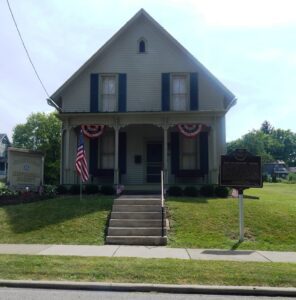
Alexander Frankfort (1842-1930), the last surviving Civil War veteran from Struthers, built this house in 1884. His wife, Louisa Jane Johns Frankfort (1851-1921), purchased the land from Thomas Struthers for $190.00. The house is of balloon frame construction and has sandstone foundation. The main beam traversing the basement was made from a large tree on the property. Married in 1874, the Frankforts had eight children, but four little ones had died by 1884. The Frankforts brought their fifth child, the infant Alma (1884-1984) to this then new house, where she and three sisters grew up. Alma lived and worked here as a seamstress for 93 years. The house was empty until 1986 when the Mohr family, Alma’s nephews, donated it to the Struthers Historical Society. The historical society renovated the house and opened as a museum in 1989.
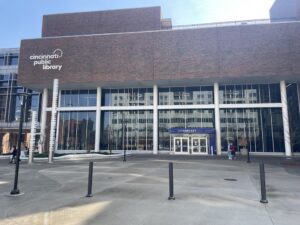
Among the first in America, Cincinnati’s public library dates from March 14, 1853. A public reading room opened in 1856, but funding remained a problem until 1867, when local school board president Rufus King II secured legislation for a renamed Cincinnati Public Library. In 1869, King lured leading librarian William Frederick Poole to organize Cincinnati as a national model for the growing public library movement. Poole designed 19th century America’s most advanced library at 629 Vine Street, which fully opened in 1874. Becoming a countywide system in 1898, the Public Library of Cincinnati and Hamilton County was a pioneer in the 20th century with special services for the blind and for children, bookmobile services, and circulation of audiovisual materials. (continued on other side)