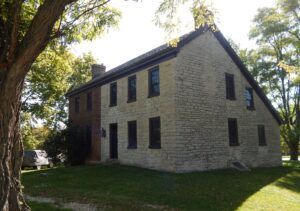
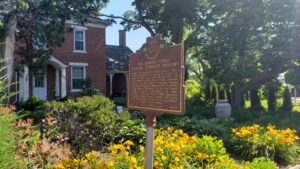
Lewis and Elizabeth (Lyons) Kemp were settlers of what became Mad River Township. With their eight children, the Kemps arrived here from Frederick County, Maryland around 1806. The stone part of the house was built shortly thereafter. Lewis donated nearby land for what became known as the “Kemp School,” established in 1815, and for a graveyard, which had its first burial in 1816 or 1817. The Kemps also hosted services of the United Brethren church. The Kemp house is an example of a “Saltbox” type, so called because of the long slope of its rear gable roof. It is believed the house’s brick portion was added around 1832.
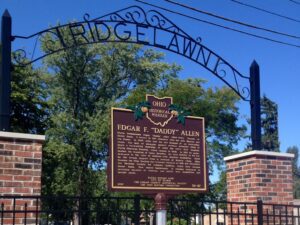
Elyria businessman Edgar “Daddy” Allen (1862 — 1937), founder of Easter Seals, is buried in this cemetery with his wife Blanche and son Homer. In 1907 Allen lost his son because of an interurban crash. The lack of adequate medical services prompted Allen to begin a fundraising campaign to build the city’s first hospital, Elyria Memorial Hospital, which opened in 1908. In 1915 he spearheaded the founding of Gates Hospital, the first facility in the U.S. dedicated to the care of children with physical disabilities. Aided by the strong support from a network of Rotary Clubs, Allen founded the Ohio Society for Crippled Children in 1919 and thereafter the National Society for Crippled Children, which later became Easter Seals. Now named Easterseals, it remains dedicated to providing services to children and adults with disabilities and special needs.
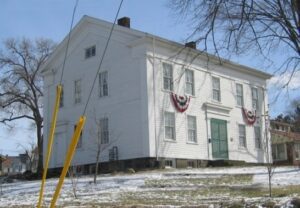
Built circa 1840 by Henry Barnhisel Jr. in the Greek Revival architectural style, the Barnhisel home is one of the oldest remaining structures in Girard. Henry and Eve Anna Barnhisel purchased the land where the house stands in 1813 when they acquired 318 acres in the Connecticut Western Reserve. The couple moved onto the land with their eleven children, and the family lived among a large group of Pennsylvania Germans who settled in Liberty Township. Their son, Henry Jr., took over the farm after his father’s death in 1824. In 1833 he married Susan Townsend. Henry contributed to his community by playing a key role in the building of both the Methodist Church and the first brick school in Girard and Liberty Township. He fathered five daughters, some of whom married into other leading families of the Mahoning Valley, including William Tod, son of the governor. Two granddaughters married into the Wicks and Stambaughs.
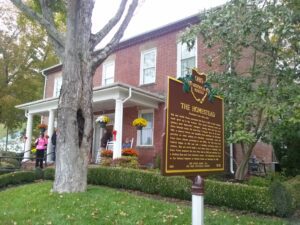
The Homestead was built in 1820 by Nehemiah Wood with an addition completed in 1822 by his son, Harrison. The Wood family, a pioneer family of Gallia County, arrived in 1805. The Homestead remained in the Wood family for over 100 years. The two-story Federal style building is constructed of bricks made on site by freed slaves who accompanied Nehemiah Wood from Virginia. The lane just below the house was a stagecoach route that ran between Chillicothe and Gallipolis. In the mid-1800s the Homestead served as an inn and stagecoach stop. The Wood family sold the farm to Rio Grande College in 1938 which used the land for college gardening and farming programs. (Continued on other side)
In 1809-1811, Magdalene Strader Borror, widow of Revolutionary War veteran Jacob Borror Jr., moved to this area from Virginia with her seven children (Martin, Jacob, Myomi, Solomon, Christine, Issac, and Absalom). Originally clearing and settling 400 acres of land given to Magdalene by her father, Christopher Strader, the family eventually prospered throughout the entire township. After her death in 1838, Magdalene was buried in nearby Scioto Cemetery, the resting place of more than seventy of her descendants.
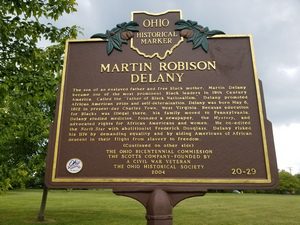
The son of an enslaved father and free Black mother, Martin Delany became one of the most prominent Black leaders in 19th Century America. Called the “Father of Black Nationalism,” Delany promoted African American pride and self-determination. Delany was born May 6, 1812 in present-day Charles Town, West Virginia. Because education for Blacks was illegal there, his family moved to Pennsylvania. Delany studied medicine, founded a newspaper, the “Mystery,” and advocated rights for African Americans and women. He co-edited the “North Star” with abolitionist Frederick Douglass. Delany risked his life by demanding equality and by aiding Americans of African descent in their fight from slavery to freedom. (Continued on other side)
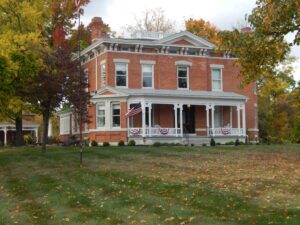
Built of bricks of clay from the Little Miami River, the King Mansion has stood majestically overlooking the town of Kings Mills since 1885. The home of industrialist Ahimaaz King and the first house in Kings Mills, this 12-room, three-story Italianate-style house is crowned with a widow’s walk and features stained-glass windows, distinctive fireplaces, and a tack room. The carriage house included a milking operation for cows on the lower level, stables on the main level, and carriage storage on the upper level. A cast iron fountain in the yard gave the name “Fountain Square” to the area. Occupied by three generations of Kings until 1988, the mansion was added to the National Register of Historic Places in 2008 and is a reminder of Ahimaaz King’s importance to the history of Kings Mills.
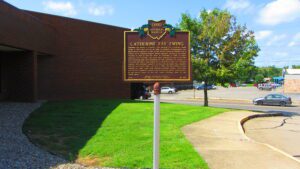
Frances Dana (Barker) Gage was born on October 12, 1808, in Marietta. She married James L. Gage in 1829 and they raised eight children, including four sons who served with Union forces during the Civil War. Throughout much of her life, Frances was deeply involved with the Temperance and Anti-Slavery movements and Women’s Rights issues. Presiding over the Women’s Rights Convention in Akron in 1851, she invited Sojourner Truth to give her famous “Ain’t I a Woman” speech. The Gage family moved in 1853 to St. Louis, the western extension of the Mason-Dixon Line, where her life was threatened whenever she spoke out against slavery. During the Civil War, she traveled south to aid Union soldiers and teach freed slaves. Though crippled and permanently disabled by a stroke, she continued to lecture on social issues until 1867. Frances Dana Gage died on November 10, 1884, in Greenwich, Connecticut.