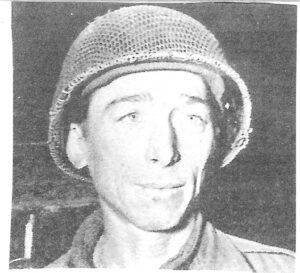
Alexander Albert Drabik was born here, in a log cabin, on December 28, 1910 to John Drabik and Frances Lewandowski, Polish immigrants from Szymborze, Germany, now Poland. Alex, youngest son of 14 children, attended Door Street School. A meat cutter, he enlisted in the United States Army in October 1942. Drabik fought in the Ardennes, Central Europe and Rhineland Campaigns of World War II. He received a Purple Heart during the Battle of the Bulge. On March 7, 1945, Sergeant Drabik led 10 Company A soldiers of the 27th Armored Infantry Battalion of the 9th Armored Division across the Ludendorff railroad bridge from Remagen, Germany to the Rhine River east bank. (Continued on other side)
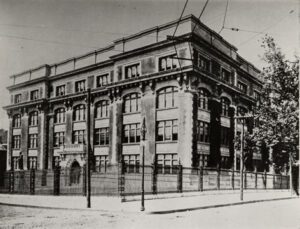
William and Abigail Cutter Woodward founded Woodward High School, the first public high school west of the Allegheny Mountains, on this site October 24, 1831. Concerned that the poor of Cincinnati had no avenues for education, the Woodwards donated land, time, funding, and expertise to this venture that brought the arts and sciences to “those who have not the means of procuring such advantages themselves.” Notables include Dr. Joseph Ray, principal, 1851-1855, author of several popular mathematics texts; Professor William McGuffey, author of the well-known readers and spellers; and William Howard Taft, Class of 1874, former U.S. President. From 1856-1863, the home of Levi and Catherine Coffin was also located on this site. Both were legendary abolitionishts who helped enslaved people escape to freedom in Canada. Levi is often referred to as the “President of the Underground Railroad.”
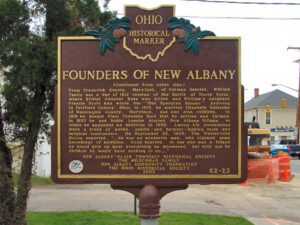
A tavern and inn, for which Noble Landon (1783-1866) obtained a liquor license in 1835, formerly occupied the southeast corner of High and Main streets. In 1837 Landon and William Yantis laid out the town of New Albany in 50-by-100-foot lots, with Landon’s lots lying on the east side and Yantis’ on the west side of High Street. Landon was born in Litchfield, Connecticut, lived as a young man in St. Albans, Vermont, and migrated to Licking County, Ohio, in 1810. He was the first clerk and first Justice of the Peace in St. Albans Township and first postmaster in Johnstown and later in New Albany. In addition to contributions as a builder-developer, Landon gave to the village lore the story of a remarkable conversion. Long known as a heavy drinker, he suddenly ordered kegs of whiskey he owned to be carried into the street and broken. He then attended church regularly. (continued on other side)
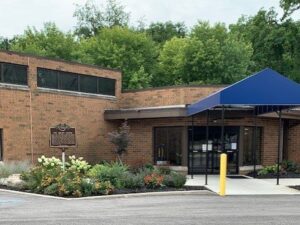
The Rotary Club of Toledo founded the “Toledo Society for Crippled Children” in 1920 to care for and treat children with disabilities, primarily those with polio. After a decade of fundraising and a substantial bequest from Edward Drummond Libbey, the Society opened a convalescent home in 1931 and moved to its own state-of-the-art facility in 1938. As the 1950s Salk vaccine reduced the prevalence of polio and the needs of Toledo’s disabled changed, the Society shifted focus to offer preschool care, adult rehabilitation, and independent living. The Society relocated to the 17-acre Monroe Street Campus in 1980 and adopted the name “The Ability Center of Greater Toledo” in 1990. The Ability Center proudly celebrated 100 years of “service above self” in 2020 and continues to create a disability-friendly Toledo.
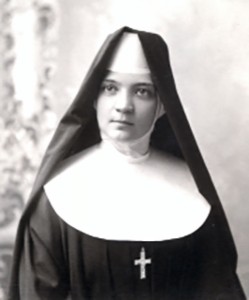
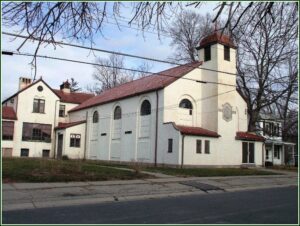
In 1916, Bishop of Toledo Joseph Schrembs requested that the Sisters of Saint Francis, Rochester, Minnesota, send nuns to work with Polish immigrant children that were flooding into greater Toledo. Mother Mary Adelaide Sandusky (1874-1964) brought 22 sisters who quickly established a new order, their Toledo motherhouse, and began teaching in parish schools. Under her steady guidance, the Sisters of St. Francis of the Congregation of Our Lady of Lourdes, Sylvania, Ohio, transformed 89-acres of farmland into a tranquil campus that included gardens, shrines, and an arboretum. Mother Adelaide designed buildings modeled on the California missions and filled them with European art as well as original ceramic murals made by the Sisters. The Sylvania Franciscans flourished and over 500 new members joined between 1916 and 1964. (Continued on other side)
Eckstein Elementary School operated on this site from 1915 to 1958, serving Glendale’s Negro children from Kindergarten through eighth grade. The school was named in honor of Eleanor Eckstein, who taught the children at various locations in the village during the time of segregation in America. Upon completing eighth grade, Eckstein School’s students were integrated with their white counterparts in grades nine through twelve at Congress Avenue School. The Eckstein School building evolved from a single family dwelling into its present structure through a series of expansions, the last of which was the addition of the gymnasium in 1928. In the mid-1950s Glendale became a part of the Princeton School District. A new consolidated high school opened in 1958, the Congress Avenue School became Glendale Elementary, and Eckstein was closed. This commemorative text was composed by alumni of the Eckstein School.
Langston Hughes Branch Library, 10200 Superior Avenue
Cleveland
, OH
One of the most recognized figures of the Harlem Renaissance, Langston Hughes was born in Joplin, Missouri on February 1, 1902 and moved to Cleveland by the time he was in high school. An avid traveler, he credited his years at Central High School for the inspiration to write and dream. The consummate Renaissance man, Hughes incorporated his love of theater, music, poetry, and literature in his writings. As an activist, he wrote about the racial politics and culture of his day. He was awarded the Spingarn Medal by the NAACP. He published over 40 books, for children and adults. Known as the “Poet Laureate of the Negro People,” Hughes most famous poem is “The Negro Speaks of Rivers.” Langston died on May 22, 1967, and his remains were interred beneath the commemoratively designed “I’ve Known Rivers” tile floor in the Schomburg Center for Research in Black Culture in Harlem.
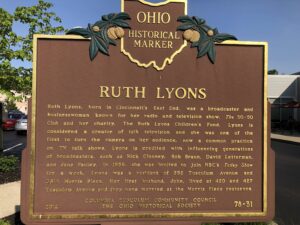
Ruth Lyons, born in Cincinnati’s East End, was a broadcaster and businesswoman known for her radio and television show, The 50-50 Club and her charity, The Ruth Lyons Children’s Fund. Lyons was considered a creator of talk television and she was one of the first to turn the camera on her audience, now a common practice on TV talk shows. Lyons is credited with influencing generations of broadcasters, such as Nick Clooney, Bob Braun, David Letterman, and Jane Pauley. In 1858, she was invited to join NBC’s Today Show for a week. Lyons was a resident of 332 Tusculum Avenue and 3614 Morris Place. Her first husband, John lived at 420 and 427 Tusculum Avenue and they were married at the Morris Place residence.