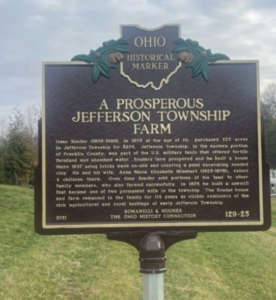
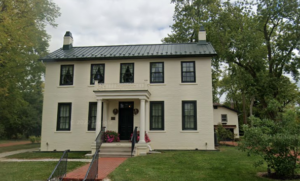
Isaac Souder (1809-1889), in 1835 at the age of 26, purchased 225 acres in Jefferson Township for $674. Jefferson Township, in the eastern portion of Franklin County, was part of the U.S. military lands that offered fertile farmland and abundant water. Souder’s farm prospered and he built a house there 1837 using bricks made on-site and creating a pond excavating needed clay. He and his wife, Anna Maria Elizabeth Minehart (1825-1878), raised 4 children there. Over time Souder sold portions of his land to other family members, who also farmed successfully. In 1874 he built a sawmill that became one of two permanent mills in the township. The Souder house and farm remained in the family for 114 years as visible reminders of the rich agricultural and rural heritage of early Jefferson Township.
Iuka Ravine, developed on land from the “Indianola Farm” that belonged to the Neil Family, is significant for its early 20th century architecture. The ravine’s natural beauty influenced architects to design homes for the upper middle class that incorporated “features of the old oak forest and glacial boulders.” Several ravine homes were designed by Frank Packard and Charles Inscho. Two classically-designed bridges built in 1912 insulated the area from traffic to create what became known during the 1920s-1950s as a “quiet professor enclave.” Iuka’s curvilinear street, one of the first in Columbus, as well as its stone walls, glacial erratics, and mature hardwoods created a “unique urban experience.” The Iuka Ravine Historic District was listed in The National Register of Historic Places in 1986 and added to the Columbus Register of Historic Properties in 1985.
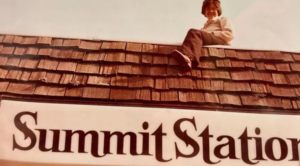
2210 Summit Street once housed one of Ohio’s longest-running lesbian bars. In 1970, a lesbian bartender at Jack’s A Go Go recognized that while Columbus had bars for gay men, it needed one geared toward lesbian clientele. Patrons knew the bar as “Jack’s,” Logan’s Off Broadway, and Summit Station. Staff welcomed women from small towns, women working in trades, women of color, butch/femme lesbians, and transgender people. Regulars recall that stepping through the door felt like finally entering a place of true belonging. Women could dance, “get together,” break up, sing karaoke, party with friends, and celebrate birthdays and holidays. Summit Station remained a safe public space, despite ongoing police harassment of its gender non-conforming regulars. A sign posted outside declared: “Ladies Night, Every Night. Men $5.” (Continued on other side)
Hugh Grant Sr. (1769-1806) owned a gristmill and land in Pittsburgh, Pennsylvania, during the 1790s. He married Catharine Barr Grant (unknown-1836) and they had 6 children: Alexander, Jacob, Isabella, Nancy, Mary, and Hugh Grant Jr. (born posthumously). In 1804 Grant purchased 450 acres of federal land at the Chillicothe land office. In 1805 he and his family moved to Jackson Township, Ohio. Uncertain of the location of his tracts, he settled his family in a log structure along the Scioto River. During the winter of 1806-1807, Grant died in a freak accident climbing a honeybee tree. Catharine Barr Grant realized they were on the wrong land and moved her family to the right property holdings where the Grant Homestead remains. She died August 17, 1836, and is buried in Union Methodist Cemetery.
Pleasant Litchford was born into slavery in Virginia in 1789. He purchased his freedom and moved his family to Ohio by 1831. A master blacksmith, Litchford bought a small farm four miles north of Columbus in 1833. By the time of his death in 1879, he was the fourth largest landowner in Perry Township. Described as “a man of iron constitution,” Litchford served as a lay-preacher, founding member, and deacon at Second Baptist Church. The church and James Poindexter, its pastor in 1847, provided an important voice during the anti-slavery movement. In 1869, Litchford sold, for $1, a parcel of land to establish a school for African American children. He was married three times and was survived by seven living children, twenty-five grandchildren, and three great-grandchildren. Pleasant Litchford was buried in the Litchford Family Cemetery.
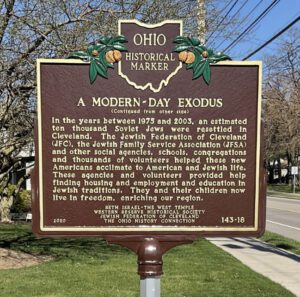
Here in 1963 congregants of Beth Israel-The West Temple, led by Louis Rosenblum, Herb Caron, and Rabbi Daniel Litt, founded the Cleveland Committee (later Council) on Soviet Anti-Semitism, the first American organization created to advocate for freedom for Soviet Jews. In 1970 this work led to the formation of the Union of Councils for Soviet Jews (UCSJ) under the leadership of Louis Rosenblum. The UCSJ, whose national office was located here 1970-1973, became the largest independent Soviet Jewry organization in the world. By the turn of the 21st century, the efforts begun here helped 1.6 million Jews leave the former Soviet Union. (Continued on other side)
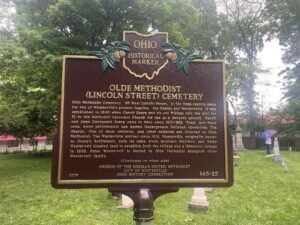
Olde Methodist Cemetery, 66 West Lincoln Street, is the final resting place for two of Westerville’s pioneer families, the Sharps and Westervelts. It was established in 1849 when Garrit Sharp and his son William sold the plot for $1 to the Methodist Episcopal Church for use as a burying ground. Garrit and Anna Goodspeed Sharp came to Ohio circa 1810-1812. They, and their sons, were abolitionists and known Underground Railroad operatives. The Sharps, five of their children, and other relatives are interred in Olde Methodist. The Westervelts arrived circa 1818. Westerville, originally known as Sharp’s Settlement, took its name when brothers Matthew and Peter Westervelt donated land to establish both the village and a Methodist college in 1839. Peter Westervelt is buried in Olde Methodist alongside other Westervelt family. (Continued on other side)
William Henry Fouse was born in Westerville to former slaves Squire Fouse and “Sallie” Syler. The first Black student to graduate from Westerville High School (1884), he worked as a bootblack and waiter to earn college tuition. Fouse graduated cum laude from Otterbein (1893), and as the college’s first Black graduate, delivered “A Plea for the Afro-American” at commencement. For forty-five years Fouse worked as a teacher and administrator in Corydon (Indiana), Gallipolis (Ohio), Covington (Kentucky), and Lexington (Kentucky). He served as principal at Lexington’s Paul Lawrence Dunbar High School from its opening in 1923 until his retirement in 1938. During that time, Fouse developed the Bluegrass Oratorical Association, served as president of the Kentucky Negro Education Association, and earned his MA in Education. In 1937, Otterbein conferred a Doctor of Pedagogy upon the distinguished educator.