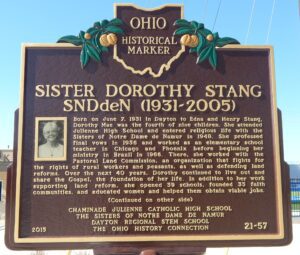
Born on June 7, 1931 in Dayton to Edna and Henry Stang, Dorothy Mae was the fourth of nine children. She attended Julienne High School and entered religious life with the Sisters of Notre Dame de Namur in 1948. She professed final vows in 1956 and worked as an elementary school teacher in Chicago and Phoenix before beginning her ministry in Brazil in 1966. There, she worked with the Pastoral Land Commission, an organization that fights for the rights of rural workers and peasants, as well as defending land reforms. Over the next 40 years, Dorothy continued to live out and share the Gospel, the foundation of her life. In addition to her work supporting land reform, she opened 39 schools, founded 35 faith communities and educated women and helped them obtain viable jobs. (Continued on other side)
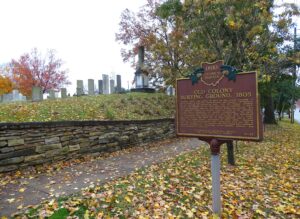
Granville, Ohio, was settled in 1805 by the Licking Company, a group formed in Granville, Massachusetts, and Granby, Connecticut, for the purpose of emigrating west. The Old Colony Burying Ground was defined on the first town plat of Granville in 1805. Many of Granville’s pioneers are interred within this ground, and the cemetery retains its original form and most of its westward facing rows of sandstone and marble gravestones. The early settlers buried here helped to lay out this town and determined the appearance and development of the village as it is today. The first burial, the infant son of Ethan Bancroft, was in April 1806. The oldest extant gravestone is dated 1808. Eighteen veterans of the Revolutionary War, thirty-nine from the War of 1812, and sixteen Civil War veterans rest here along with ministers, farmers, industrialists, physicians, young mothers, children, and other citizens of Granville.
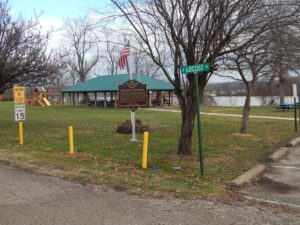
Cheshire Village Park, E. Main Street at the river
Cheshire
, OH
In 1955, at the age of 67, Emma Rowena “Grandma” Gatewood became the first woman to hike the 2,050 mile Appalachian Trail alone and in one season. The Gallia County, Ohio resident hiked the Appalachian Trail again in 1957 and 1964, becoming the first to walk its length three times. In 1959, she hiked the Oregan Trail, from Independence, Missouri to Portland, Oregon. She was a founder of the Buckeye Trail and life member of the Buckeye Trail Association, which named part of the trail after her. Grandma Gatewood was born in 1887 on a farm near Mercerville, one of 15 children, and died in 1973 at the age of 85, the mother of 11 and “grandma” to many more. SHe was inducted into the Appalachian Trail Hall of Fame in 2012.
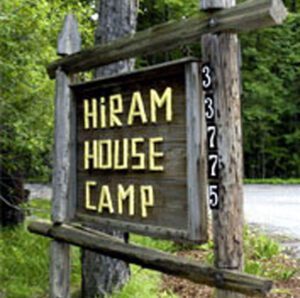
Hiram House was Ohio’s first settlement house and among the earliest in the nation, opening in October 1896 in Cleveland’s Whiskey Island neighborhood. Representing the ideals of a late-1800s urban progressive movement, settlement houses provided–through “service, not charity” –health, recreational, and self-development opportunities that were not widely available in this era. Founded by Hiram College divinity graduate George A. Bellamy (1872-1960), Hiram House administered a wide range of social services for people of different ethnic and economic backgrounds. Bellamy established the “Fresh Air Camp” circa 1900; Cleveland industrialist Samuel Mather donated this tract of land in 1903. In continuous operation since its founding, Hiram House has provided outdoor experiences and educational programs for thousands of Ohio children.
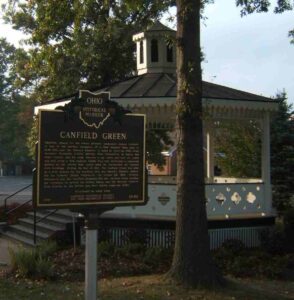
Canfield, named for the area’s primary landowner Judson Canfield, is one of the earliest examples of a New England town plan in both Ohio and the Western Reserve. It dates to April 20, 1798, when surveyor Nathaniel Church arrived from Connecticut to layout the town. Church and his team erected a log cabin and laid out roads and lots using a New England Green Plan that envisioned a communal ground at the center that would later be surrounded by various civil buildings. During the War of 1812, the Canfield Green was used as a drill ground for the Northern Ohio and Western Reserve militia, led by General Elijah Wadsworth. On August 23, 1812, General Wadsworth and the Canfield Dragoons left the Canfield Green heading for Cleveland to defend the United States and the Western Reserve from attacks by the British and their Native American allies. (Continued on other side)
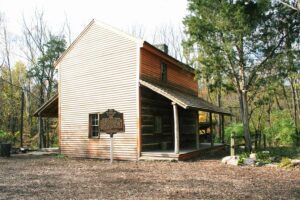
The 1804 Iddings House is the oldest structure on its original site in Miami County. A second generation American and cousin to General “Mad” Anthony Wayne, Benjamin Iddings brought his wife, Phoebe, and six of their ten children up the Stillwater River into Newton Township and constructed the log house in 1804. In 1976 the structure was placed on the National Register of Historic Places with an initial restoration in 1981. Thanks to community support, further restoration was completed in 2006.
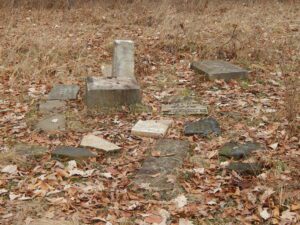
There are 48 known members of the Postle family buried in the cemetery. Their stories are interwoven with the history of Prairie Township, Franklin County, and Ohio. In 1810, Shadrach and Anna Stacia Postle were among the first settlers of Prairie Township. Their son Job was a veteran of the War of 1812 and later owned the Checker Inn, a popular stopping place on the National Road. In the 1860s, Smith Postle and his son, William Sylvester Postle, were some of the first manufacturers of clay drainage tile in Ohio. Their products improved drainage in farm fields and fostered the growth of the tile industry in the state. Gabriel Postle was the first Postle buried in the cemetery in 1829. Twelve graves are of children under the age of six, which testifies to the hardships endured by the area’s early residents. Other graves include those of John Whitehurst, a freed slave who lived with the family of the Job Postle and John Tracy, a veteran of the Civil War. In 1870, Nancy Postle was the last person buried in the cemetery.
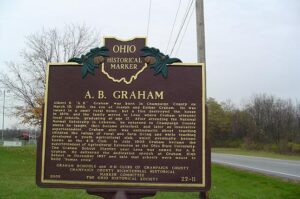
Albert B. “A.B.” Graham was born in Champaign County on March 13, 1868, the son of Joseph and Esther Graham. He was raised in a small rural home, but a fire destroyed the house in 1879, and the family moved to Lena where Graham attended local schools, graduating at age 17. After attending the National Normal University in Lebanon, he returned to Champaign County where he taught, then became principal, and later an innovative superintendent. Graham also was enthusiastic about teaching children the values of rural and farm living and while teaching developed a youth agricultural club, which eventually became known as the 4-H Club. In July 1905 Graham became the superintendent of Agricultural Extension at the Ohio State University. The Graham School District near Lena was named for A.B. Graham. He delivered the dedication speech at Graham High School in December 1957 and said that schools were meant to build “human souls.”