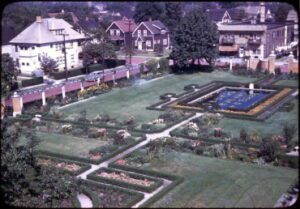
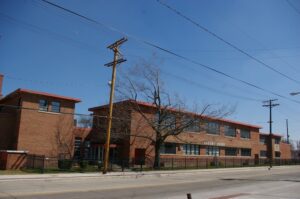
The Village of Collinwood was originally a part of Euclid Township of the Western Reserve and named after the death of railroad chief engineer Charles Collins in 1876. Originally known as “Frogsville,” the population of Collinwood dramatically increased in the 1870s, due partly to repair roundhouses of the Lake Shore & Michigan Southern Railroad. By 1901, the Village has grown to 7,500, and as a result, the schoolhouse, which once housed 200 students and four classrooms, had been enlarged twice to house 350 students in eight classrooms. Constructed in 1901, the Lakeview School was the site of a tragedy that reverberated across the nation and around the world. (Continued on other side)
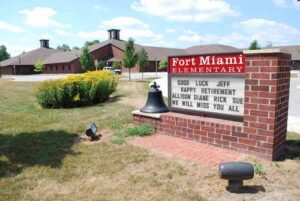
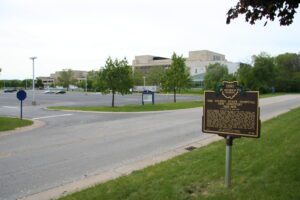
For nearly a century, this 98-acre site was occupied by an orphanage that, over the years, cared for several thousand destitute children. Founded in nearby Toledo in 1867 as the Protestant Orphan’s Home, the orphanage became the Lucas County Children’s Home shortly after it was relocated to this former farmland in 1887. It was renamed the Miami Children’s Center in 1960 before closing permanently in 1986. The main campus, across the River Road, was sold for residential use. The playground, on this side of the road, originally connected to the main campus by a tunnel, was given to the Maumee school system in 2004 as the site for the current Ft. Miami Elementary School. On these grounds, the laughter of a new generation of children at play is being heard once more….a fitting tribute to the disadvantaged boys and girls who formerly lived here.
William E. Telling (1869-1938) was one of ten children born in a farmhouse on this property. As a boy he sold strawberries and milk door-to-door and worked in a local sandstone quarry until at age 23 he purchased a milk route. He and four brothers formed the Telling Brothers Ice Cream Company in 1895 with William as president. A merger in 1915 formed the Telling Belle Vernon Dairy Company that was the first local distributor of pasteurized, glass-bottled milk. Their unique bacteriological laboratory (later Sealtest Laboratories) developed the baby food S.M.A. His recipe for success was “just work and work and work some more; do the work of two and draw the pay of one.”
Toledo State Hospital opened in January 1888 as the Toledo Asylum for the Insane. Originally located immediately south of this cemetery, the hospital was designed to function as a self-contained community for 650 people. Patients lived in large cottages, surrounded by a post office, church, library, male and female hospital, strong wards, bakery, and dining hall. People were admitted with mild to severe forms of mental illness, and a variety of other disabling conditions, including developmental, medical or neurological, as well as for addictions, injuries, and old age. Work became a form of treatment, with patients involved in construction, farming, laundry, and other jobs to help maintain the hospital. Patients could also participate in recreational activities from gardening to playing in the hospital band. The State Hospital became home for many, as hospitalization could last a lifetime, often spanning decades. (continued on other side)
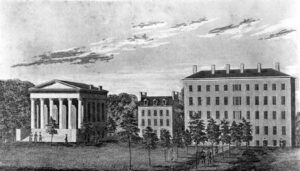
The Lanes, Baptist merchants from New Orleans, and the Kempers, a Presbyterian family from Cincinnati, gave money and land respectively for Cincinnati’s first manual labor theological seminary and high school, which opened in suburban Walnut Hills in 1829. The Reverend Lyman Beecher came from Boston as its first president. The president’s house, now known as the Stowe House after Beecher’s daughter Harriet Beecher Stowe, author of Uncle Tom’s Cabin, still remains at Gilbert and Foraker. Lane Theological Seminary, bound by present day Gilbert, Chapel, Park, and Yale streets, continued to educate Presbyterian ministers until 1932, when it was merged with McCormick Theological Seminary in Chicago.
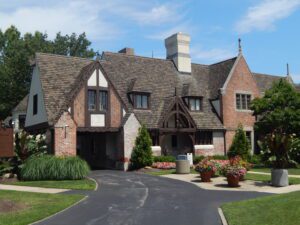
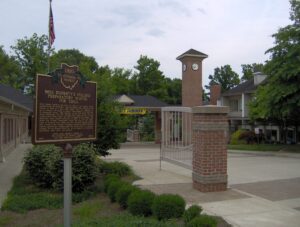
Mary Harlan Doherty was born in 1862 in the Dayton Street neighborhood of Cincinnati. She graduated from Woodward High School in 1880 at a time when women were not expected to go to college, but rather to marry, raise children, and take care of household duties. Miss Doherty, as she was known, saw the world differently. She felt strongly that women should not only possess solid social skills, but also be prepared for college. She graduated from Cornell University in 1899. In 1906 she established the College Preparatory School for Girls in the former home of Superior Court Judge and Ohio Governor George Hoadley, with a class of 125 students. Enrollment doubled by 1920, with Miss Doherty guiding her students under the school’s motto, Ad Summum, meaning “To the Highest Point,” or, as she viewed it, to strive for excellence, hard work, and service.
Karamu House, Incorporated was established in 1915 as the Playhouse Settlement, one of Cleveland’s many settlement houses for migrant and immigrant communities. Initiated by the Men’s Club of the Second Presbyterian Church, in 1915 Oberlin College and University of Chicago social work graduates, Russell and Rowena Woodham Jellliffe were hired as the founding directors. Originally located at 2239 East 38th Street, the Playhouse Settlement offered children’s theater and other social, recreational, and educational activities. It soon developed a partnership with the Dumas Dramatic Club, a local African American theater company that later became known as the Gilpin Players. (continued on other side)
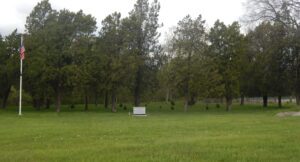
Toledo State Hospital opened in January 1888 as the Toledo Asylum for the Insane. People were admitted with mild to severe forms of mental illness, and a variety of developmental, medical and neurological conditions, as well as for addictions, injuries, and old age. Originally built to house 650 people, by the 1950s its campus had grown to accommodate over 3,000. Growing access to new medications and treatments then began a gradual decline in patient population. Eventually, most of the buildings were razed, and much of the hospital’s property was transferred, later becoming the site of The Medical College of Ohio. This transfer included the two Toledo State Hospital cemeteries, with documented burials (as of 2009) totaling 1,994 persons. Toledo State Hospital New Cemetery was opened in 1922, when the Old Cemetery (1888-1922), located .5 miles to the northeast, reached capacity. (continued on other side)