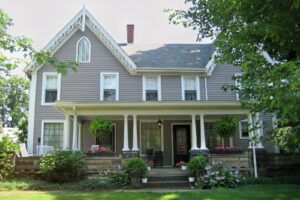
Unserheim, meaning “Our Home” in German, is the name of this ante-bellum Queen Anne style home, which was placed on the National Register of Historic Places in 1998. From 1857-1878, it was home to Daniel Howell Hise, a Quaker and ardent abolitionist. On April 8, 1849, Hise wrote, “Welcome! Welcome to the protection I can give, with or without the law.” A major stop on the Underground Railroad, Unserheim’s secret rooms and tunnel provided shelter to slaves on their flight to freedom. Hise’s belief in abolitionism was so strong that following John Brown’s Raid at Harper’s Ferry, he was instrumental in erecting the Edwin Coppock Monument at Hope Cemetery. Coppock had been executed for his participation in the raid. Hise also supported the Women’s Rights Movement and opened Unserheim to such notable guests as famed suffragists Susan B. Anthony and Sojourner Truth.
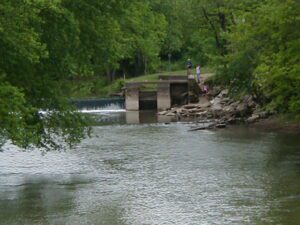
Michael Uhrich, Sr. founded Uhrich’s Mill on this site in 1806. Uhrich emigrated from Pennsylvania in 1804 and became one of the first County Commissioners upon the formation of Tuscarawas County in February 1808. In 1833, the same year Mill Township was organized, Michael Uhrich, Jr. platted the town named Waterford, which became Uhrichsville approximately six years later. During the Ohio-Erie Canal period, Uhrich’s Mill – consisting of four wheels (one for sawing wood, one for wheat, and two for grinding corn) – became the focal point for nearly all grain produced in the Stillwater Valley and shipped to Cleveland markets via the canal.
Born in Massachusetts in 1805, Sala Bosworth spent all but nineteen years of his eighty-five years in Washington County. After studying at the Philadelphia Academy of Fine Arts, he returned to the county to paint many full size and miniature portraits of prominent Washington County citizens. His historical drawings were used in Samuel P. Hildreth’s Pioneer History. He is also known for his mural in what is now the Unitarian Universalist Church in Marietta. Bosworth moved to Cincinnati late in life and started to paint with watercolors. He died there in 1890. Charles Sullivan also studied at the Philadelphia Academy and became a fast friend of Bosworth after coming to Washington County in 1833. While he also painted portraits, he excelled in his landscapes, including views of Blennerhassett Island, the Blennerhassett mansion, and the mounds at Marietta. Sullivan died in Marietta in 1867.
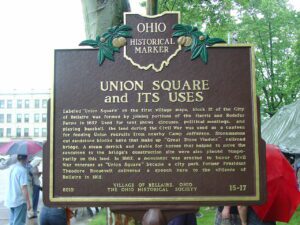
Labeled “Union Square” on the first village maps, block 12 of the City of Bellaire was formed by joining portions of the Harris and Rodefer Farms in 1857. Used for tent shows, circuses, political meetings, and playing baseball, the land during the Civil War was used as a canteen for feeding Union recruits from nearby Camp Jefferson. Stonemasons cut sandstone blocks here that make up “Great Stone Viaduct” railroad bridge. A steam derrick and stable for horses that helped to move the sandstone to the bridge’s construction site were also placed temporarily on this land. In 1882, a monument was erected to honor Civil War veterans as “Union Square” became a city park. Former President Theodore Roosevelt delivered a speech here to the citizens of Bellaire in 1912.
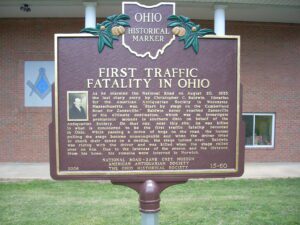
As he traveled the National Road on August 20, 1835, the last diary entry by Christopher C. Baldwin, librarian for the American Antiquarian Society in Worcester, Massachusetts, was, “Start by stage on the Cumberland Road for Zanesville.” Baldwin never reached Zanesville or his ultimate destination, which was to investigate prehistoric mounds in southern Ohio on behalf of the Antiquarian Society. On that day, near this site, he was killed in what is considered to be the first traffic fatality recorded in Ohio. While passing a drove of hogs on the road, the horses pulling the stage became unmanageable and when the driver tried to check their speed on a decline, the stage turned over. Baldwin was riding with the driver and was killed when the stage rolled over on him. Due to the lateness of the season and the distance from his home, his remains were interred in Norwich.
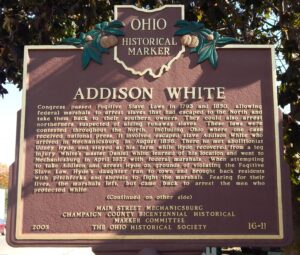
Congress passed Fugitive Slave Laws in 1793 and 1850, allowing federal marshals to arrest slaves that had escaped to the North and take them back to their southern owners. They could also arrest northerners suspected of aiding runaway slaves. These laws were contested throughout the North, including Ohio where one case received national press. It involved escaped slave Addison White who arrived in Mechanicsburg in August 1856. There he met abolitionist Udney Hyde and stayed at his farm while Hyde recovered from a leg injury. White’s master Daniel White learned of his location and went to Mechanicsburg in April 1857 with federal marshals. When attempting to take Addison and arrest Hyde on grounds of violating the Fugitive Slave Law, Hyde’s daughter ran to town and brought back residents with pitchforks and shovels to fight the marshals. Fearing for their lives, the marshals left, but came back to arrest the men who protected White. [continued on other side]
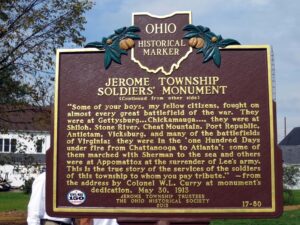
This monument was dedicated on Memorial Day of 1913 to honor the Union soldiers of the Civil War from Jerome Township. Many citizens, school children, and Civil War veterans attended the dedication as Col. W.L. Curry, who fought at Chickamauga, spoke to the crowd. The zinc monument contains the names of 400 soldiers of the township. The shaft is just over 21 feet high. Placed inside was a time capsule containing a number of historical documents including 60 photographs of Civil War veterans. Donations from a grateful community and a bequest from R.L. Woodburn, a Civil War veteran and Ohio legislator funded the monument.
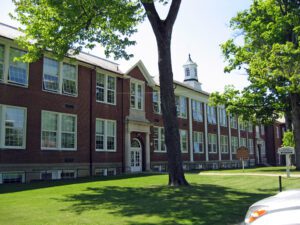
Poland Academy, an elite private school, was established on this site in 1830 and in 1859 graduated its most notable student William McKinley, who became the 25th president of the United States. In 1862, the school changed its name to Poland Seminary and was one of the first schools in northeast Ohio to admit girls on an equal basis. Ida Tarbell, who became a prominent national journalist and author was Preceptress of the Seminary from 1880-1882. William Calhoun graduated from the Seminary and became the U.S. Ambassador to China from 1910-1913. The school became a public institution in 1909 when it became the Poland Seminary High School. In 1972 it was the site of Poland Junior High School and Poland Middle School in 1985.