

, OH
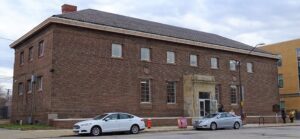
City architect Frederic H. Betz designed the St. Clair Avenue Public Bath House and it was constructed in 1919-1920 at a cost of $320,000. The facility included a large gymnasium, swimming pool, and laundry, in addition to showers. City Council dedicated the newly completed building to the late, beloved Cleveland Indians shortstop Raymond Chapman in 1920. The St. Clair Recreation Center, as it was later known, was in the impact zone and survived the East Ohio Gas Company disaster on October 20, 1944. The facility was remodeled in 1949 and subsequent renovations demonstrate the utility of the building. Edward J. Kovacic (1910-1974) was the superintendent of the bathhouse from 1933-1934 and served on the City Council from 1940-1953. In 1977, the facility was renamed to honor Kovacic’s contributions to the citizens of the St. Clair neighborhood and to the city. (Continued on other side)

, OH
The Greater Abyssinia Baptist Church (GABC) organized with 250 members on December 16, 1945, at a Phillis Wheatley Association meeting. Led by its first pastor, Rev. John Rollins Plummer, the congregation raised $47,000 to purchase the Jewish Synagogue at East 105th Street and Tacoma Avenue from the Beth Hamedrosh Hagodel Beth Israel Congregation in 1946. It later purchased a parsonage, land for parking, and created a Federal Credit Union. Tragically, Rev. Plummer was killed in a car accident on October 22, 1951. The church’s lower auditorium was remodeled and dedicated as J.R. Plummer Memorial Hall. Honoring its missionary and pastoral care foundations, the church built a $3M senior citizens complex nearby. An endowment fund, instituted by its pastor’s savings in 1995, ensures that this commitment to civic leadership endures.
, OH
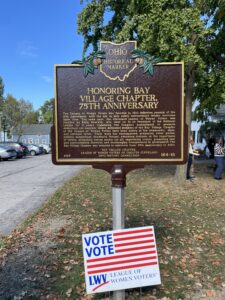
The Bay Village Chapter of the League of Women Voters was established in Spring 1948, with Dorothy M. Austin as president. The goal of the chapter was to ensure all citizens of Bay Village had the information they needed to cast an educated vote. They first met in the Cahoon family homestead, which then served as the city library and later as Rose Hill Museum. Gladys H. Luecke led the group on its first study, a city charter form of government for the village. Voters approved the charter on April 12, 1949, and the Village of Bay officially became the “City of Bay Village” in 1951. Since its founding, the Bay Village Chapter has made an educated voter its first priority by supporting citizen participation in government and influencing public policy through education and advocacy.

, OH
The Central Avenue Public Bath House was designed by Frederic Betz, the City of Cleveland’s first appointed architect. Opened in February 1920, it served the Black population in the congested Central neighborhood. The brick building featured symmetrical windows and entrances at either end that led into men’s and women’s waiting rooms and individual shower rooms. Larger group showers for children were in the basement. The second floor featured club rooms as well as a physician’s room and a nurse’s room. In 1926, a swimming pool and gymnasium were added. In 1940, as the need for public bathing facilities waned, Central Avenue Public Bath House was converted into a recreation center. One of Cleveland’s five remaining Bath Houses, Central Avenue stands as a manifestation of the city’s commitment to the health and welfare of its citizens.
, OH
Prominent architect William S. Lougee designed the Woodland Public Bath House that opened in 1915 at a cost of approximately $90,000. The first floor of the facility included separate shower baths for men and women, an office, waiting rooms, and a gymnasium with a 53-yard running track. The second story was divided into four rooms: a club room, a small city library branch, a baby dispensary, and clinic. The basement featured an indoor swimming pool popular among adults and children. Like other public bath houses in Cleveland, the Woodland Bath House was an invaluable social space for its diverse community of largely Hungarian, but also Slovak, Bohemian, Italian, Lithuanian, and Jewish residents. In 1918, the City estimated that 254,508 residents had used Woodland Bath House facilities, enjoying classes, camps, baths, and clinics.