

, OH
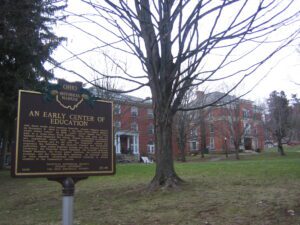
Just three weeks after reaching Granville, pioneer villagers decided on December 9, 1805 to build a log cabin where eighty children would attend school. By 1820, public school classes were being held in a three-story brick building. When rail lines and the National Road bypassed the village, dreams of becoming an industrial and commercial center were dashed. Educational institutions, however, thrived and by the Civil War Granville’s citizens had organized the following: the Granville Literary and Theological Institution, later called Granville College and then renamed Denison University; the Granville Female Seminary, the Granville Episcopal Female Seminary, the Young Ladies’ Institute, the Granville Female Academy, and the Granville Male Academy. As Granville enters its third century, educational excellence continues to attract students to the community’s schools.
, OH
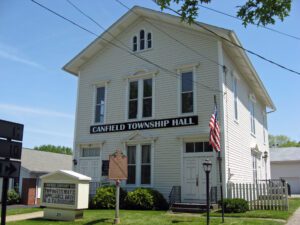
The Canfield Township Hall was erected in 1884. It served as the first public building in which the Canfield citizens could conduct town business, elections, and public meetings. An example of Renaissance Revival or “Italianate” architecture, the building is typical of late Victorian commercial buildings, but constructed of wood rather than of the customary brick. Drafted by Colonel S. Kinney, it was originally constructed for the sum of $2,389 by G.W. Strock at the corner of South Broad and East Main streets, on a lot purchased for $500. In 1936, R.J. Neff moved the hall several hundred feet south to its present location. In addition to official township meetings, the second floor has been used for a variety of activities, including social meetings, lectures, contests, dances, and roller-skating. The building served as an early home of the Canfield Historical Society and operated continuously for over one hundred and twenty-five years.
, OH
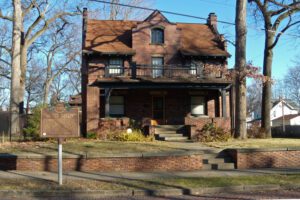
Akron, an industrial boomtown in the early twentieth century, grew in population nearly fivefold between 1900 and 1920. As the city industrialized, middle class residents sought homes on West Hill, away from the smoke and soot of heavy industry on the East Side. The Hall Park Allotment Historic District in West Hill represents a notable early twentieth century neighborhood. Developed by Philander Hall between 1902 and 1919 during the height of Akron’s “rubber boom,” it consists of several houses representing the picturesque styles of the period, including the American Foursquare, Craftsman, Colonial, and Medieval Revival Styles. With its gently curving brick streets, hilly topography, and mature trees, the Hall Park Allotment Historic District evokes the feeling of a distinct period of time in Akron’s history and constitutes a neighborhood of distinctive historical character and architectural merit.
, OH
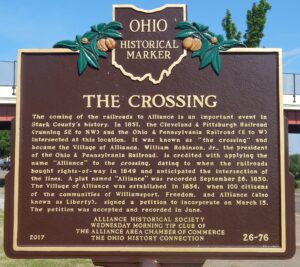
The coming of the railroads to Alliance is an important event in Stark County’s history. In 1851, the Cleveland & Pittsburgh Railroad (running SE to NW) and the Ohio & Pennsylvania Railroad (E to W) intersected at this location. It was known as “the crossing” and became the Village of Alliance. William Robinson, Jr., the president of the Ohio & Pennsylvania Railroad, is credited with applying the name “Alliance” to the crossing, dating to when the railroads bought rights-of-way in 1849 and anticipated the intersection of the lines. A plat named “Alliance” was recorded September 26, 1850. The Village of Alliance was established in 1854, when 100 citizens of the communities of Williamsport, Freedom, and Alliance (also known as Liberty), signed a petition to incorporate on March 15. The petition was accepted and recorded in June.
, OH
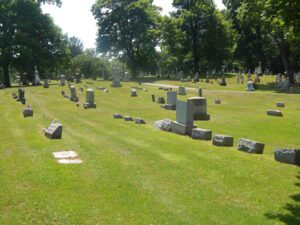
For more than two centuries, this burial ground has been a final resting place for those individuals whose lives represented the community history of Canfield. The earliest existing tombstone marks the death of Huldah Tanner in 1803. Seven earlier deaths in Canfield Township are recorded from 1798 to 1803, but the gravesites are unknown. Elijah and Rhoda Hopkins Wadsworth formally deeded the cemetery to the citizens of Canfield in 1810 with a first edition of land donated by Matthew B. Whittlesey in 1811. In 1862-1863, the graveyard was again enlarged. For seventy years the cemetery and fencing were maintained on a volunteer basis. When the Village of Canfield was incorporated in 1869, the care and management was vested in a board of trustees. (continued on other side)
, OH
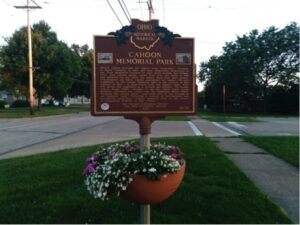
Joseph Cahoon brought his family from Vergennes, Vermont, to Dover Township in 1810, and they established themselves as the first permanent settlers in what would become Bay Village, Ohio. The Cahoon house, called Rose Hill, was built in 1818 and replaced the log cabin the family built upon their arrival. Granddaughter Ida Maria Cahoon bequeathed her family’s 115-acre homestead as the Cahoon Memorial Park to the citizens of Bay Village in 1917. In accordance with the family’s wish, Rose Hill serves the community as a museum and library. The Reuben Osborn House (1815), thought to be the oldest frame house between Cleveland and Lorain, and the Community House (1882), formerly the Cahoon barn, join Rose Hill on the grounds of the memorial park. Providing a variety of recreational and educational activities, Cahoon Memorial Park is the center of community activity in Bay Village.
, OH
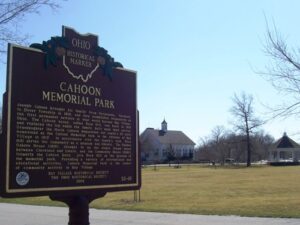
Joseph Cahoon brought his family from Vergennes, Vermont, to Dover Township in 1810, and they established themselves as the first permanent settlers in what would become Bay Village, Ohio. The Cahoon house, called Rose Hill, was built in 1818 and replaced the log cabin the family built upon their arrival. Granddaughter Ida Maria Cahoon bequeathed her family’s 115-acre homestead as the Cahoon Memorial Park to the citizens of Bay Village in 1917. In accordance with the family’s wish, Rose Hill serves the community as a museum and library. The Reuben Osborn House (1815), thought to be the oldest frame house between Cleveland and Lorain, and the Community House (1882), formerly the Cahoon barn, join Rose Hill on the grounds of the memorial park. Providing a variety of recreational and educational activities, Cahoon Memorial Park is the center of community activity in Bay Village.
, OH
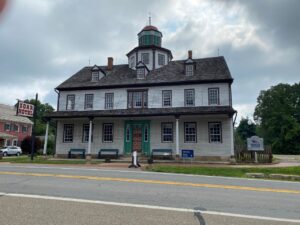
Zoar Separatists built the hotel in 1833 to accommodate overflow travelers from their original Ohio & Erie Canal inn. The hotel proved an economic boon to the Zoar community, but, by bringing the outside world into Zoar, ultimately became a source of discontent for members. During its heyday, the Zoar Hotel catered to curiosity-seekers, visiting artists, and families escaping the summer heat of nearby cities. Notable guests included Marcus Hanna and President William McKinley. The original structure was enlarged several times, including the now demolished 1892 Queen Anne addition which doubled the accommodations. By the mid-twentieth century, the hotel remained open as a popular restaurant with Rathskeller bar until closing to the public in July 1983. The exterior was restored by the Ohio History Connection in 2001-2002.