

, OH
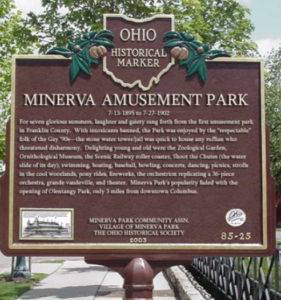
For seven glorious summers, from July 13, 1895 to July 27, 1902, laughter and gaiety rang forth from the first amusement park in Franklin County. With intoxicants banned, the Park was enjoyed by the “respectable” folk of the Gay ’90s – the stone water tower/jail was quick to house any ruffian who threatened disharmony. Delighting young and old were the Zoological Garden, Ornithological Museum, the Scenic Railway roller coaster, Shoot the Chutes (the water slide of its day), swimming, boating, baseball, bowling, concerts, dancing, picnics, strolls in the cool woodlands, pony rides, fireworks, the orchestrion replicating a 36-piece orchestra, grande vaudeville, and theater. Minerva Park’s popularity faded with the opening of Olentangy Park, only 3 miles from downtown Columbus.
, OH
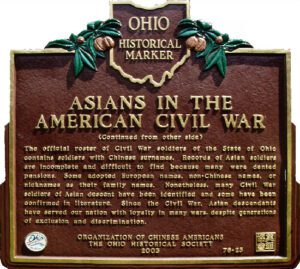
Despite exclusionary laws preventing U.S. citizenship, Asians served in the Union and Confederate armies and navies during the American Civil War (1861-1865). Many of these soldiers were denied citizenship following their services due to the anti-Asian sentiment, which culminated in the Naturalization Act of 1870 and the Chinese Exclusion Act of 1882. The exclusionary laws continued until 1943, and all restrictions on national origin or race were abolished in 1965. In April 2003, House Joint Resolution 45 was introduced to Congress to posthumously proclaim Civil War soldiers of Asian descent to be honorary citizens of the United States as recognition of their honorable services. (continued on other side)
, OH
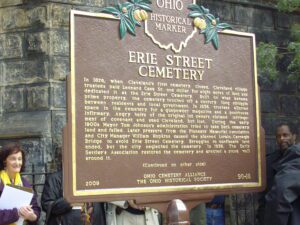
In 1826, when Cleveland’s first cemetery closed, Cleveland village trustees paid Leonard Case Sr. one dollar for eight acres of land and dedicated it as the Erie Street Cemetery. Built on what became prime property, the cemetery touched off a century long struggle between residents and local government. In 1836, trustees allotted space in the cemetery for a gunpowder magazine and a poorhouse infirmary. Angry heirs of the original lot owners claimed infringement of covenant and sued Cleveland, but lost. During the early 1900s Mayor Tom Johnson’s administration tried to take back cemetery land and failed. Later pressure from the Pioneers’ Memorial Association and City Manager William Hopkins caused the planned Lorain Carnegie Bridge to avoid Erie Street Cemetery. Struggles to confiscate land ended, but the city neglected the cemetery. In 1939, The Early Settler’s Association restored the cemetery and erected a stone wall around it. (continued on other side)
, OH
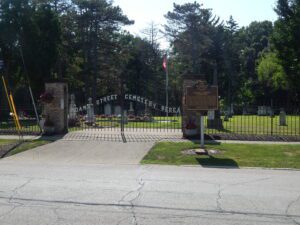
Known as the “Village Cemetery,” this was Berea’s main burial ground from 1834 to the 1880s. However, in 1886, the Cleveland Stone Co. purchased quarries adjacent to the cemetery, where Coe Lake is today. Quarrying had already caused flooding and landslides in the area. Local stories say that the company operated too near to the edge of cemetery, causing a landslide in the northwest corner that exposed some graves. Worried families moved their loved ones’ remains to other cemeteries, including those of five Civil War veterans. Pioneering families, 16 Civil War veterans, 3 mayors of Berea, several quarry owners, and many ordinary people still rest here. Of the original 589 burials, 40% were children. (Continued on other side)
, OH
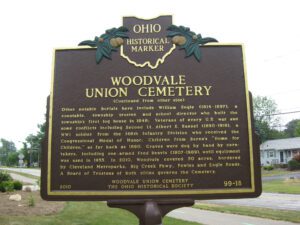
Woodvale Cemetery was established in the mid-1800s, in Middleburgh Township, Ohio. The oldest marked grave holds Fred G. Klink (1835-1858), whose family donated a half acre of land for burials. In 1876, Frank M. Stearns (1832-1911) suggested the unnamed cemetery be called Woodvale, after the wooded vale beside it. In 1908, a fire destroyed the caretaker’s house and many cemetery records. Woodvale became a non-profit, union cemetery in 1931, owned by Berea and the Village of Middleburg Hts. and covering 35 acres at 7535 Engle Road. Pioneer families buried here: Fowles, Kraft, Lovejoy, Sprague, and Stearns. Also buried here: John Baldwin (1799-1884) founder of Baldwin University and James Wallace (1878-1953) founder of German Wallace College (merged in 1913 to become Baldwin Wallace College) (Continued other side)
, OH
United Colored American Cemetery is among the earliest in situ African American cemeteries in Hamilton County. The 11.6 acres in Madisonville were purchased by the United Colored American Association (UCAA) after the legislated closure of their earlier Avondale cemetery. Many Avondale burials and headstones were moved prior to the new cemetery’s dedication on May 30, 1883. Designed by Adolph Strauch, United Colored American Cemetery features the looping roads and picturesque elements typical of his designs at Spring Grove and Eden Park. After the dissolution of the UCAA, Cincinnati mayor Charles P. Taft asked Union Baptist Church to take ownership and maintenance of the cemetery. Union Baptist assumed ownership in 1968 and burials continued until 2019. United Colored American Cemetery was listed on the National Register of Historic Places in 2022.
, OH
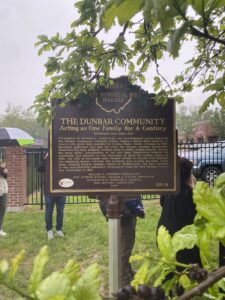
Dunbar, or Corsica Hollow, was an African American neighborhood on the western edge of Madisonville. Its streets and lots were laid out in 1886 after Mahlon and Anna Leonard subdivided their 10-acre tract near Duck Creek and sold lots to African Americans. Many early Dunbar residents were from the South; some born there prior to emancipation. Prominent early citizens included Harriet Deatherage, Elihu Parks, Gandison Embry, Thomas Duett, and James Murphy. Dunbar was home to the New Mission Missionary Baptist Church, founded in 1907. Originally meeting in a one-room building, the extant congregation relocated to Ravenna Street in 1963. By the late 1920s, Dunbar had about forty houses, a grocery run by Henry Lowman, and a hair salon run by Flora Hector. (Continued on other side)
, OH
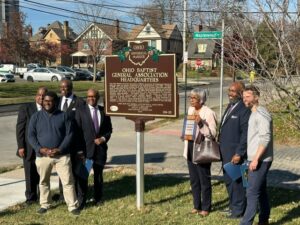
The Ohio Baptist General Association (OBGA) acquired 48 Parkwood Avenue in 1954 and used the former residence as its headquarters until 1996. Formed in 1896, the Association includes more than forty African American churches, many formed prior to the Civil War. Baptist general associations nationwide became an important voice during the 1960s Civil Rights Movement as they addressed the wrongs of racial violence and discrimination in business, housing, and education. The OGBA fought for the ideals of justice and freedom with its strongly-held Baptist beliefs. “America with her wealth as a great nation,“ OGBA President Wilber A. Page declared in 1957, “is well able to face integration and give a democracy to all her citizens.” The former Association Headquarters was listed in the National Register of Historic Places on December 3, 2020.