

, OH
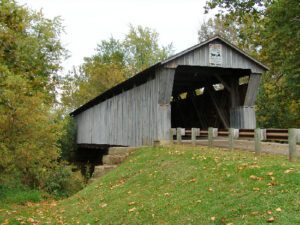
In March, 1887, the Franklin County Commissioners announced the building of a bridge in Madison Township over Little Walnut Creek at Kramer’s Ford. Area citizens had petitioned for a bridge to transport agricultural products to the canal and railroad. Michael Corbett of Groveport contracted to construct the abutments and the Columbus Bridge Company built the covered bridge for $2,690.00. Reuban L. Partridge, company vice president, supervised the building, using his patented truss system consisting of double and triple truss members constructed of pine and oak.
, OH
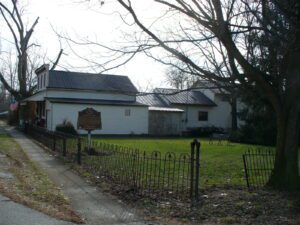
The foundation for the first Welsh settlement in Ohio was laid on June 29, 1801, when William and Morgan Gwilym purchased land in what is now Morgan Township at the Cincinnati Land Office. The Welsh, who settled in Pennsylvania beginning in the late eighteenth century, moved westward and settled here in 1802. This area was also the major terminus for the 1818 migration from Montgomeryshire and Cardiganshire in Wales. In 1803 a Congregational Church was organized and services were held in members’ homes or outdoors. A brick Meetinghouse, complete with a Welsh death door leading to the cemetery, was constructed in 1824. The building now serves as the Community House. The present brick church was built in 1854. For many years, the library, formed in 1852, was housed in the New London Special School District building that stood on this site. (Continued on other side)
, OH
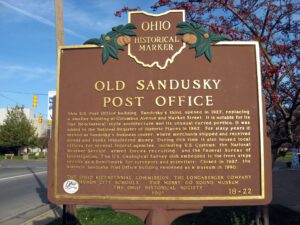
This U.S. Post Office building, Sandusky’s third, opened in 1927, replacing a smaller building at Columbus Avenue and Market Street. It is notable for its fine Neoclassical-style architecture and its unusual curved portico. It was added to the National Register of Historic Places in 1982. For sixty years it served as Sandusky’s business center, where merchants shipped and received goods and banks transferred money. During this time it also housed local offices for several federal agencies, including U.S. Customs, the National Weather Service, armed forces recruiting, and the Federal Bureau of Investigation. The U.S. Geological Survey disk embedded in the front steps serves as a benchmark for surveyors and scientists. Closed in 1987, the historic Sandusky Post Office building reopened as a museum in 1990.
, OH
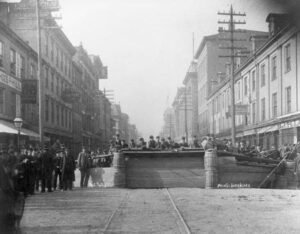
In March 1884, public confidence of Cincinnati law enforcement was extremely low. The public believed that murderers and other serious offenders were not brought to justice promptly or received little punishment. Civil unrest was brought to a boil when a seventeen-year-old was sentenced to only twenty years for manslaughter after brutally murdering his employer. On March 28, thousands of citizens stormed the county jail and courthouse. The riots lasted three days requiring forces from the Sheriff’s Office, city police, and local and state militia to restore order. Fifty-four people were killed and more than 200 wounded. The courthouse and jail suffered enormous damage, and valuable records were destroyed from the assault and fire. The riot gained international notoriety and helped pave the way for removal of political favoritism and a larger police force.
, OH
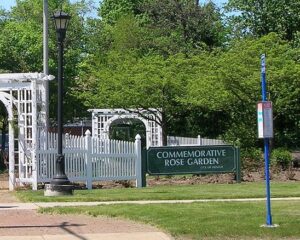
From the 1920s through the 1970s, Mentor was recognized as the Rose Capital of the Nation. Lake effect climate, a variety of soils, and abundant water made Mentor ideal for growing roses. Over a dozen growers produced about five million plants a year from their fields in Mentor. The Civic Center Complex was once a massive field of roses, and streets such as Tea Rose, Wyant, and Rosebud were named in honor of the blossoms that grew so abundantly here. Notable growers include Gerard K. Klyn, the largest rose grower in the Midwest; Joseph Kallay, who in 1932 received U.S. patent No. 10 for “Blaze;” Melvin E. Wyant, accredited rose grower, judge, and lecturer; Joseph J. Kern, nationally recognized expert on old fashioned roses; and Paul R. Bosley, who specialized in hybrid tea roses. By the 1970s, increased land values and development led to depletion of much of Mentor’s nursery lands.
, OH
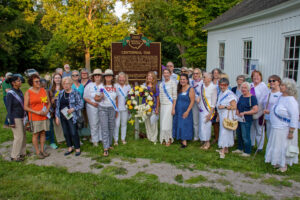
The Newbury Woman Suffrage Political Club, headquartered at Union Chapel, planted the Centennial Oak on July 4, 1876. The White Oak (Quercus alba) was chosen for its endurance, longevity, and beauty. The picnic and planting celebration included speeches, songs, fireworks, and a poem dedicated to the Oak written by local suffragist Anna Green. As the club gained national recognition, it attracted such notable suffragists as Susan B. Anthony and Harriet Taylor Upton as visitors and speakers. A Newbury gathering on August 23, 1919, held to celebrate Ohio’s recent ratification of the 19th Amendment, included suffragists Upton and Frances Jennings Casement. The last living founding member of Newbury’s Woman Suffrage Club, Dr. Julia Porter Green, led a parade from the chapel to Centennial Oak. There she placed a wreath of evergreen and goldenglow upon the tree.
, OH
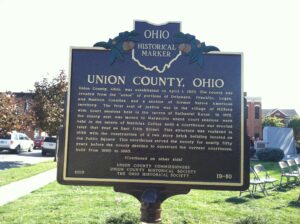
Union County, Ohio, was established on April 1, 1820. The county was created from the “union” of portions of Delaware, Franklin, Logan, and Madison Counties, and a section of former Native American territory. The first seat of justice was in the village of Milford with court sessions held in the tavern of Nathaniel Kazar. In 1822, the county seat was moved to Marysville where court sessions were held in the tavern of Matthias Collins until a courthouse was erected later that year on East Fifth Street. This structure was replaced in 1838 with the construction of a two story brick building located on the Public Square. This courthouse served the county for nearly fifty years before the county decided to construct the current courthouse, built from 1880 to 1883.
, OH
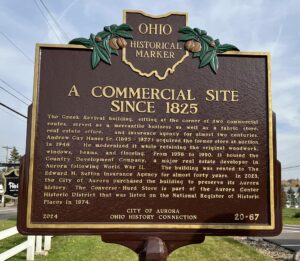
James Willard Converse (1806-1892) opened his store in 1825 at 10 South Chillicothe Road. Serving residents, merchants, and travelers, the store proved central to Aurora’s early commercial development. Converse’s Daybook survives as a glimpse into the habits of early citizens, who, along with household items, regularly purchased whiskey. Surprisingly, such sales surged on George Washington’s February 22 birthday. Converse deeded the business to employee Seth A. Gillett in 1834. Hopson Hurd Sr. (1793-1869) purchased it from Gillett in 1845. Hurd’s store was popular with local farmers who used their home made cheese as legal tender and enjoyed the barrel of whiskey kept in Hurd’s basement for customers who paid their bills. Hurd added a cheese warehouse to his store and, as a major exporter of cheese to Cleveland, Warren, and Pittsburgh, amassed a sizeable fortune.