

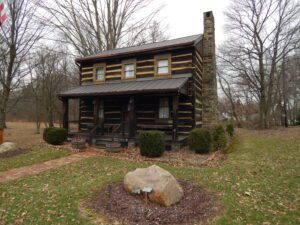
, OH
This circa 1840s log house, which now serves as a museum and home to the East Palestine Historical Society, was originally located at the corner of West Main and Walnut Streets. Some of its most notable and earliest residents were Dr. Robert Chamberlin (1798-1876), the town’s first resident physician, and his wife Rebecca (1810-1895). Chamberlin practiced medicine for 30 years, serving the town as a township trustee in 1834, the first postmaster in 1836, and township clerk in 1839. (Continued on other side)
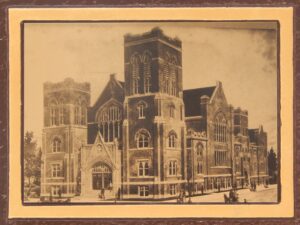
, OH
The Euclid Avenue United Brethren Church, later the Mount Enon Missionary Baptist Church, was erected at Third & Euclid Street in Dayton. Milton Wright, a bishop of the church, was present at the laying of the cornerstone on May 28, 1911. Bishop and Mrs. Susan (Koerner) Wright were the parents of Orville and Wilbur Wright and their siblings Reuchlin, Lorin and Katherine. The church’s congregation included Orville and Katherine Wright and other notable Daytonians such as local historian and former pastor Dr. Augustus W. Drury, food distributor and potato chip maker Daniel Mikesell and Prof. Josiah P. Landis of the Bonebrake Theological Seminary. The church playedd a role in offering aid during the disasterous flood of 1913.
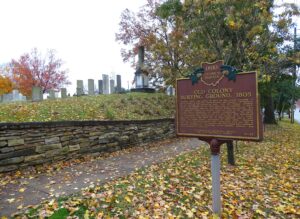
, OH
Granville, Ohio, was settled in 1805 by the Licking Company, a group formed in Granville, Massachusetts, and Granby, Connecticut, for the purpose of emigrating west. The Old Colony Burying Ground was defined on the first town plat of Granville in 1805. Many of Granville’s pioneers are interred within this ground, and the cemetery retains its original form and most of its westward facing rows of sandstone and marble gravestones. The early settlers buried here helped to lay out this town and determined the appearance and development of the village as it is today. The first burial, the infant son of Ethan Bancroft, was in April 1806. The oldest extant gravestone is dated 1808. Eighteen veterans of the Revolutionary War, thirty-nine from the War of 1812, and sixteen Civil War veterans rest here along with ministers, farmers, industrialists, physicians, young mothers, children, and other citizens of Granville.
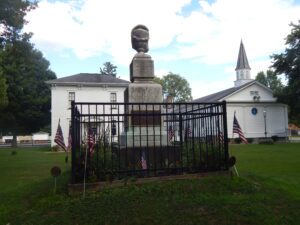
, OH
With the outbreak of the Civil War in 1861, many young men of Bristol Township enlisted in the army when President Abraham Lincoln issued his call to defend the Union cause. The death toll of some of these men at the Battle of Shiloh in Tennessee in April 1862 touched the local community as did the loss of Bristol Township lives at the Battle of Perryville in Kentucky, the Battle of Cedar Mountain in Virginia, and other theaters of war later in the year. The local citizenry responded to a plan for a lasting public memorial at the Town Park through a fund raising campaign. In 1863 the town square was transformed with a marble monument placed on an elevated mound at its center. The monument was designed by local artist Frank J. Hammond and manufactured by Myers, Uhl & Company of Cleveland at a cost of $500. [continued on other side]
, OH
Underground Railroad crossings, agents, and conductors were common along the Ohio River between Washington County, Ohio and Wood County, Virginia. At Constitution, six miles upriver from Belpre, Judge Ephraim Cutler listened for hoot owl calls that signaled when a boatload of runaway slaves was crossing from Virginia to the Ohio shore. “Aunt Jenny,” a slave woman in Virginia, used a horn signal to alert abolitionist John Stone in Belpre when fugitive slaves were crossing. At Little Hocking, eight miles downriver from Belpre, slaves crossing from Virginia looked for a lantern signal to guide them to the Horace Curtis Station on the Ohio River shore. Runaway slaves were also assisted by Thomas Vickers at Twin Bridges, James Lawton at Barlow, and others as they traveled northward by various routes through Morgan County to Putnam in Muskingum County where the Underground Railroad merged with the Muskingum River Corridor.
, OH
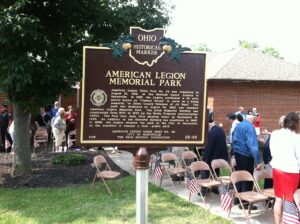
American Legion Union Post No. 79 was organized on August 21, 1919, at the National Guard Armory in Marysville. In 1927, the Legion purchased a 24 acre parcel known as “Clement Woods” to serve as a living memorial “to Union County Veterans of All Wars”. The park was dedicated on August 24, 1927, and renamed American Legion Memorial Park. The brick Memorial Building was constructed from 1937 to 1938 by the Works Progress Administration (WPA). The Post held their first meeting there on September 12, 1938. An addition to the Memorial Building was completed in 1960. In 1989, the Legion donated the park to the City of Marysville on the condition it remains a free, public park.
, OH
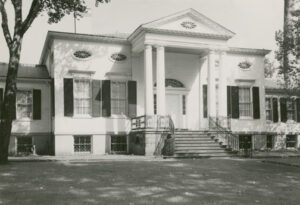
This Federal house was begun about 1820 for Martin Baum (1765-1831), one of Cincinnati’s early merchants. Art patron and abolitionist Nicholas Longworth (1782-1863) lived here for more than thirty years and commissioned the notable landscape murals in the foyer painted by African-American artist Robert S. Duncanson (1821-1872). Iron magnate David Sinton (1808-1900), the subsequent owner, bequeathed the house to his daughter Anna Sinton Taft (1852?-1931). She and her husband Charles Phelps Taft (1843-1929), older half-brother of William Howard Taft (1857-1930), who accepted his party’s nomination for president from the portico in 1908, assembled the acclaimed art collection displayed here. Bequeathed to the people of Cincinnati in 1927, the Taft Museum of Art opened to the public in 1932. It was designated a National Historic Landmark in 1973.
, OH
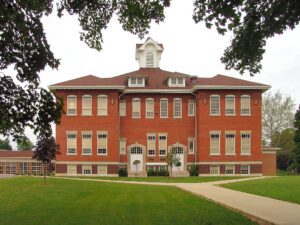
The first school in what is now Pataskala was a “subscription school” operated by Amariah Cubberly on the nearby banks of the South Fork of the Licking River in the 1820s. Subscription schools, which charged fees, were the forerunners of rural public schools in many parts of Ohio. By the 1830s several one-room public schools served the children of the area, but in 1870 the civic minded citizens of Pataskala provided a centralized building for grades one through twelve on Main Street, where the old Town Hall now stands. This school was moved to the new building on this site in 1908. When the Southwest Licking Local School District was established in 1953, Pataskala Elementary School continued in the building. Additions in 1968 and 2000 enhanced its educational capabilities. This 1908 Queen Anne architectural style building was listed on the National Register of Historical Places in 1983.