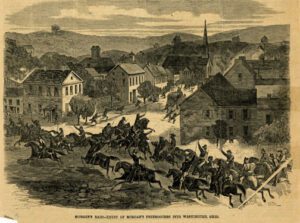
During the summer of 1863, General John Hunt Morgan, a Confederate cavalry leader from Kentucky, invaded southern Ohio with 2,460 mounted men. Throughout the campaign Morgan’s men plundered and looted before being captured by Union forces. On July 17, Morgan led his troops into Wilkesville stealing horses, sacking stores, and robbing private citizens. That night Morgan and some of his troops took lodging and meals with his first cousin Ruth Virginia Althar Cline and her husband Dr. William Cline. Morgan’s troops camped near the house of John and Elzia Levis where Elzia cooked for the men for fear they would harm her family. Additional soldiers of the raiding party stayed on the village square. Legend has it that while Morgan slept at the Cline Mansion, his black servant stole his looted money, and abolitionists Dr. Cline and Abraham Morris, helped him escape to freedom on the Underground Railroad.
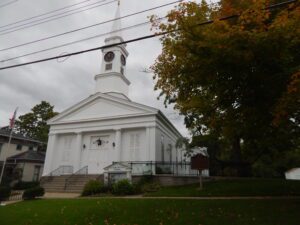
Organized August 23, 1822. Twinsburg pioneers, many from Killingworth, Connecticut, worshiped in various locations for 31 years until this church was built in 1848. Its design is attributed to master builder Simeon Porter. The spire is an 1857 replacement. The edifice is notable for being a Classic Revival translation of the standard meeting house of the preceding Federal period.
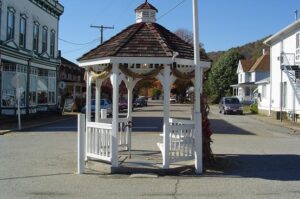
Monroe County’s ground-water resources are valuable assets for its people and economy. Especially notable are the substantial quantities of water that can be obtained in the medium sand and gravel underground aquifers located on the eastern side of the county. The Sardis Town Pump, which taps into one of these aquifers, has been in continuous operation since the nineteenth century and has played an important role in the daily life of Sardis residents. At approximately 78 feet deep, it was originally operated with a hand pump and converted to electricity in 1951. It is the drinking choice for many in the community and throughout Monroe County. It is the last of four known public wells that have served the village of Sardis.
A. B. Graham, superintendent of Springfield Township Rural schools in Clark County, established the Boys and Girls Agricultural Experiment Club, which revolutionized agricultural education and non-formal youth development methods. The first meeting of the club, said to be the nation’s first farm club for young people, was held at this site on January 15, 1902 in the basement of the Clark County Courthouse. This was the start of what would be called a 4-H Club a few years later. Through the years, the overall objective of A.B. Graham and 4-H has remained the same: the development of youth as individuals and as responsible and productive citizens.
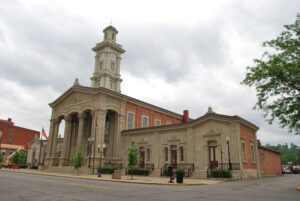
Ross County’s first courthouse was Ohio’s first statehouse. The courthouse was erected on the Public Square in 1801. Thomas Worthington, one of the building’s superintendents, laid out the foundation. Chillicothe was the last capital of the Northwest Territory, and the final session of the territorial legislature met in the courthouse in 1801. Ohio’s first constitution was written here in 1802. On March 1, 1803, Ohio’s first General Assembly convened in the building, making it the statehouse. During a time of strained relations between Native Americans and settlers in Ohio, the great Shawnee leader Tecumseh delivered a speech here in 1807 to reassure citizens that the Indians would remain peaceful. The courthouse served as the statehouse from 1803 to 1810 and from 1812 to 1816. The building was razed in 1852 to make way for the present courthouse.
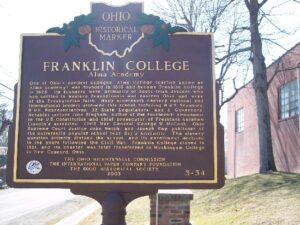
One of Ohio’s earliest colleges, Alma College (earlier known as Alma Academy) was founded in 1818 and became Franklin College in 1825. Its founders were primarily of Scots-Irish descent who had settled in western Pennsylvania and eastern Ohio and were of the Presbyterian faith. Many nineteenth-century national and international leaders attended this school, including 8 U.S. Senators, 9 U.S. Representatives, 32 State Legislators, and 2 Governors. Notables include John Bingham, author of the Fourteenth Amendment to the U.S. Constitution and chief prosecutor of President Abraham Lincoln’s assassins; Civil War General George W. McCook; Ohio Supreme Court Justice John Welch; and Joseph Ray, publisher of the universally popular school text Ray’s Arithmetic. The slavery question bitterly divided the school, and its enrollment declined in the years following the Civil War. Franklin College closed in 1921, and its charter was later transferred to Muskingum College in New Concord, Ohio.
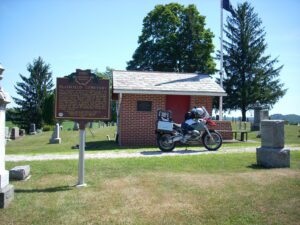
This cemetery, established in 1810, is the final resting place of many of the founders of Plainfield and Linton Township. Besides the early date of its founding, it is notable for the number of armed forces veterans interred here, who represent every major conflict since the Revolutionary War. The graves of eighty-nine Civil War soldiers-a number nearly equal to those of veterans involved in all other wars between the War of 1812 and the Vietnam War-indicate the depth of Plainfield’s involvement in that conflict.
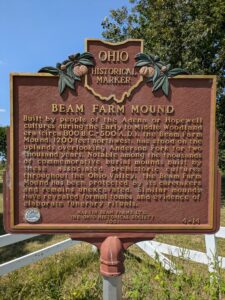
Built by people of the Adena or Hopewell cultures during the Early to Middle Woodland era (circa 800 B.C – 500 A.D), the Beam Farm Mound, 1200 feet northwest, has stood on the uplands overlooking Anderson Fork for two thousand years. Notable among the thousands of commemorative burial mounds built by these associated prehistoric cultures throughout the Ohio Valley, the Beam Farm Mound has been protected by its caretakers and remains unexcavated. Similar mounds have revealed formal tombs and evidence of elaborate funerary rituals.