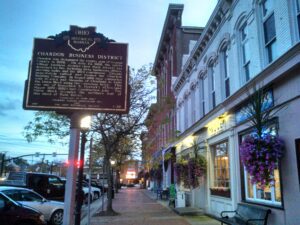
Chardon was designated the county seat of Geauga County in 1808. On July 25, 1868, the entire village business district (now Main Street) was destroyed by fire, including forty businesses, offices, meeting halls, and the 1824 courthouse. Citizens immediately rallied and formed the Chardon Building Company. In August 1868 they contracted with Herrick and Simmons of Cleveland to build the Union Block using fire-resistant brick. This was one of Rensselaer R. Herrick’s (Cleveland Mayor 1879-1882) last construction jobs. The Union Block occupies the northern half of this block of Main Street. (Continued on other side)
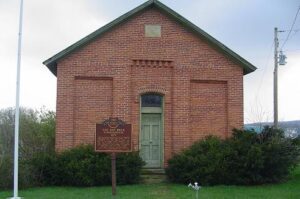
Typical of many schoolhouses in the Frankfort area during the 1800s, this school, with its pot-bellied stove and flip-top desks, was part of the public school system of that era. The building and its contents have been restored by the citizens of Frankfort in conjunction with the Budd Company.
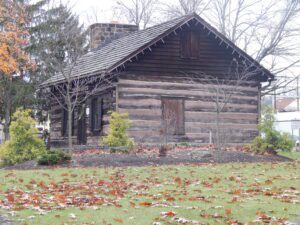
This log building was constructed in 1801 by David Hoge on the west side of Third Street. It served as his home and was the first Federal land office in that part of the Northwest Territory known as the Seven Ranges. In 1809 it was moved and 12 years later encased in a brick structure where it was discovered in 1940. It has been preserved by the citizens of Jefferson County.
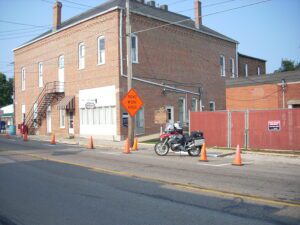
This building was a center of community life from the time of its construction in 1886 to the late 1930s. Once common, such combinations of governmental offices and commercial and entertainment space are today rare. The second floor opera house retains many original features, including stage backdrops, dressing rooms, and seats. Vaudeville, theater companies, and entertainment of all kinds were hosted here and many performers signed the backstage walls: Buffalo Bill dated his signature October 28, 1888. Along with village offices, first floor tenants have included the Vermillion Township Trustees, the Eddie Stover Hat Shop, and the F.L. Smith Watch Repair and Jewelry Store. Hayesville’s citizens approved the hall’s construction on April 18, 1884 by a vote of 100 to 13. Contractor Samuel Craig completed the building two years later at a cost of $4,852.20. Located on the Lincoln Highway, this building was listed on the National Register of Historic Places in 1976.
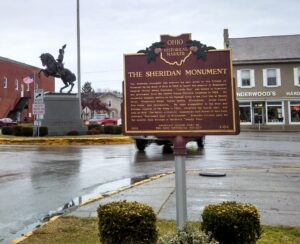
The Sheridan monument was erected by and given to the Village of Somerset by the State of Ohio in 1905 to honor the memory of Somerset’s General Phillip Henry Sheridan. “Little Phil” was raised in Somerset and graduated from the United States Military Academy in 1852. He rendered valuable service to the Federal Army in the Civil War at Stone’s River, Missionary Ridge, Yellow Tavern, Winchester, Cedar Creek, Five Forks, and Appomattox. He later commanded in the West and became General of the Army in 1883, received his fourth star, and died in 1888. The heroic sculpture, created by Carl Heber of New York, portrays “Sheridan’s Ride” to Winchester. Somerset citizens paid for the granite base through a children’s “penny fund.”
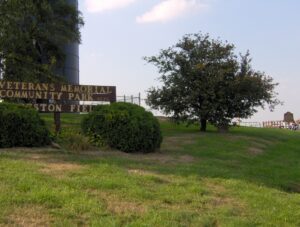
With a population of 475 residents, the Beallsville community gained the unfortunate distinction of having suffered the highest known per-capita casualty rate during the Vietnam War. Six Beallsville men, all under the age of 21, were killed in action in Vietnam between 1966 and 1971, a profound tragedy for this close-knit community. In 1969 Beallsville citizens worked with congressional representatives to prevent further loss of life, to no avail. Five other Monroe County men lost their lives in the conflict as well, magnifying the loss for one of Ohio’s least-populated counties. (continued on other side)
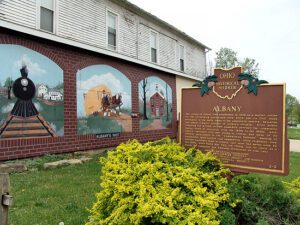
The village of Albany was established in 1838 as a market center for the surrounding agricultural area, which saw its first white settlement in the early years of the nineteenth century. Education was always a major concern of Albany’s citizens. Since public schooling was minimal, private academies provided the community various levels of education from the 1840s to the 1880s. Anti-slavery sentiment also was strong in Albany, and many of its citizens participated in the “Underground Railroad.” Because of educational opportunities and sympathetic white neighbors, free African-Americans came to Albany, but most had moved away by the 1930s. After World War Two, the village lost its status as a center for commerce and business.
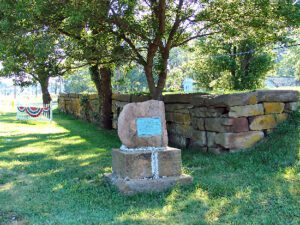
At this site on July 4, 1825, Governor DeWitt Clinton of New York, a Master Mason, turned the first shovelful of earth for the Ohio Canal. The ceremony was attended by area citizens and Master Masons. In the early 1840s James A. Garfield, who was to become 20th President of the United States and a Master Mason, led tow horses on the canal.