

, OH
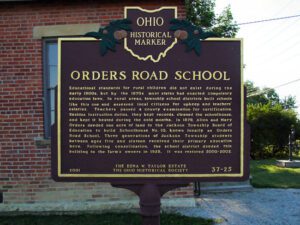
Educational standards for rural children did not exist during the early 1800s, but by the 1870s most states had enacted compulsory education laws. In rural areas, township school districts built schools like this one and assessed local citizens for upkeep and teacher’s salaries. Teachers passed a county examination for certification. Besides instruction duties, they kept records, cleaned the schoolhouse, and kept it heated during the cold months. In 1879, Allen and Mary Orders deeded one acre of land to the Jackson Township Board of Education to build Schoolhouse No. 10, known locally as Orders Road School. Three generations of Jackson Township students between ages five and sixteen received their primary education here. Following consolidation, the school district deeded this building to the farm’s owners in 1928. It was restored in 2000-2002.
, OH
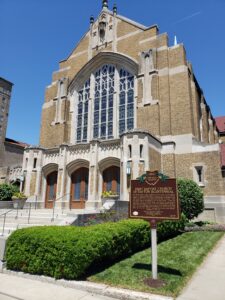
First Baptist Church of Dayton organized on May 29, 1824. A council met on the porch of William Huffman’s home at Third and Jefferson and approved 9 members as a congregation. The next day Lydia Huffman was baptized in the Great Miami River, the first recorded Baptist immersion in the city. Their first church building was erected in 1827 on Main Street. In 1829 the congregation suffered a Campbellite schism. Those resolved to remain Baptist incorporated on February 25, 1837, as The First Regular Baptist Church of Dayton, Ohio. The foundations for the Monument Avenue building were begun prior to the 1913 Dayton flood and the cornerstone was laid May 31, 1914. The building was completed, furnished, and ready for worship on June 26, 1915. (Continued on other side)
, OH
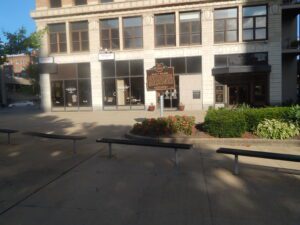
The figure atop the Soldiers’ Monument has looked over Youngstown’s Central Square since 1870. Ohio Governor David Tod began campaigning for a monument for Youngstown’s fallen soldiers even before the Civil War ended. The community raised $15,000, and the cornerstone was laid in 1868. The memorial was completed and dedicated on July 4, 1870, with Governor Rutherford B. Hayes and Congressman James A. Garfield, both future U.S. presidents, attending the ceremony. Four cannons procured by Garfield formerly surrounded the monument. In 1951 the figure on the pedestal was accidentally damaged. A new statue of Carrara marble was commissioned, sculpted in Italy, and installed in 1955. The Bertolini Bros., a local marble firm, donated the new figure, which as patterned after the original, as their gift to the city.
, OH
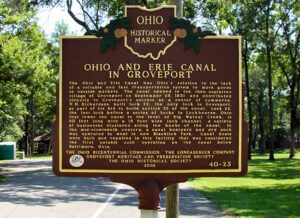
The Ohio and Erie Canal was Ohio’s solution to the lack of a reliable and fast transportation system to move goods to outside markets. The canal opened in the then unplatted village of Groveport on September 25, 1831 and contributed directly to Groveport’s success as a center of commerce. W.H. Richardson built lock 22, the only lock in Groveport, as part of his bid to build section 52 of the canal. Lock 22, the last lock before a series of locks in Lockbourne, Ohio that lower the canal to the level of Big Walnut Creek, is 90 feet long with a 15 foot wide lock channel. A variety of businesses clustered along the banks of the canal. In the mid-nineteenth century, a canal boatyard and dry dock was operated in what is now Blacklick Park. Canal boats were built and repaired in this facility that was considered the first notable such operation on the canal below Baltimore, Ohio.
, OH
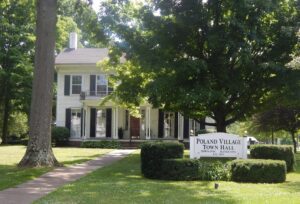
The Village of Poland officially incorporated in August 1866, a year after the end of the Civil War. In April 1867, the citizens elected John Leslie as mayor. As of 1880, Poland’s population exceeded 400. Through its history, the village has consisted of a four-acre village green, churches, schools, hotels, a sawmill, gristmill, post office, tannery, and foundry, as well as carriage, tin, and cabinet shops; drug, dry goods, and hardware stores, and doctors, blacksmiths, and shoemakers. Residents swam in and skated on Yellow Creek. The Poland Municipal Forest was established in 1938 and annexed later as the Village continued to grow. In 1966, the residents held a three day Centennial Celebration, featuring an address by Governor James Rhodes. The centennial year also saw the publication of a history of Poland and the restoration of Centennial Gardens.
, OH
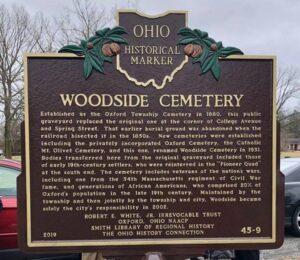
Established as the Oxford Township Cemetery in 1880, this public graveyard replaced the original one at the corner of College Avenue and Spring Street. That earlier burial ground was abandoned when the railroad bisected it in the 1850s. New cemeteries were established including the privately incorporated Oxford Cemetery, the Catholic Mt. Olivet Cemetery, and this one, renamed Woodside Cemetery in 1931. Bodies transferred here from the original graveyard included those of early 19th-century settlers, who were reinterred in the “Pioneer Quad” at the south end. The cemetery includes veterans of the nation’s wars, including one from the 54th Massachusetts regiment of Civil War fame, and generations of African Americans, who comprised 20% of Oxford’s population in the late 19th century. Maintained by the township and then jointly by the township and city, Woodside became solely the city’s responsibility in 2002.
, OH
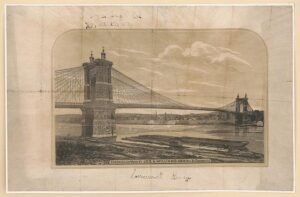
The Covington-Cincinnati Bridge Company under the leadership of Amos Shinkle built the first Ohio River bridge linking the North and South following the Civil War. The bridge was privately operated until purchased in 1955 by Kentucky and later renamed the “John A. Roebling Suspension Bridge.” Completed in 1866, this National Civil Engineering Landmark was the only bridge in service over the Ohio River during the 1937 flood. Since 1976, its national and local heritage has been commemorated with beautification lighting and flags sponsored by the citizens and institutions for which the bridge stands as a community symbol. (Continued on other side)
, OH
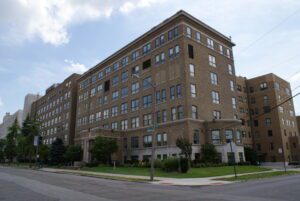
In late 1911, the Right Reverend Joseph Schrembs, Toledo’s first Bishop, corresponded with Sister Mary Bernardine McMullen and two companions, Sister Mary Anthony McMullen and Sister Mary DeChantel Lyons, and asked them to come to Toledo to establish the second of three Catholic hospitals in the new diocese. Land was purchased in 1916 on the corner of Madison Avenue and 23rd Street to build what would become a seven-story hospital. Noted Chicago architect, Meyer J. Sturm, was hired to design and construct the hospital using up-to-date methods of hospital construction. Costing approximately $300,000, Mercy Hospital of Toledo was completed in 1918. Bishop Schrembs dedicated and blessed the hospital on June 21 in a grand ceremony involving clergy of the diocese and the Mercy Hospital Guild as guests of honor.