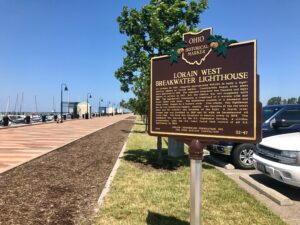
On October 22, 1913, Congress appropriated $35,000 to build a light-and-fog station at Lorain harbor. Construction began after plans were approved in 1916. The concrete structure was finished and light placed in service in 1917, but the station was not completed until 1919. The lighthouse’s foundation is comprised of a wooden crib and boxes filled with stone. The lighthouse consists of a basement and three floors, topped by a lantern room. Like others, this lighthouse had its own identifying signals, namely, the duration of the fog horn’s blast and the rotation and duration of the light. A fourth order Fresnel lens was installed in 1919 and lit with an incandescent oil vapor lamp. The lamp was converted to electric power in 1932. The lighthouse was manned by the U.S. Lighthouse Service, a civilian organization, until the U.S. Coast Guard took control of all U.S. lighthouses in 1939.
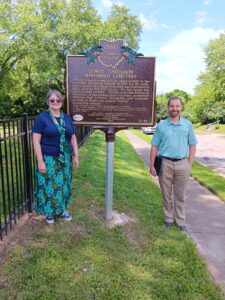
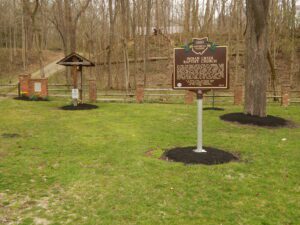
Gowdy Cemetery was sold by James Gowdy to the Associate Reformed Church in 1820 for 50 cents. After Xenia’s Woodland Cemetery was chartered in 1845, Gowdy fell into disuse. Its last burial was James Gowdy in 1853. Gowdy Associate Reformed Cemetery is the resting place for many prominent citizens that brought mercantile and economic growth to Xenia and Greene County. Gravesites include:
Revolutionary War veteran Robert Kendall (1751-1842);
War of 1812 veterans James (1777-1853) and Robert Gowdy (1732-1831);
James and Samuel Gowdy (1780-1851), who opened Xenia’s first permanent store in 1806.
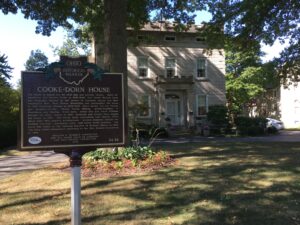
Eleutheros Cooke. The Cooke-Dorn house was the last home of attorney Eleutheros Cooke (1787-1864) who served four years in the Ohio legislature and one term in the 22nd Congress of the United States. An early proponent of railroads, Cooke received one of the first charters granted to a railroad west of the Alleghany Mountains, for the Mad River & Lake Erie line. He and wife Martha had six children, four of whom lived to adulthood. Two rose to prominence in the Civil War era. Jay was a successful banker and became known as the “financier of the Civil War” for his efforts to secure loans from Northern banks to support the Union’s war effort. Henry was appointed as the first governor of the short-lived Territory of the District of Columbia in 1871 (which was replaced in 1874).
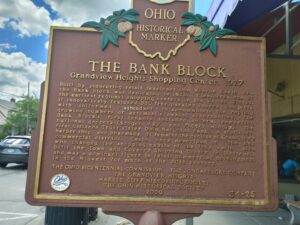
Built by pioneering retail developer Don Monroe Casto Sr., the Bank Block was dedicated in 1928. Considered one of the earliest regional shopping centers in the United States, it innovatively featured 350 free parking spaces-complete with uniformed attendant-to accommodate the rapidly growing numbers of automobile-owning suburbanites. The Bank Block’s first tenants included several competing national grocers (Kroger, A&P, and Piggly Wiggly), the First Citizens Trust (later Ohio National Bank), a stationer, barber shop, and pharmacy. It remains the nucleus of Grandview’s commercial district. Casto, once described as “the man who changed the shopping habits of the free world,” also built the Town and Country Shopping Center in Whitehall and was a dominant figure in retail commercial development in the Midwest for much of the 20th century.
The Indian Creek Regular Baptist Church was established in 1810 as an arm of the Little Cedar Creek Church of Brookville, Indiana. The congregation purchased three acres of land for a burial ground and church and built a log structure here in 1811. Members voted in 1812 that they would receive no person who believed in the principles of slavery. By 1829, membership had reached 150 and the present brick meeting house was built. In the 1840s, membership declined due to conflict over mission activity The congregation dissolved in 1879 and the land was deeded to the Indian Creek Cemetery Association in 1880. The county park system received the property in 1960 through and with the cooperation of the Butler County Historical Society and the Cemetery Association.
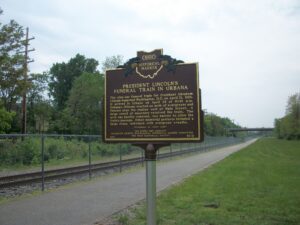
The nine-car funeral train for President Abraham Lincoln departed Washington, D.C. on April 21, 1865. It arrived in Urbana on April 29 at 10:40 p.m. Urbana’s citizens erected an arch of evergreens and flowers near the station west of Main Street. A large crowd of mourners received the train. The arch was hastily removed, too narrow to allow the train’s passage. Other memorial gestures included a large cross, entwined with evergreen wreaths.
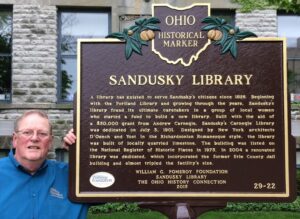
A library has existed to serve Sandusky’s citizens since 1826. Beginning with the Portland Library and growing through the years, Sandusky’s library found its ultimate caretakers in a group of local women who started a fund to build a new library. Built with the aid of a $50,000 grant from Andrew Carnegie, Sandusky’s Carnegie Library was dedicated on July 3, 1901. Designed by New York architects D’Oench and Yost in the Richardsonian Romanesque style, the library was built of locally quarried limestone. The building was listed on the National Register of Historic Places in 1975. In 2004 a renovated library was dedicated, which incorporated the former Erie County Jail building and almost tripled the facility’s size.
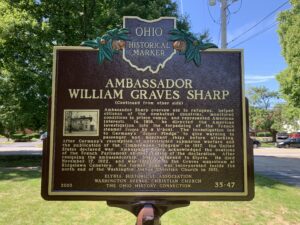
William Graves Sharp lived at this location before and after his tenure as Ambassador to France during World War I. He was born to George Sharp and Mahala Graves Sharp in Mount Gilead, Ohio, on March 14, 1859. As children, Sharp and his twin brother George moved to Elyria with their mother and grandparents, William and Ephra Graves. An Elyria High School graduate, Sharp earned a law degree from the University of Michigan in 1881. He was a journalist, lawyer, industrialist, and Lorain County Prosecutor. Serving three terms in the U.S. House of Representatives, Sharp introduced the first legislation providing for airmail service. Shortly before the outbreak of World War I, President Woodrow Wilson named Sharp as ambassador to France. He served from December 4, 1914, to April 14, 1919. (Continued on other side)