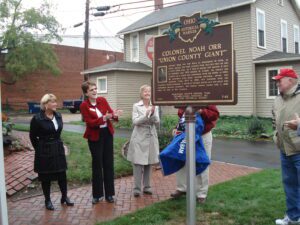
Cyprian Lee (1792-1854) settled in the Union County wilderness in 1820 and purchased the 118 West Sixth Street lot in 1828 for $6. County treasurer, coroner, shoemaker, and anti-slavery activist, Lee lived here in a log cabin until 1832 when this Greek Revival two-story brick house was completed. Other notable citizens to have resided in this oldest brick house in Marysville were showman Noah Orr (1836-1882), also known as the “Union County Giant,” and Josiah Jacob Morelock (1833-1899), a member of the Marysville City Council and the first Fire Department in Marysville. The Morelock family tannery business and stables were located behind this house.
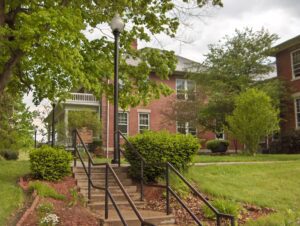
In the first quarter of the nineteenth century, when the general public believed that the insane and paupers could be rehabilitated into productive citizens, the Ohio Legislature gave authorization to county commissioners to establish county “poor houses.” The Athens County Home, formerly known as the Athens County Infirmary, opened on this site in 1857 to provide care for indigent citizens of Athens County. When fire destroyed the original building in 1903, a new building was constructed from 1904-1905, designed with the capacity to house up to one hundred people. When it was built, it was considered to be one of the finest and most modern charitable institutions of its time. The facility continued to provide housing for indigent and elderly residents until 1997 when the County Commissioners closed the home and it became a primary location for the delivery of social services in Athens County. (continued on the other side)
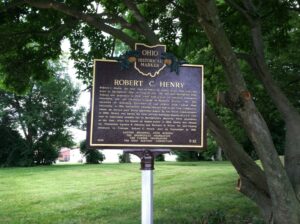
Robert C. Henry, the first African-American mayor of an Ohio city, was born in Springfield, Ohio, on July 16, 1921. He attended Springfield High School and graduated in 1939. After high school, he attended Wittenberg University and the Cleveland College of Mortuary Science. He also received an honorary Doctorate of Law degree from Central State University. In 1961, Springfield citizens elected him to the City Commission, where he served until being appointed mayor by his fellow commissioners in 1966. Henry was among the first African-American mayors of a U.S. city, and is especially notable due to Springfield’s majority white population at the time. After his tenure as mayor ended in 1968, Henry was chosen by presidents Lyndon B. Johnson and Richard M. Nixon for fact- finding missions in Vietnam. Robert C. Henry died on September 8, 1981.
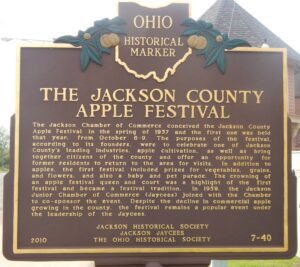
The Jackson Chamber of Commerce conceived the Jackson County Apple Festival in the spring of 1937 and the first one was held that year, from October 6-9. The purposes of the festival, according to its founders, were to celebrate one of Jackson County’s leading industries, apple cultivation, as well as bring together citizens of the county and offer an opportunity for former residents to return to the area for visits. In addition to apples, the first festival included prizes for vegetables, grains, and flowers, and also a baby and pet parade. The crowning of an apple festival queen and court was a highlight of the first festival and became a festival tradition. In 1959, the Jackson Junior Chamber of Commerce (Jaycees) joined with the Chamber to co-sponsor the event. Despite the decline in commercial apple growing in the county, the festival remains a popular event under the leadership of the Jaycees.
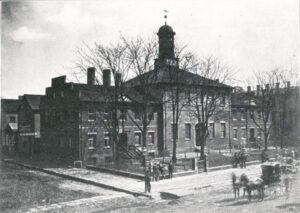
In 1809 the citizens of Zanesville erected a building on this site which served as the capitol of Ohio from October 1, 1810, until May 1, 1812. The 9th and 10th sessions of the Ohio General Assembly met here before returning to Chillicothe in May 1812. The building was then used as the Muskingum County Courthouse until the present courthouse was built in 1874. The 1809 date stone from the old building was incorporated into the new building and may be seen over the front steps.
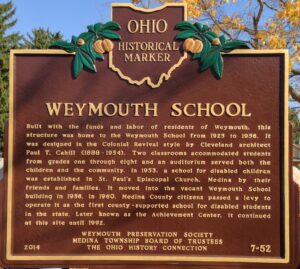
Built with the funds and labor of residents of Weymouth, this structure was home to the Weymouth School from 1925 to 1956. It was designed in the Colonial Revival style by Cleveland architect Paul T. Cahill (1888-1954). Two classrooms accommodated students from grades one through eight and an auditorium served both the children and the community. In 1953, a school for disabled children was established in St. Paul’s Episcopal Church, Medina by their friends and families. It moved into the vacant Weymouth School building in 1956. In 1960, Medina County citizens passed a levy to operate it as the first county-supported school for disabled students in the state. Later known as the Achievement Center, it continued at this site until 1992.
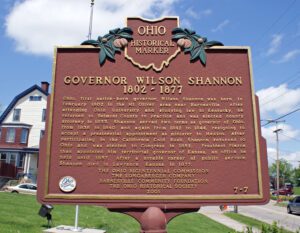
Ohio, first native-born governor, Wilson Shannon was born in February 1802 in the Mt. Olivet area near Barnesville. After attending Ohio University and studying law in Kentucky, he returned to Belmont County to practice and was elected county attorney in 1833. Shannon served two terms as governor of Ohio, from 1838 to 1840 and again from 1842 to 1844, resigning to accept a presidential appointment as minister to Mexico. After participating in the California Gold Rush, Shannon returned to Ohio and was elected to Congress in 1852. President Pierce then appointed him territorial governor of Kansas, an office he held until 1857. After a notable career of public service, Shannon died in Lawrence, Kansas, in 1877.
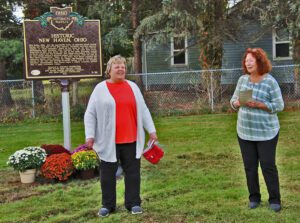
New Haven, Ohio, was the mercantile center of southwest Huron County during the first half of the 19th century. Residents described immense wagons, or “land schooners,” lined up for miles on the New Haven-Worthington Road traveling from Columbus to the Lake Erie ports. Organized in 1815, New Haven was one of the early townships formed in Huron County and the Firelands. The village was platted, with streets at right angles around a diamond-shaped town green, after the plan of New Haven, Connecticut. When, in the 1840s, New Haven rejected the railroad’s direct route through the village, the Sandusky & Newark was routed to the west and through Plymouth taking with it the shipping business. Subsequently, New Haven began a steady economic decline into a small crossroads village.