

, OH
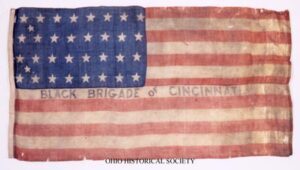
Following the success of Confederate forces in eastern Kentucky and General John Hunt Morgan’s raids there in 1862, Cincinnatians believed that Southern invasion was imminent. Anxious officials ordered Cincinnati citizens to form home guards, but black men willing to volunteer were rebuffed when they attempted to join a defense force. Instead, police serving as provost guards rounded up many and marched them by bayonet to build fortifications in Kentucky. Reacting to the shameful treatment of the blacks eager to support the Union, the commander of the Department of Ohio dispatched Major General Lewis Wallace to command the civilians and to liberate black men forced into service. (continued on other side)
, OH
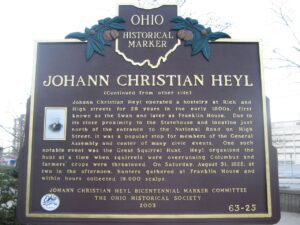
Johann Christian Heyl (1788-1877), the first German and first Lutheran to settle in Columbus, was one of the original 15 settlers of the city. A baker by trade, Heyl came to bake for the soldiers quartered in Franklinton during the War of 1812. He founded the city’s first Lutheran Church and helped financially underwrite the German Theological Seminary, which later became Capital University. An early civic leader, Heyl served on City Council for 14 years, was County Treasurer for 8 years, an associate judge in the Court of Common Pleas for 14 years, was appointed to the first public school board, and was the first Chief of the Fire Department. His Sunbury Road home was a stop on the Underground Railroad. (continued on other side)
, OH
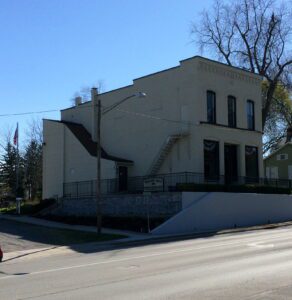
Henry Hanford Wakeman (1840-1879) of New York came to Waterville and became a successful businessman. He conceived the idea of a local Masonic Lodge, which became Wakeman Lodge No. 522 Free and Accepted Masons in 1879, and bequeathed $1,000 toward the construction of a meeting place. In 1880, a cornerstone was laid and this building was dedicated on October 21, 1881. For over 100 years, the Masons held their meetings upstairs while the lower floor was often rented out to a succession of businesses or used for public gatherings. Rising maintenance expenses and lower membership numbers caused the Masons to put Wakeman Hall up for sale in 1995. The Waterville Historical Society purchased the building in 1997 and spent several years rehabilitating it to serve as a local history archive and the Historical Society’s meeting place.
, OH
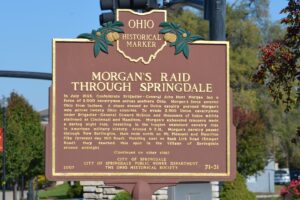
In July 1863, Confederate Brigadier-General John Hunt Morgan led a force of 2,000 cavalrymen across southern Ohio. Morgan’s force entered Ohio from Indiana. A chase ensued as Union cavalry pursued Morgan’s men across twenty Ohio counties. To evade 2,500 Union cavalrymen under Brigadier-General Edward Hobson and thousands of Union militia stationed at Cincinnati and Hamilton, Morgan’s exhausted troopers made a daring night ride, resulting in the longest sustained cavalry ride in American military history. Around 9 P.M., Morgan’s cavalry passed through New Burlington, then rode north on Mt. Pleasant and Hamilton Pike (present day Mill Road). Heading east on Bank Lick Road (Kemper Road), they reached this spot in the Village of Springdale around midnight. (Continued on other side)
, OH
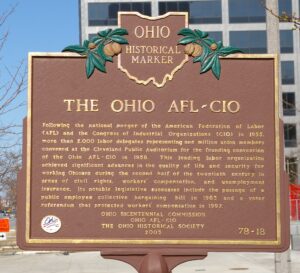
Following the national merger of the American Federation of Labor (AFL) and the Congress of Industrial Organizations (CIO) in 1955, more than 2,000 labor delegates representing one million union members convened at the Cleveland Public Auditorium for the founding convention of the Ohio AFL-CIO in 1958. This leading labor organization achieved significant advances in the quality of life and security for working Ohioans during the second half of the twentieth century in areas of civil rights, workers’ compensation, and unemployment insurance. Its notable legislative successes include the passage of a public employee collective bargaining bill in 1983 and a voter referendum that protected worker’s compensation in 1997.
, OH
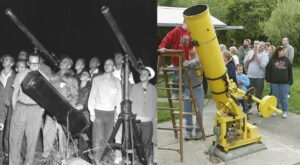
On October 4, 1957 the Soviet Union surprised the world with the launching of Sputnik 1, the world’s first artificial satellite. The Cincinnati Astronomical Society’s Moonwatch Team, organized in 1956 as part of its participation in the International Geophysical Year, was immediately activated by the Smithsonian Astrophysical Observatory (S.A.O.). First observations of satellites were made December 15, 1957. On these grounds, from 1957 to 1964, the Cincinnati Moonwatch Team, principally under the leadership of Tom Van Flandern (1940-2009), spent thousands of man-hours optically observing and recording data to verify the positions of satellites in space. Many times the team compiled the best satellite tracking records in the world. Because of this work The Moonwatch Team and the Cincinnati Astronomical Society were recognized by the S.A.O. as one of its leading teams worldwide.
, OH
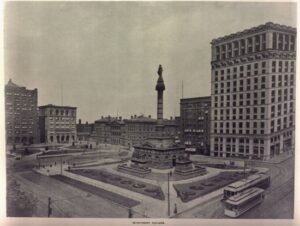
This monument, dedicated July 4, 1894, honors Cuyahoga County men and women, who performed military and patriotic duties during the Civil War (1861-1865). William J. Gleason (1846-1905), army veteran and local businessman, proposed its creation in 1879. Captain Levi Tucker Scofield (1842-1917), Cleveland architect and sculptor, designed the structure and supervised its 19-month construction by contractors, A. McAllister and Andrew Dall. George T. Brewster of Boston and George Wagner of New York, professional artists, assisted Scofield as sculptors. A 12-member Monument Commission, appointed by Governor Joseph B. Foraker in 1888, oversaw the project, which included the removal of William Walcutt’s 1860 marble statue of Commodore Oliver Hazard Perry from the site. The monument’s cost of $280,000 was raised by a countywide property tax levy. An 11-member commission maintains the monument funded by the county. (continued on other side)
, OH
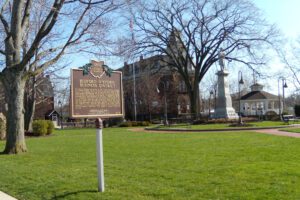
The town of Bedford was settled in 1837. Early residents, Hezekiah and Clarissa Dunham donated the land that serves as Bedford Public Square. The Dunhams built one of the area’s first homes in 1832, which stands at 729 Broadway with the letters H & D above the doorway. Early settlers were attracted to the area by the abundance of natural resources and a large waterfall for mill sites. Bedford also served as a stagecoach stop on the route from Cleveland to Pittsburgh. The road or Turnpike Road as it was called was originally part of the Mahoning Indian Trail. By 1895 the road was renamed Main Street (and later Broadway) when the Akron, Bedford, and Cleveland Railway Company (ABC) traversed the middle of the street carrying passengers. The interurban is called “America’s first high speed long distance electric interurban” with speeds in excess of 60 miles per hour. [continued on other side]