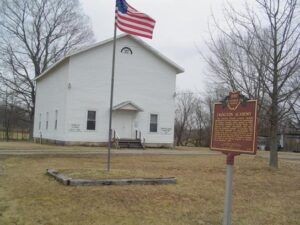
The Ewington Citizens’ Literary Institute purchased this site and sponsored the construction of Ewington Academy which opened in 1859. The building, designed by George Ewing, was financed by popular subscription with much labor and materials donated. It provided high school level education to approximately 60 students each year. It ceased operation as an academy in 1901 and then served as an elementary school until about 1947. Ewington Academy was listed on the National Register of Historic Places September, 1982.
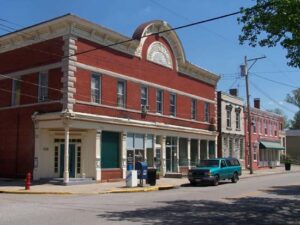
Originally called St. Clairsville and platted in 1801, Decatur was named for early 19th century naval hero Stephen Decatur. It is among the oldest villages in Brown County, which before 1817 was a part of Adams County. Among its notable early residents were Nathaniel Beasley (1774-1835), the first surveyor of Adams County, and Sarah Boone Montgomery (1763-1848), a heroine of the border wars in Kentucky. Decatur and Byrd Township supported at least four known stations on the Underground Railroad. Many area residents helped conduct escaping slaves northward to freedom.
Public park at the Intersection of North Main Street and West High Street
Mount Gilead
, OH
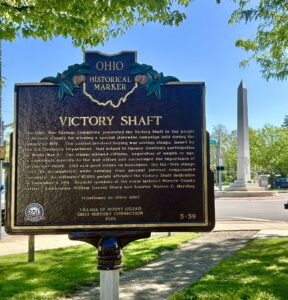
The Ohio War Savings Committee presented the Victory Shaft to the people of Morrow County for winning a special statewide campaign held during the summer of 1919. The contest involved buying war savings stamps, issued by the U.S. Treasury Department, that helped to finance America’s participation in World War I. The stamps allowed citizens, regardless of wealth or age, to contribute directly to the war effort and encouraged the importance of savings and thrift. Sold as a good return on investment, the tax-free stamps could be accumulated while earning four percent interest compounded quarterly. An estimated 10,000 people attended the Victory Shaft dedication on December 4, 1919. Keynote speakers at the event included Morrow County natives, Ambassador William Graves Sharp and Senator Warren G. Harding. (Continued on other side)
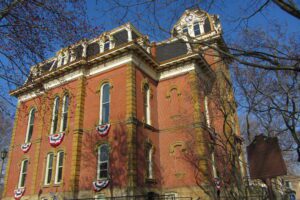
In 1764, Colonel Henry Bouquet established the site of what is now Coshocton. In 1811, the county was founded and the town incorporated as the county seat. The Coshocton County Courthouse, the third on this site, was built between 1873 and 1875 by contractors Carpenter and Williams of Meadville, Pennsylvania. The Second Empire structure features a five-story tower containing a four-faced clock and the bell from the previous 1824 courthouse. The courthouse contains a notable mural by artist Arthur William Woelfle depicting the signing of Bouquet’s treaty with the Indians near the Walhonding River in November 1764. The Coshocton County Courthouse was added to the National Register of Historic Places in 1973.
Prior to the Civil War, New Richmond citizens participated actively in the abolitionist movement and the Underground Railroad. In 1836, James G. Birney published The Philanthropist, an abolitionist newspaper, in New Richmond before moving publication to Cincinnati. Local tradition tells of Jim, a slave living in Kentucky who was given permission from his master to visit his parents in New Richmond. He aided his friend Joe, a fugitive slave, by packing him in a box and placing him on a riverboat headed to New Richmond. Famed Cincinnati abolitionist Levi Coffin recorded, “A few abolitionist – white men – who lived near were called into see the fugitive and to advise in regard to his safety.” Joe was taken from Jim’s parents’ home to Cincinnati where Levi Coffin purchased him a train ticket to Sandusky, from where he traveled to Canada.
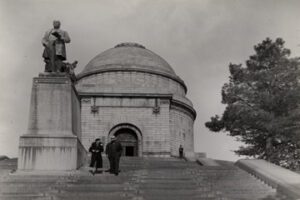
William McKinley served the nation as president, the people of Ohio as governor, and the citizens of his congressional district as a representative. McKinley was shot by an assassin in Buffalo, New York, in September 1901 and died several days later. The McKinley National Memorial, funded by children’s donations, was dedicated in 1907. It is the burial site of the 25th President, First Lady Ida Saxton McKinley, and two daughters. Designed by architect Harold Van Buren Magonigle, the pink Milford granite structure was designated a National Historic Landmark in 1975.
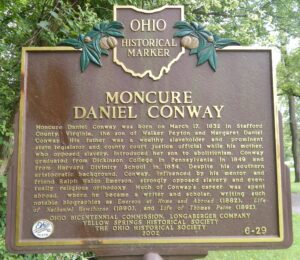
Moncure Daniel Conway was born on March 17, 1832 in Stafford County, Virginia, the son of Walker Peyton and Margaret Daniel Conway. His father was a wealthy slaveholder and prominent state legislator and county court justice official while his mother, who opposed slavery, introduced her son to abolitionism. Conway graduated from Dickinson College in Pennsylvania in 1849 and from Harvard Divinity School in 1854. Despite his southern aristocratic background, Conway, influenced by his mentor and friend Ralph Waldo Emerson, strongly opposed slavery and eventually religious orthodoxy. Much of Conway’s career was spent abroad, where he became a writer and scholar, writing such notable biographies as Emerson at Home and Abroad (1882), Life of Nathaniel Hawthorne (1890), and Life of Thomas Paine (1892).
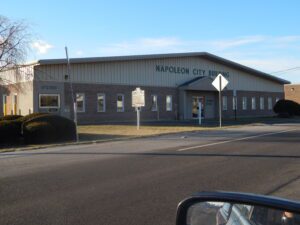
The completion of the Miami and Erie Canal passing through Napoleon in 1843 provided a way to receive manufactured goods, export farm products, and power local mills. The early industries of Napoleon utilized the canal as a source of reliable water power, which led to the development of a mid-19th-century industrial waterfront. Some of the local businesses that relied on the canal were Sayger’s Saw-mill (1843), John Ritter Flouring Mill (1850), Augustin Pilliod’s Napoleon Flouring Mill (1853), and the Napoleon Woolen Mill (1863). These mills used flumes, or artificial channels, to divert canal water to their water wheels. These brick-arch flumes were instrumental in bringing Napoleon into the national economy.