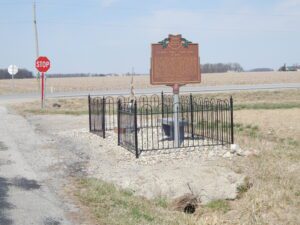
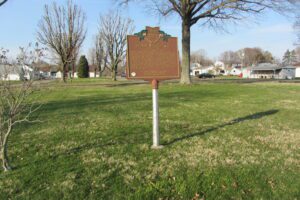
One of Ohio’s greatest manhunts ended here on the morning of July 23, 1948. Robert M. Daniels and John C. West, parolees from the state prison in Mansfield, had gone on a killing spree that left six people dead. Driving west on U.S. Route 224 in a stolen auto transport truck, the pair approached this intersection and encountered a roadblock. It was manned by Van Wert County Sheriff Roy Shaffer, Frank Friemoth, the county game warden, and Sergeant Leonard Conn of the Van Wert city police. West was driving the truck; Daniels was asleep in a car overhead. As Sheriff Shaffer climbed onto the truck and apprehended Daniels, West leaped from the cab and shot Conn in the chest and Friemoth in the arm. Conn returned fire and killed West. The officers survived their wounds. Daniels was convicted, sentenced to die, and electrocuted at the Ohio Penitentiary in Columbus on January 3, 1949. This marker pays tribute to all law enforcement officers who risk their lives to protect the citizens of their communities.
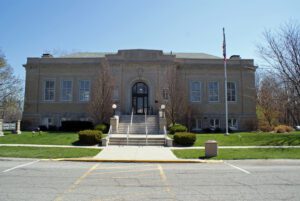
In 1912, the president of the Public Library Association in Paulding requested funding from philanthropist Andrew Carnegie to build a library in Paulding. At first the Carnegie Corporation of New York refused, stating that it only provided funding to communities with larger populations, but when the Library Association said it would serve the entire county, which had a larger population, the request was granted. As a result Paulding became the site for the first “county” Carnegie library in the United States, built for a total cost of $40,000. Carnegie provided funding for 2,811 libraries, of which 1,946 were built in the United States. Placed on the National Register of Historic Places in 1984, the Paulding County Carnegie Library continues to service the needs of all citizens of Paulding County.
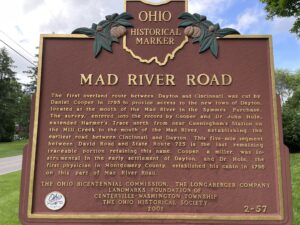
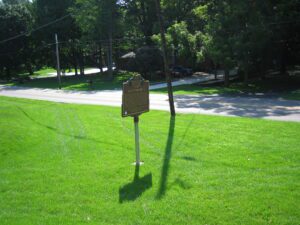
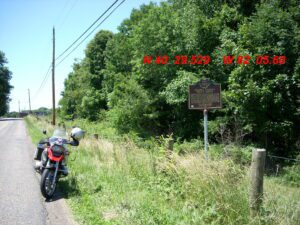
The first overland route between Dayton and Cincinnati was cut by Daniel Cooper in 1795 to provide access to the new town of Dayton, located at the mouth of the Mad River in the Symmes Purchase. The survey, entered into the record by Cooper and Dr. John Hole, extended Harmer’s Trace north from near Cunningham’s Station on the Mill Creek to the mouth of the Mad River, establishing the earliest road between Cincinnati and Dayton. This five-mile segment between David Road and State Route 725 is the last remaining traceable portion retaining this name. Cooper, a miller, was instrumental in the early settlement of Dayton, and Dr. Hole, the first physician in Montgomery County, established his cabin in 1796 on this part of Mad River Road.
The first overland route between Dayton and Cincinnati was cut by Daniel Cooper in 1795 to provide access to the new town of Dayton, located at the mouth of the Mad River in the Symmes Purchase. The survey, entered into the record by Cooper and Dr. John Hole, extended Harmer’s Trace north from near Cunningham’s Station on the Mill Creek to the mouth of the Mad River, establishing the earliest road between Cincinnati and Dayton. This five-mile segment between David Road and State Route 725 is the last remaining traceable portion retaining this name. Cooper, a miller, was instrumental in the early settlement of Dayton, and Dr. Hole, the first physician in Montgomery County, established his cabin in 1796 on this part of Mad River Road.
George Washington Crile was born in 1864 at Chili, in Crawford Township, Coshocton County. Before embarking on his notable medical career, he graduated from Northwestern Ohio Normal School (now Ohio Northern University) at Ada, teaching for two years before becoming principal at Plainfield School. Crile first studied medicine under village physician Dr. A.E. Walker, who loaned him medical books and took him on calls to visit rural patients. Later in life Crile credited his early experience in education in Plainfield as one of the most influential points in his career. (continued on other side)
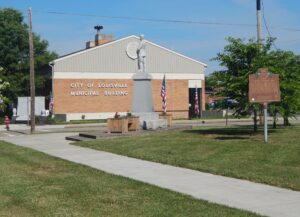
At this site on September 17, 1952, an assembly of Louisville citizens led by Olga T. Weber joined U.S. Congressman Frank T. Bow in commemorating the completion of U.S. Constitution on September 17, 1787. With the goal of promoting a wider understanding of citizens’ rights and responsibilities, the Committee for the Preservation of the Constitution lobbied for both state and national observances. In 1953, Governor Frank Lausche proclaimed September 17 as Constitution Day in Ohio; subsequently President Dwight D. Eisenhower proclaimed the week of September 17, 1955 as Constitution Week. The committee, incorporated in 1962, has marked the anniversary each year since–making this Louisville tradition the nation’s longest continuing observance of Constitution Day.
On French Ridge in Richland Township, on June 5, 1863, local citizens in defiance of conscription attacked Elias Robinson, an enrolling officer of the Union Army. When Captain James Drake, the provost marshal, imprisoned the ringleaders, armed locals released them. Colonel William Wallace of the 15th Ohio Volunteer Infantry was sent to the scene with a force of 420 soldiers from Camp Chase in Columbus. On June 17, the soldiers approached the fortified camp of nearly one thousand malcontents. After firing upon the soldiers, the “rebels” scattered with only a few captured or wounded. The next morning, local Peace Democrats, led by politician Daniel P. Leadbetter, negotiated a surrender of the ringleaders. More than forty people were indicted for involvement in the rebellion, but only Lorenzo Blanchard, owner of the farm where the camp was located, was found guilty. Once this riot at “Fort Fizzle” ended, resistance to the draft in Holmes County subsided.
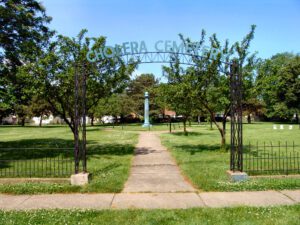
Of the city’s 5,667 people in 1849, 3,500 fled, and 400 of those remaining were victims of cholera. Most are buried here, some only in rough boxes in a common grave. The scourge came again in 1850 and 1852 but with less toll. “Dismay stalked abroad in the daytime and the drowsy night was hideous with the wailings of the disconsolate.”