Sherwood Anderson (1876-1941), author of 27 works, gave up a successful business career in Elyria, Ohio, to concentrate on writing. Born in Camden, Anderson spent his formative years (1884-1895) in Clyde, and in 1919 he published his most notable book, Winesburg, Ohio. Clyde and small-town Ohio inspired many of its tales. Critics also praised his short story collections, including The Triumph of the Egg (1921) and Death in the Woods (1933). Commercially successful as a writer, Anderson moved to rural Virginia, where in 1927 he purchased and operated two newspapers while continuing his literary career. Through his writings and encouragement he was a major influence to a younger generation of writers, including William Faulkner, Ernest Hemingway, and John Steinbeck. Sherwood Anderson is buried in Marion, Virginia.
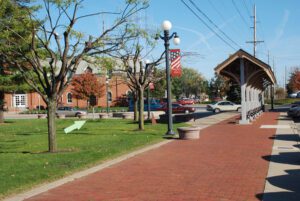
Bainbridge Center Historic District. Founded in 1817, Bainbridge Township was named for Commodore William Bainbridge, commander of the USS Constitution during the War of 1812. The unincorporated hamlet of Bainbridge Center is both the geographic and historic center of Bainbridge Township. The town hall, churches, stores, shops, a school, and post office were established in Bainbridge Center. The architecture of houses in the area, most notably those built during the Greek revival period, reflects the agricultural past of the community and its development in the twentieth century. Citizens gathered in The Center to attend church and school, shop, and participate in social and political functions.
Bainbridge Center Historic District. Founded in 1817, Bainbridge Township was named for Commodore William Bainbridge, commander of the USS Constitution during the War of 1812. The unincorporated hamlet of Bainbridge Center is both the geographic and historic center of Bainbridge Township. The town hall, churches, stores, shops, a school, and post office were established in Bainbridge Center. The architecture of houses in the area, most notably those built during the Greek revival period, reflects the agricultural past of the community and its development in the twentieth century. Citizens gathered in The Center to attend church and school, shop, and participate in social and political functions.
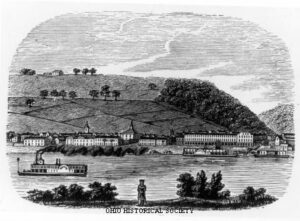
Ripley was incorporated as the village of Staunton in 1812. Its name was changed in 1816 to honor General Eleazer Wheelock Ripley, a hero of the War of 1812. In the years before railroads, Ripley was a principal Ohio River shipping center. Also important were its extensive boat-building, tobacco, pork, and timber industries. Ripley too was the home of saw and planing mills, iron foundries, and a piano factory. Such varied commerce enabled Ripley to remain vibrant throughout the nineteenth century. Although noted as a port, Ripley is best remembered as an abolitionist stronghold. Many of its citizens, including Rev. John Rankin and John P. Parker, served as conductors on the famed “Underground Railroad.” The notoriety of Ripley’s anti-slavery network perhaps eclipsed that of nearby Cincinnati, earning the town a reputation as the “Black Hole of Abolitionism.” (Continued on side two)
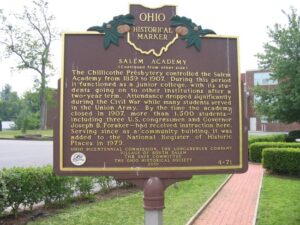
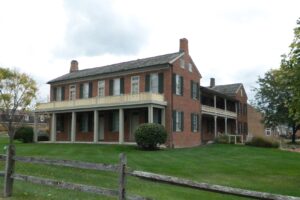
Presbyterian minister Hugh Stewart Fullerton asked his congregation in 1841: “Shall we endeavor to form an academy to provide better educational advantages to the young citizens of this remote community?” Predating the founding of the town of South Salem, the Salem Academy was built and opened in 1842, its stone coming from a quarry south of Greenfield. Its primary purpose was to prepare ministers and teachers for the West. Professor J.A. Lowes served as principal during the “golden age” of the academy from 1848 to 1858. (continued on other side)
David Snively built the Federal-style Pennsylvania House in 1839 along the newly constructed National Road. This tavern and inn was an important stopover for livestock drovers and pioneers traveling by foot, on horseback, or in Conestoga wagons during the westward expansion of the United States in the nineteenth century. Dr. Isaac K. Funk, of Funk & Wagnalls fame, lived in the house in the 1840s while his father served as its tavern keeper. Closed as an inn after the Civil War, it then served as a doctor’s clinic, boarding house, and secondhand shop before falling into total disrepair. The Lagonda Chapter of the Daughters of the American Revolution saved it from demolition and has owned and operated it as a museum since 1941. The Pennsylvania House was put on the National Register of Historic Places in 1972.
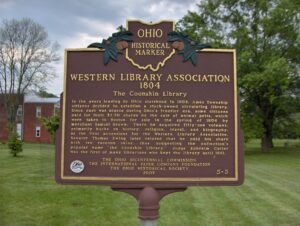
In the years leading to Ohio statehood in 1803, Ames Township citizens decided to establish a stock-owned circulating library. Since cash was scarce during Ohio’s frontier era, some citizens paid for their $2.50 shares by the sale of animal pelts, which were taken to Boston for sale in the spring of 1804 by merchant Samuel Brown. There he acquired fifty-one volumes, primarily books on history, religion, travel, and biography, as the first accessions for the Western Library Association. Senator Thomas Ewing later related that he paid his share with ten raccoon skins, thus suggesting the collection’s popular name “the Coonskin Library.” Judge Ephraim Cutler was the first of many librarians who kept the library until 1861.
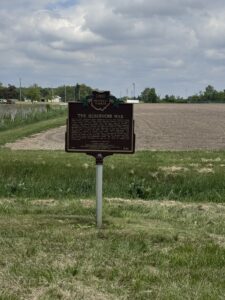
Here in 1887, frustrated locals destroyed the Six Mile Reservoir when legal efforts to close it failed. Years after any boat ran on the Wabash & Erie Canal, its water source, the 2,000-acre reservoir, became a stagnant, uncultivable breeding ground for disease-carrying mosquitos. Legislative attempts to abandon the canal and reservoir failed because manufacturers in Defiance used the waterway to float logs downstream. On the night of April 25, 1887, 200 men calling themselves “The Dynamiters” carried a banner that read, “No Compromise! The Reservoir Must Go!” and converged here, overpowered citizen guards, gouged the banks of the reservoir, dynamited the bulkhead and lock, and burned down the lockkeeper’s house. The next day, Governor Joseph B. Foraker denounced the acts of the “mob of lawless and rioting men.” (Continued on other side)