

, OH
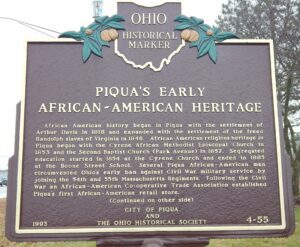
African-American history began in Piqua with the settlement of Arthur Davis in 1818 and expanded with the settlement of the freed Randolph slaves of Virginia in 1846. African-American religious heritage in Piqua began with the Cyrene African Methodist Episcopal Church in 1853 and the Second Baptist Church (Park Avenue) in 1857. Segregated education started in 1854 at the Cyrene Church and ended in 1885 at the Boone Street School. Several Piqua African-American men circumvented Ohio’s early ban against Civil War military service by joining the 54th and 55th Massachusetts Regiments. Following the Civil War an African-American Co-operative Trade Association established Piqua’s first African-American retail store. Continued on/from other side)
, OH
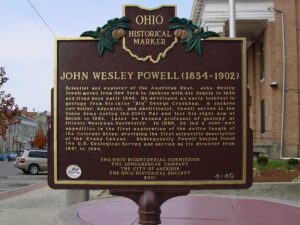
Scientist and explorer of the American West, John Wesley Powell moved from New York to Jackson with his family in 1838 and lived here until 1846. He developed an early interest in geology from his tutor “Big” George Crookham, a Jackson salt boiler, educator, and abolitionist. Powell served in the Union Army during the Civil War and lost his right arm at Shiloh in 1862. Later he became professor of geology at Illinois Wesleyan University. In 1869, he led a nine-man expedition in the first exploration of the entire length of the Colorado River, providing the first scientific description of the Grand Canyon. Subsequently Powell helped found the U.S. Geological Survey and served as its director from 1881 to 1894.
, OH
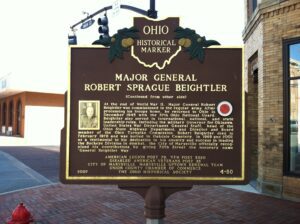
Robert Sprague Beightler was born in 1892 in Marysville. A graduate of Marysville High School, he began his career as a soldier in 1911, when he enlisted as a private in Marysville’s guard unit, Company E, Fourth Ohio Infantry Regiment. He served in Mexico from 1916-1917, World War I from 1917-1919, and World War II from 1940-1945. From his stint with the Ohio Infantry, he rose in rank to command the famous 37th Ohio National Guard Buckeye Division as Major General during WWII. Beightler was one of the most successful National Guard Generals and the only National Guard General to lead his troops through both training and combat in WWII. He was with his troops through 700 days of fighting in the South Pacific Theater. Fighting occurred on Bougainville Island and in the islands of New Georgia and the Philippines. (Continued on other side)
, OH
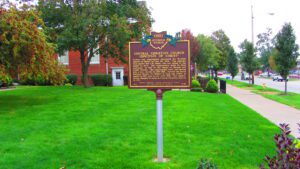
Harvey Howard, a local druggist, built the house at 407 North Market Street around 1860. After many owners, Captain James B. Taylor bought the home in 1893. Taylor commanded Company H of the 120th Ohio Volunteer Infantry during the Civil War. He studied law after the war and moved his practice to Wooster in 1882. Taylor’s wife Emelie died in 1905 and in 1906 Taylor sold the property to become Wooster’s first city hospital. Many of the town’s noted physicians practiced here and the facility was eventually enlarged to accommodate 30 beds. The house was a hospital until 1943, when Central Christian Church purchased it. The church used the building for education programs and restored much of its decor, including four fireplaces, inlaid floors, and bronze door hardware.
, OH
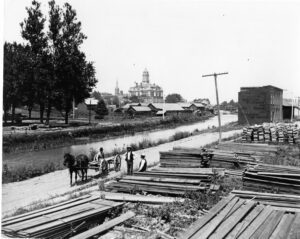
Miami & Erie Canal and Napoleon’s First Cemetery. The Miami & Erie Canal stretched approximately 250 miles from Cincinnati to Toledo. Napoleon and other towns on the Maumee River’s banks were on a slackwater section of the canal. Between 1825 and 1845, laborers constructed the canal using shovels, picks, wheelbarrows, and horse and mule-drawn carts. In Henry County, Napoleon, and elsewhere, German and Irish immigrants and area farmers did the work and were paid around 30 cents a day. As the canal brought more people and business to the area, villages such as Florida, Damascus, and Texas flourished and the county seat of Napoleon boomed. The canal and consequent growth took their tolls, however. Sickness and disease such as “ague” (malaria) and cholera spread and carried off many. Napoleon’s first cemetery was located in the vicinity of 500 East Clinton Street, near the route of the canal.
, OH
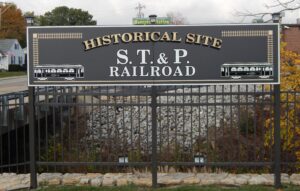
Asa Bushnell, former Governor of Ohio, encouraged by the light grade of the land, decided to establish the Springfield, Troy, and Piqua Railway (ST&P) in July 1904. The interurban traction line utilized sixty-pound rail and traveled over only one bridge. With direct current electricity generated in Springfield, the ST&P used four double-ended fifty-foot cars, each with a railroad roof, arch windows, GE-57 engines, and fifty-horsepower motors. The ST&P traveled from Springfield’s Fountain Square to Maitland, Hill Top, Lawrenceville, Bushnell, North Hampton, Dialton, Thackery, Proctors, Christiansburg, Brights, and Casstown and ended at Troy’s North Market Street Bridge. Later rights were granted to travel over the Great Miami River into Troy in conjunction with the Cincinnati, Hamilton, and Dayton Railway. The northwest right-of-way from Casstown to Piqua was secured but never built.
, OH
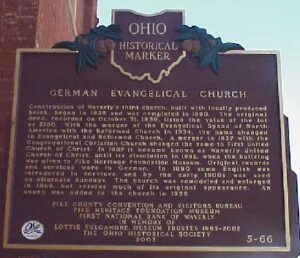
Construction of Waverly’s third church, built with locally produced brick, began in 1859 and was completed in 1860. The original deed, recorded on October 31, 1859, listed the value of the lot as $180. With the merger of the Evangelical Synod of North America with the Reformed Church in 1934, the name changed to Evangelical and Reformed Church. A merger in 1957 with the Congregational Christian Church changed the name to First United Church of Christ. In 1987 it became known as Waverly United Church of Christ, until its dissolution in 1992, when the building was given to Pike Heritage Foundation Museum. Original records and services were in German. In 1890 some English was introduced in services, and by the early 1900s was used on alternate Sundays. The church was remodeled and enlarged in 1869, but retains much of its original appearance. An annex was added to the church in 1959.
, OH
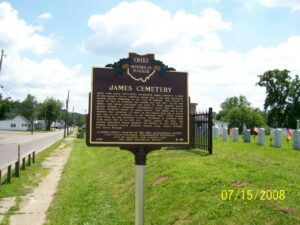
Major John James (1772-1854) established James Cemetery in 1828 on and around a Native American mound that is the only significant ancient mound remaining in the city of Jackson. The mound is about 70 feet in diameter and nearly six feet tall. In the late 1800s, this mound comprised one point of three ancient mound groups forming a triangular configuration along East Broadway Street, formerly known as James Street. One group was a few hundred feet northeast of here on the Watson farm and a second was just to the northwest on the Warnicke farm. These mounds were built by the Hopewell Culture, prominent in southern Ohio from about 100 BC to 400 AD. Major James, his wife, and several immediate family members are buried on the mound including Jackson County pioneers Andrew Long, Daniel Hoffman, and David Mitchell.