

, OH
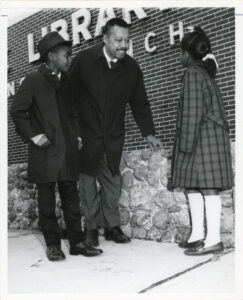
On November 19, 1968, the Columbus Metropolitan Library dedicated the first public library in the nation named after Dr. Martin Luther King Jr. After King’s assassination on April 4, 1968, the East Side Community Council requested that the new library being planned for the King-Lincoln Bronzeville community bear his name. The King family had both family and civic ties to Columbus and were honored by the tribute. More than 1,000 people gathered outside 1600 E. Long Street to hear Martin Luther King Sr. deliver the November dedication speech. Continuing the King family tradition, Martin Luther King III cut the ribbon to open a new branch building at 1487 E. Long Street on October 18, 2018. The Martin Luther King Branch was the first Columbus public library to bear an individual’s name.
, OH
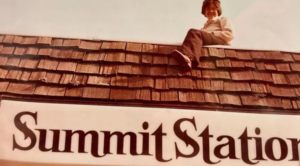
2210 Summit Street once housed one of Ohio’s longest-running lesbian bars. In 1970, a lesbian bartender at Jack’s A Go Go recognized that while Columbus had bars for gay men, it needed one geared toward lesbian clientele. Patrons knew the bar as “Jack’s,” Logan’s Off Broadway, and Summit Station. Staff welcomed women from small towns, women working in trades, women of color, butch/femme lesbians, and transgender people. Regulars recall that stepping through the door felt like finally entering a place of true belonging. Women could dance, “get together,” break up, sing karaoke, party with friends, and celebrate birthdays and holidays. Summit Station remained a safe public space, despite ongoing police harassment of its gender non-conforming regulars. A sign posted outside declared: “Ladies Night, Every Night. Men $5.” (Continued on other side)
, OH
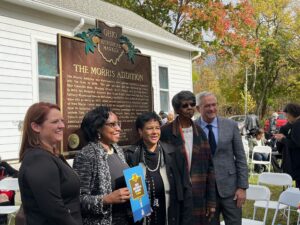
Bethel A.M.E. Church was the first African American church in Worthington. Black residents joined Worthington’s established churches as early as 1847 or worshipped together in their homes. Peter Banks with D.H. Taborn, Charles Kiner, J.T. Horton, and James Birkhead organized the A.M.E. congregation in 1896. Rapid growth moved their meetings to the Worthington Town Hall by 1897. A lot was purchased from Millie Alston on September 24, 1897, and a house relocated to serve as Bethel Chapel. Local carpenter Chester Hard constructed a new building that was dedicated as St. John A.M.E. in 1914. The church has served as the religious and social hub of Worthington’s Black community for more than a century. While St. John A.M.E. Church retains their original location, worship services moved to 7700 Crosswoods Drive in 2004.
, OH
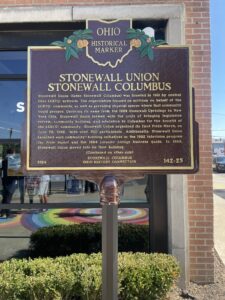
Stonewall Union (later Stonewall Columbus) was founded in 1981 by central Ohio LGBTQ+ activists. The organization focused on activism on behalf of the LGBTQ+ community, as well as providing physical spaces where that community could prosper. Deriving its name from the 1969 Stonewall Uprisings in New York City, Stonewall Union formed with the goals of bringing legislative reform, community building, and education to Columbus for the benefit of the LGBTQ+ community. Stonewall Union organized its first Pride March, on June 26, 1982, with over 500 participants. Additionally, Stonewall Union launched such community-building initiatives as the 1982 television program Gay Pride Report and the 1984 Lavender Listings business guide. In 1985, Stonewall Union moved into its first building. (Continued on other side)
, OH
Benjamin Russel Hanby (1833-1867) enrolled at Otterbein University in 1849. To afford tuition and to aid his family, Hanby alternated college terms with teaching in nearby public schools. While a student in 1856, he was moved by the story of a slave and his sweetheart to compose the anti-slavery ballad “Darling Nelly Gray.” The song quickly proved popular in abolitionist circles. After graduation, Hanby worked as an Otterbein agent, educator, United Brethren minister, and compiler and publisher for Chicago’s Root & Cady music house. He composed “Up on the Housetop” in 1864 while leading a New Paris singing school. During his short life, Hanby composed 80 songs, including the internationally-known hymn “Who is He in Yonder Stall.” Benjamin Hanby died of tuberculosis on March 16, 1867. He is buried in Otterbein Cemetery.
, OH
“…on Sunday morning, especially in the African American community, you could go down the street and hear The Wings Over Jordan just coming from everybody’s house….” Glenn Brackens, 2017. Upholding the sanctity of traditional African American spirituals, believing in the power of radio to uplift listeners, and recognizing his choir’s rich talent, Rev. Glenn T. Settle (1894-1967), pastor of Gethsemane Baptist Church, originated the “Negro Hour” on Cleveland’s WGAR in 1937. The Sunday morning radio show featured the choir’s moving renditions of spirituals and was originally directed by James Tate (1918-1986). Williette Firmbanks Thompson (1910-1992) was assistant director and a soloist (Continued on other side)
, OH
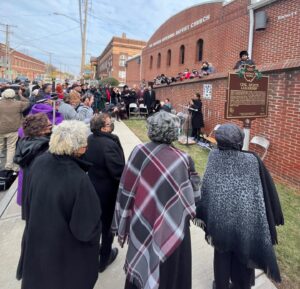
The Greater Abyssinia Baptist Church (GABC) organized with 250 members on December 16, 1945, at a Phillis Wheatley Association meeting. Led by its first pastor, Rev. John Rollins Plummer, the congregation raised $47,000 to purchase the Jewish Synagogue at East 105th Street and Tacoma Avenue from the Beth Hamedrosh Hagodel Beth Israel Congregation in 1946. It later purchased a parsonage, land for parking, and created a Federal Credit Union. Tragically, Rev. Plummer was killed in a car accident on October 22, 1951. The church’s lower auditorium was remodeled and dedicated as J.R. Plummer Memorial Hall. Honoring its missionary and pastoral care foundations, the church built a $3M senior citizens complex nearby. An endowment fund, instituted by its pastor’s savings in 1995, ensures that this commitment to civic leadership endures.
, OH
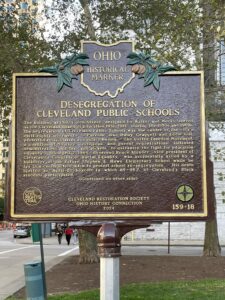
The building at 1380 E. 6th Street, designed by Walker and Weeks, served as the Cleveland Board of Education 1931-2013. During the 1950s and 1960s, the segregation of Cleveland Public Schools was the center of the city’s civil rights movement. Parents, like Daisy Craggett and Eddie Gill, protested relay classes and intact busing. The United Freedom Movement, a coalition of 50 civic, religious, and parent organizations, initiated demonstrations, sit-ins, and pickets, to galvanize the fight for education equality. On April 7, 1964, Reverend Bruce Klunder, vice president of Cleveland’s Congress of Racial Equality, was accidentally killed by a bulldozer at the future Stephen E. Howe Elementary School while he lay in a construction ditch to protest school re-segregation. His death ignited an April 20 boycott in which 85-95% of Cleveland’s Black students participated. (Continued on other side)