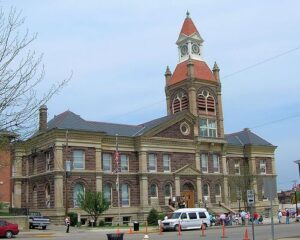
Established as the county seat of Pickaway County in 1810, Circleville derives its name from the circular portion of a large Hopewell-era earthwork upon which it was built. The Circleville earthworks, described in 1772 by Rev. David Jones for a Boston magazine, comprised an 1,100 foot diameter circle connected to a 900 foot square. Town director Daniel Dreisbach platted the town directly atop the earthworks, integrating the town plan into the prehistoric landscape. An octagonal courthouse stood directly in the center.
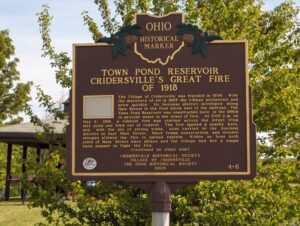
Behind the Cridersville Fire Department, 100 E. Main Street
Cridersville
, OH
The Village of Cridersville was founded in 1856. With the discovery of oil in 1885 the village prospered and grew quickly. Its business district developed along Main Street in the first block east of the railroad. The Town Pond Reservoir was constructed here in the 1890s to provide water in the event of fire. At 3:00 p.m. on May 2, 1918, a rubbish fire was started across the street from this pond and blew out of control. The fire ignited a nearby barn, and, with the aid of strong winds, soon carried to the business district on East Main Street. Wood frame construction and wooden shingles allowed the fire to spread rapidly. Within an hour both sides of Main Street were ablaze and the village had but a single hand pumper to fight the fire. (continued on other side)
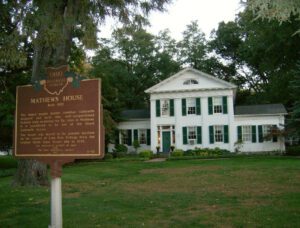
The famed master builder Jonathan Goldsmith designed and built this well-proportioned Federal style residence for Dr. John H. Mathews. It is considered to be one of the finest Goldsmith houses. The house was moved to its present location on the campus of Lake Erie College from the original North State Street site in 1949.
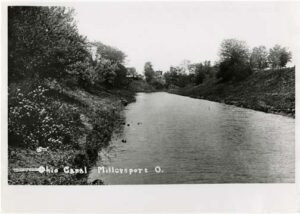
On this site the Ohio & Erie Canal flowed south and down-level under the Market Street Bridge. Nearby Pawpaw Creek and the canal culturally divided the Swiss settlers to the west in Basil and the Virginia pioneers to the east in New Market (Baltimore by 1833). In March 1825, the “Twin Cities” were “dedicated” one day apart and energized a feud that often erupted at the bridge where “the boys of one village entered the other at their peril and where the worst of the intervillage fights were held.” The rivalry stretched well into the twentieth century and was arguably terminated with an uneasy consolidation of the two towns in 1947.
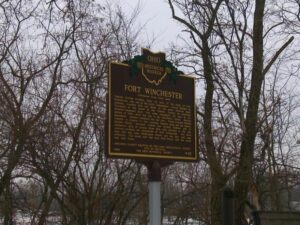
General William Henry Harrison ordered the construction of Fort Winchester at the beginning of October 1812 and it was completed October 15. The fort served as a forward observation post and supply depot for the American army during the War of 1812. Until Fort Meigs was completed in 1813, Fort Winchester was the front line against the British and their Indian allies. During the siege of Fort Meigs, Fort Winchester was a rendezvous point for the troops of General Green Clay and those of Colonel William Dudley. Fort Winchester outlined the shape of a parallelogram, measuring 600 by 300 feet in size. Blockhouses anchored the four corners of the fort and within its stockade were storehouses and a hospital.
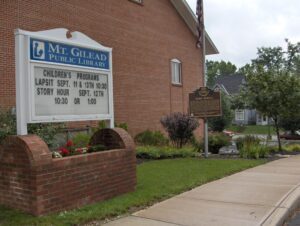
The author of fifteen novels, ten plays, and more than 100 stories, Dawn Powell was born in 1896 in Mount Gilead at 53 West North Street and grew up in Shelby. She graduated from Lake Erie College in Painesville and moved to New York in 1918. Although some of her early works, such as She Walks in Beauty (1928) and The Bride’s House (1929), draw from her life in small-town Ohio, she is best known for her satiric portrayals of life in New York, including A Time to Be Born (1942) and The Wicked Pavilion (1954). Often compared to Dorothy Parker and associated with contemporaries John Dos Passos, Edmund Wilson, Ernest Hemingway, and Gore Vidal, Powell received the Marjorie Peabody Waite Award for lifelong achievement in literature in 1964. She died in New York in 1965.
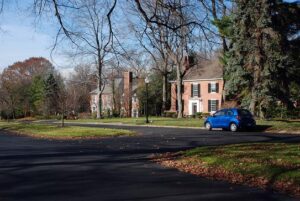
Youngstown’s earliest automobile suburb, Forest Glen Estates was developed in the 1920s during a period of change in urban transportation patterns and rapid expansion in the regional steel economy. A composite of design work by leading northeastern Ohio landscape and residential architects, the park-like suburb integrates period revival architecture into the natural landscape and blends gracefully with adjacent Mill Creek Park. Gently curving streets with low curbs and landscaped islands were a novel departure from traditional grid patterns. Attached garages and walkways that connect to driveways rather than the street reflect the influence of the personal automobile in the suburban landscape during this era. In 1998, the Forest Glen Estates Historic District was listed on the National Register of Historic Places.
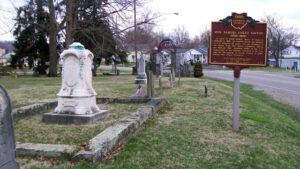
(1792-1862) A native of South Hadley, Massachusetts, he came to Gallipolis ca. 1818. An eminent lawyer and member of U.S. Congress 22 years, he was chairman of the House Ways and Means Committee during the Mexican War, founding father of the U.S. Department of the Interior, honored in his own time by the naming of Vinton County in 1850. Buried Pine Street Cemetery.