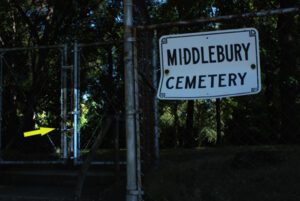
This burying ground was the first public cemetery located within Akron’s boundaries. It was also known as the “Old Cemetery” and the “Newton Street Cemetery.” Deacon Titus Chapman donated this land in 1808 as a burying ground, and he was probably the first person interred here when he died later that year. Early Akron settlers and their descendents, including veterans of the American Revolution, are buried here. Some of the gravestones were among the finest brought to the Western Reserve from Connecticut. The Middlebury Cemetery was used until 1853.
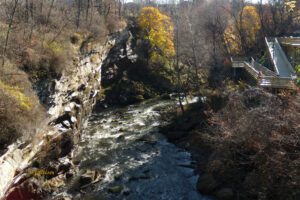
In 1879, local hardware store owners L.W. Loomis and H.E. Parks established a summer resort at Front Street and Prospect Avenue. The High Bridge Glens and Caves park spanned both sides of the Cuyahoga River and featured a dance and dining pavilion, scenic trails and overlooks, cascades and waterfalls, deep caverns, curious geological formations, and a suspension footbridge. The park also offered several manmade attractions, including what is believed to have been one of the earliest roller coasters in the area. At the height of its popularity, the park attracted more than 8,000 visitors a day, including Congressman (later president of the United States) William McKinley. (continued on other side)
801 E. Pete Rose Way, Bicentennial Commons at Sawyer Point
Cincinnati
, OH
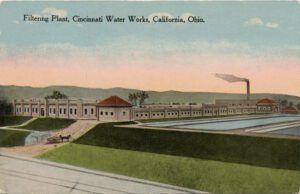
On June 25, 1839, Greater Cincinnati Water Works became the first publicly owned water system in Ohio, when the city purchased a privately owned water company in operation since 1821. This purchase required approval of the voters of Cincinnati and authorization by the Ohio State Legislature. The Water Works, with two steam pumps at this site, three and a half miles of iron pipe, and 19 miles of wooden pipe, provided one million gallons of water per day. Front Street Pumping Station (ruins at this site) replaced earlier facilities and operated from 1865 to1907.
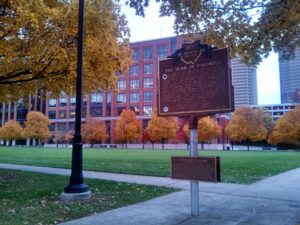
Thousands of Irish immigrants came to Columbus to seek personal and religious freedom. With the “Great Hunger” in Ireland and the completion of the Ohio and Erie Canal and the National Road, immigration to Columbus increased in the mid nineteenth century. They initially settled in the north side of the city in the swamp flats, where inexpensive land was available and work could be had on the railroads. Settlement spread to Franklinton, on Naghten Street, later known as “Irish Broadway”- part of which is now Nationwide Boulevard, and to nearby Flytown. The immigrants became domestic workers, civil servants, entrepreneurs, and served the city in police and fire departments. Others were leaders in government, law, medicine, and education. Their legacy continues today in the Irish-American population of Columbus, Ohio.
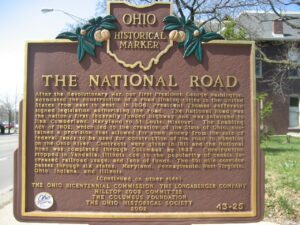
After the Revolutionary War, our first President, George Washington, advocated the construction of a road linking cities in the United States from east to west. In 1806, President Thomas Jefferson signed legislation authorizing the road. The National Road was the nation’s first federally funded highway and was intended to link Cumberland, Maryland to St. Louis, Missouri. The Enabling Act of 1802, which led to the creation of the state of Ohio, contained a provision that allowed for some money from the sale of federal lands to be used for construction of the road to Wheeling on the Ohio River. Contracts were given in 1811 and the National Road was completed through Columbus by 1833. Construction stopped in Vandalia, Illinois due to the popularity of canals, increased railroad usage, and lack of funds. The 591-mile corridor passes through six states: Maryland, Pennsylvania, West Virginia, Ohio, Indiana, and Illinois.
The Civil War created orphaned and impoverished children across the nation. To establish a home for area children, a group of Hamilton women met with Reverends Thane Miller and Benjamin W. Chidlaw in January 1869. By May, the women had rented a house on North C Street. Five years later, a new house was needed. Local businessmen Clark Lane and Elbridge G. Dyer pledged a combined $10,000 to purchase the property at 425 South D Street. One condition of the gift was that home’s operators had to raise an additional $2,000 to cover expenses. The newer, larger home opened in September 1875. In 1902, Robert and Eleanor Beckett McKinney donated funds to build a hospital on the property, named Ruth Hospital, to honor their deceased infant daughter. Mrs. McKinney and her mother, Martha Beckett, had long supported the home’s work. (Continued on other side)
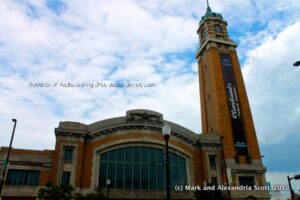
Since opening in 1912, the West Side Market, Cleveland’s oldest continuously operating, municipally-owned market, has been an anchor to the historic Ohio City neighborhood. Built to replace the Pearl Street Market and the Central Market. All three served Cleveland’s growing population in the early 20th century, but only the West Side Market remains. Designed by architects W. Dominick Benes and Benjamin Hubbell, the 30,000 square foot space has a dramatic vaulted Guastavino tile ceiling and a signature clock tower that is 137 feet high. The Seth Thomas clock Company manufactured the clock. (Continued on other side)
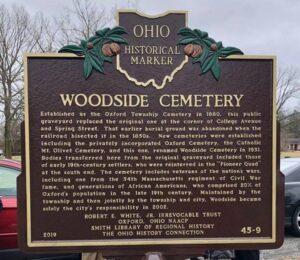
Established as the Oxford Township Cemetery in 1880, this public graveyard replaced the original one at the corner of College Avenue and Spring Street. That earlier burial ground was abandoned when the railroad bisected it in the 1850s. New cemeteries were established including the privately incorporated Oxford Cemetery, the Catholic Mt. Olivet Cemetery, and this one, renamed Woodside Cemetery in 1931. Bodies transferred here from the original graveyard included those of early 19th-century settlers, who were reinterred in the “Pioneer Quad” at the south end. The cemetery includes veterans of the nation’s wars, including one from the 54th Massachusetts regiment of Civil War fame, and generations of African Americans, who comprised 20% of Oxford’s population in the late 19th century. Maintained by the township and then jointly by the township and city, Woodside became solely the city’s responsibility in 2002.