

, OH
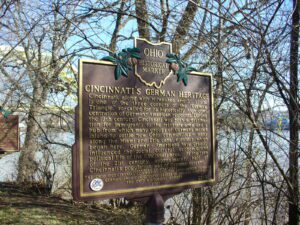
Cincinnati, along with Milwaukee and St. Louis, is one of the three corners of the “German Triangle,” so-called for its historically high concentration of German-American residents. During the 19th century, Cincinnati was both a destination for immigrants to the tri-state area and a hub from which many groups of Germans moved inland to settle new Ohio communities-many along the Miami and Erie canal corridor which began here. German-Americans have greatly influenced the social, cultural, economic and political life of the Cincinnati area. At the turn of the 21st century, approximately half of Cincinnati’s population was of German descent. (Continued on other side)
, OH
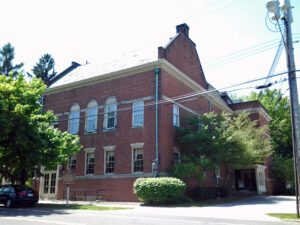
The Canfield WPA Memorial Building was constructed by the Works Progress Administration, a federal government program instituted by President Franklin D. Roosevelt as an effort to aid the United States in its recovery from the Great Depression of the late 1920s and 1930s. Local merchant Arron Weisner donated lands on the west side of Broad Street for the proposed project. A six member committee, comprised of two persons each representing the Argus Masonic Lodge, the American Legion, and the Village of Canfield, determined that the building be “a community building built around community projects.” Through local subscription and $60,000 in federal funds, the WPA project moved forward. The Youngstown architectural firm of W.H. Cook and W. Canfield designed the building in the Colonial Revival style. A ground breaking ceremony was held on December 20, 1935. During World War II, the United States government maintained offices in the building. (Continued on other side)
, OH
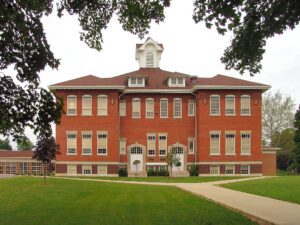
The first school in what is now Pataskala was a “subscription school” operated by Amariah Cubberly on the nearby banks of the South Fork of the Licking River in the 1820s. Subscription schools, which charged fees, were the forerunners of rural public schools in many parts of Ohio. By the 1830s several one-room public schools served the children of the area, but in 1870 the civic minded citizens of Pataskala provided a centralized building for grades one through twelve on Main Street, where the old Town Hall now stands. This school was moved to the new building on this site in 1908. When the Southwest Licking Local School District was established in 1953, Pataskala Elementary School continued in the building. Additions in 1968 and 2000 enhanced its educational capabilities. This 1908 Queen Anne architectural style building was listed on the National Register of Historical Places in 1983.
, OH
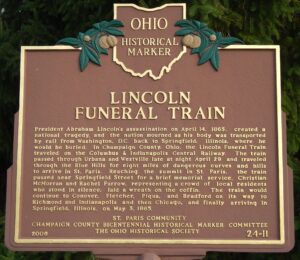
President Abraham Lincoln’s assassination on April 14, 1865, created a national tragedy, and the nation mourned as his body was transported by rail from Washington D.C. back to Springfield, Illinois, where he would be buried. In Champaign County, Ohio, the train passed through Urbana and Westville late at night April 29 and traveled through the Blue Hills for eight miles of dangerous curves and hills to arrive in St. Paris. Reaching the summit in St. Paris, the train paused near Springfield Street for a brief memorial service. Christian McMorran and Rachel Furrow, representing a crowd of local residents who stood in silence, laid a wreath on the coffin. The train would continue to Conover, Fletcher, Piqua, and Bradford on its way to Richmond and Indianapolis and then Chicago, finally arriving in Springfield, Illinois, on May 3, 1865.
, OH
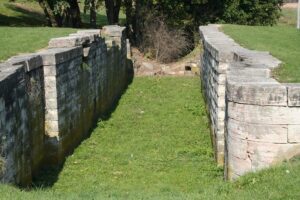
This section of the Miami and Erie Canal, constructed from 1833-1837, was vital to this region’s commerce and development. It allowed for farmers and businesses to get their goods to larger markets at a lower cost and faster speed than by hauling overland. Passengers could also travel across the area by canal boat. John Clark saw the location of the Lock 15, situated in Monroe Township at the junction of the Milton-Carlisle Pike (Main Street), as an opportunity and in 1840, platted the new town of Tippecanoe City (now Tipp City). Many types of commerce and trade grew up around the canal including boarding houses, saloons, a tannery, and a mill. Some of the original buildings still stand, such as a mill to the west of Lock 15, John Clark’s home at the southeast corner of Main and First streets, and the hotel at the northeast corner of Main and Second streets.
, OH
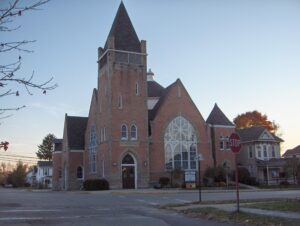
The Mechanicsburg United Methodist congregation was founded in the early nineteenth century and met first in open-air camp meetings before moving into a small log school building. In 1820 the congregation built a wood framed church on East Sandusky Street and that building was replaced with a brick structure in 1838. The congregation split in 1853 into Trinity Methodist and First Methodist with both groups serving the village of Mechanicsburg for 103 years before coming back together in 1956. The current United Methodist Church was built in the early 1890s and dedicated in 1894 on the corner of Main and Race Streets. The Gothic Revival style church was placed on the National Register of Historic Places in 1985.
, OH
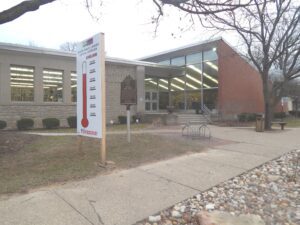
The American Sheet and Tin Plate Company founded the first Dover Public Library for the benefit of its employees at the corner of Front Street and Factory Street in 1902. Five years later, the library moved to a residence on Cherry and Fifth Streets. In 1916 the city dismantled “the old Downey residence” and built a high school in its place, with the public library occupying the basement. In 1934, the library moved to a converted residence at 417 North Walnut Street. Over time, however, the building became inadequate to house this beloved institution. In 1953 the city of Dover passed a bond issue to build a new library for the community. The new building, located at this site, opened in 1955.
, OH
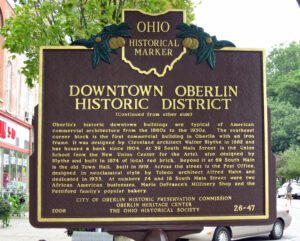
The intersection of Main and College streets has been the center of Oberlin since the town and college were founded in 1833. The first downtown buildings were made of wood and were destroyed by a series of spectacular fires. The first college building, Oberlin Hall, stood on the southwest corner of College and Main and included recitation rooms, a dining hall, chapel, offices, and lodging. In 1887, Akron architect Frank Weary designed the large brick building at numbers 5 to 13 West College. Number 23 West College (Gibson Block) once housed a silent movie theater on the second floor. East College Street’s historic buildings include the Apollo Theater, which showed Oberlin’s first talking movie on May 11, 1928. From 1897 to 1929, an interurban streetcar line connected Oberlin’s downtown to Cleveland. Oberlin’s downtown historic district was placed on the National Register of Historic Places in 2003.