

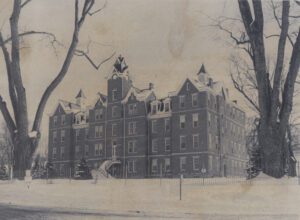
, OH
The surrounding 132 acres of land served as the Knox County Poor Farm (aka Knox County Infirmary and County Home) from 1842 to 1955. The farm was nearly self-sustaining. Able residents grew their own food, raised livestock, and did various chores as partial compensation for their care. In 1874, a fire in the original wood farmhouse resulted in one death. Public outrage and concerns for residents’ safety compelled the county commissioners to build a new “fireproof” poorhouse. The four-story brick building was constructed from 1875-1877. It is believed to be the last building designed by architect William Tinsley, utilizing a version of the Kirkbride Plan. This plan, conceived by Dr. Thomas Story Kirkbride, improved the layout of institutions and infirmaries for the well-being of their charges. (Continued on other side)
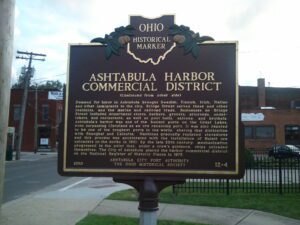
, OH
When the Pittsburgh, Youngstown and Ashtabula Railroad was finished in 1873, Ashtabula’s harbor became a direct route to ship iron ore to the booming steel mills of Youngstown and Pittsburgh. On the west side of the Ashtabula River, a brush-filled gulley became Bridge Street. New buildings and bridges attest to the harbor’s importance as a commercial and shipping hub from the late 19th through mid 20th centuries. Fires destroyed wood-frame buildings on the block closest to the river. A fire in 1886 nearly cleared the north side of Bridge Street. Another fire swept over the south side in 1900. Fire resistant brick buildings replaced frame structures and over the course of rebuilding, the level of the street rose approximately eight feet. In 1889, a swing-span bridge replaced the original pontoon bridge over the river. A bascule lift (draw) bridge replaced the swing bridge in 1925.
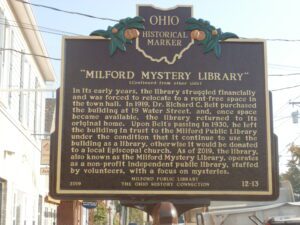
, OH
The Milford Public Library, Clermont County’s oldest continuously operating library, was founded in 1900 by a local civic organization, the Milford Village Improvement Society. It was preceded by a circulating library–one that charges patrons for renting books–that was chartered in 1822. At the time of the Milford Public Library’s founding, circulating libraries were in decline and public libraries were increasing in number as an inexpensive alternative. To obtain support for their proposed “reading room,” the Society’s Literary Committee travelled door-to-door, soliciting members and books. To become a member of the library, adults paid 25 cents and children paid 10 cents in annual dues. The library’s first–and current–home is the stone building at 19 Water Street. (Continued on other side)
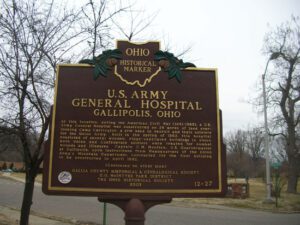
, OH
At this location, during the American Civil War (1861-1865), a U.S. Army General Hospital was constructed on 29 acres of land overlooking Camp Carrington, a site used to recruit and train soldiers for the Union Army. Built in the spring of 1862, this hospital consisted of several wooden, ridge-ventilated buildings in which both Union and Confederate soldiers were treated for combat wounds and illnesses. Captain C.M. Moulton, U.S. Quartermaster at Gallipolis, upon instructions from Headquarters of the Union Army’s Mountain Department, contracted for the first building to be constructed in April 1862. (continued on other side)
, OH
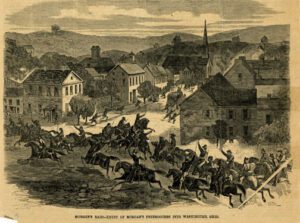
As Morgan’s Raiders rode eastward across southern Ohio during the third week of July 1863, the scattered defensive forces pursuing him consolidated and drew closer. Four regiments under Brigadier General Eliakim P. Scammon (including the 23rd Ohio, containing future U.S. Presidents Rutherford B. Hayes and William McKinley Jr.) arrived here by steamboat on July 18, preventing Morgan from entering Pomeroy. Brigadier General Henry Moses Judah’s division also arrived in Pomeroy on July 18, immediately marching east following Morgan. Following Morgan’s defeat at Buffington Island on July 19, both Judah and Brigadier General Edward H. Hobson returned to Pomeroy and headquartered at the Grand Dilcher Hotel. Of the approximately 900 Confederate prisoners captured in Meigs County, 227 were held here at the courthouse before being sent downriver to Cincinnati.
, OH
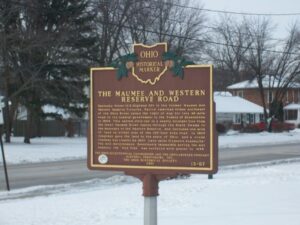
Sandusky Street (U.S. Highway 20) is the former Maumee and Western Reserve Turnpike. Native American tribes northwest of the Ohio River ceded the right of way for this 46-mile road to the federal government in the Treaty of Brownstown in 1808. This narrow strip ran in a nearly straight line from the lower Maumee River rapids through the Black Swamp to the boundary of the Western Reserve, and included one mile of land on either side of the 120-foot wide road. In 1823 Congress gave the land to the state of Ohio, and a crude roadway was cleared by 1827. Land sales financed roadbuilding and maintenance. Notoriously impassible during the wet seasons, the “Mud Pike” was surfaced with gravel in 1838.
, OH
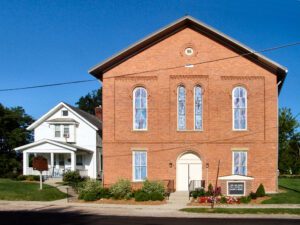
Organized in 1845, Zion African Methodist Episcopal Church is the oldest congregation of African descent in Delaware, with Reverend Daniel Winslow serving as the first minister. In 1853 the cornerstone of the first church was laid, which was dedicated in 1855. Three former Pastors of Zion became Bishops in the AME Church–James A. Shorter, 1868; John Mifflin Brown, 1868; and Cornelius T. Shaffer, 1900. In 1876 the existing church was razed and carpenter, brick mason, and plaster church members built the present edifice. A fire destroyed the interior on December 19, 1983, and for two years the congregation met in the recreation building of the Londontown Apartments, undercroft of the William Street Methodist Church, and sanctuary of the Victory Seventh Day Adventist Church. On the first Sunday in October 1985, Presiding Elder Virgil Cummins, Pastor Rodney Thomas, and the congregation marched from the Adventist Church back into the restored sanctuary.
, OH
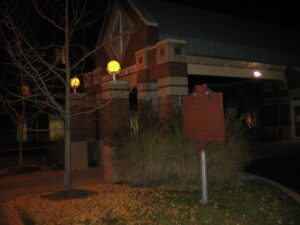
A group of concerned Cincinnati women organized, in 1855, The Protestant Home for the Friendless and Female Guardian Society as a private, not-for-profit maternity home for destitute women and children. These public minded social leaders were aware that Cincinnati had grown beyond the time when the poor or unfortunate were cared for by their neighbors. The Home, which was funded through bequests and personal donations, was founded to care for poor mothers and babies, unmarried pregnant women, wanderers and strangers in the city, and to promote adoptions. (Continued on other side)