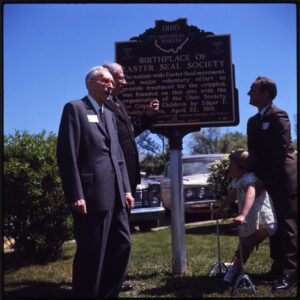
The nation-wide Easter Seal movement, first major voluntary effort to provide treatment for the crippled, was founded on this site with the organization of the Ohio Society for Crippled Children by Edgar F. (Daddy) Allen, April 22, 1919.
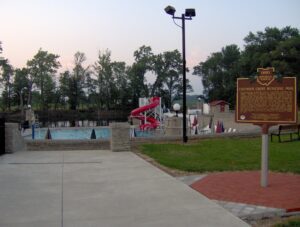
The construction of Putnam County’s first public swimming pool helped Columbus Grove weather the Great Depression of the 1930s. President Franklin D. Roosevelt’s Works Progress Administration (WPA) and the Village of Columbus Grove planned the pool to provide much-needed jobs and recreational facilities for the residents of Putnam County. Between the fall of 1935 and 1936, local men (and two women) built the pool and shelter house by hand from rock quarried on site. The workers were not trained stone masons or cutters. Befitting their limited skills, the pool was built in a simplified Norman Revival/Rustic architectural style. Wages ranged from $.33 to $.55 per hour. The pool’s grand opening was July 1, 1937. That first year, adults paid $.25 to swim, and children were charged $.10. The Columbus Grove Municipal Pool was listed on the National Register of Historic Places in 1997.
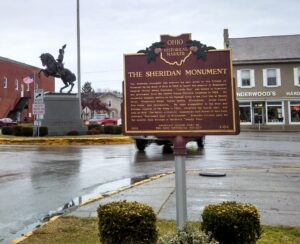
The Sheridan monument was erected by and given to the Village of Somerset by the State of Ohio in 1905 to honor the memory of Somerset’s General Phillip Henry Sheridan. “Little Phil” was raised in Somerset and graduated from the United States Military Academy in 1852. He rendered valuable service to the Federal Army in the Civil War at Stone’s River, Missionary Ridge, Yellow Tavern, Winchester, Cedar Creek, Five Forks, and Appomattox. He later commanded in the West and became General of the Army in 1883, received his fourth star, and died in 1888. The heroic sculpture, created by Carl Heber of New York, portrays “Sheridan’s Ride” to Winchester. Somerset citizens paid for the granite base through a children’s “penny fund.”
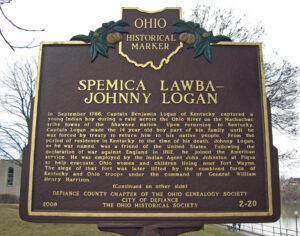
In September 1786, Captain Benjamin Logan of Kentucky captured a young Indian boy during a raid across the Ohio River on the Machachac tribe towns of the Shawnee nation. Upon returning to Kentucky, Captain Logan made the 14 year old boy part of his family until he was forced by treaty to return him to his native people. From the period of residence in Kentucky to the time of his death, Johnny Logan, as he was named, was a friend of the United States. Following the declaration of war against England in 1812, he joined the American service. He was employed by the Indian Agent John Johnston at Piqua to help evacuate Ohio women and children living near Fort Wayne. The siege of that fort was later lifted by the combined force of Kentucky and Ohio troops under the command of General William Henry Harrison. [continued on other side]
On Allen Street between Lower and Upper Market Streets
Lebanon
, OH
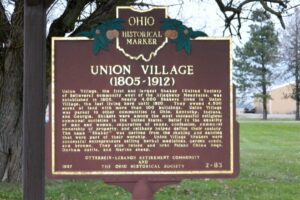
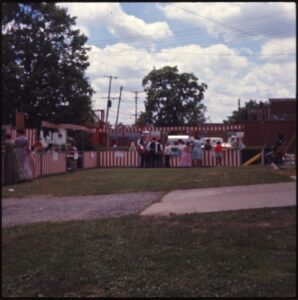
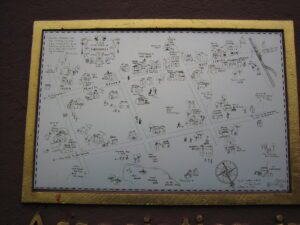
Union Village, the first and largest Shaker (United Society of Believers) community west of the Allegheny Mountains, was established in 1805. Nearly 4,000 Shakers lived in Union Village, the last living here until 1920. They owned 4,500 acres of land with more than 100 buildings. Union Village was parent to other communities in Ohio, Kentucky, Indiana, and Georgia. Shakers were among the most successful religious communal societies in the United States. Believe in equality of men and women, separation of sexes, confession, communal ownership of property, and celibacy helped define their society. The name “Shaker” was derived from the shaking and dancing that were part of their worship. Union Village Shakers were successful entrepreneurs selling herbal medicines, garden seeds, and brooms. They also raised and bred Poland China hogs, Durham cattle, and Merino sheep.
The West Liberty area, in the Mad River Valley, was the location of at least seven Shawnee Indian villages. This elevated site was the location of one of those villages. Several septs or divisions of the Shawnee nation lived in this area after being forced from their homes in southern Ohio. In 1786, together with Simon Kenton, Colonel Benjamin Logan’s army destroyed all the Shawnee villages in retaliation for the Indian raids in southern Ohio and Kentucky. Consequently, the remaining Shawnees moved to northwest Ohio near the present-day site of Maumee.
Acclaimed author and illustrator of juvenile literature Lois Lenski was born in Springfield in 1893, grew up in Anna, and graduated from Sidney High School. In 1915, Lenski graduated from The Ohio State University and moved to New York City to work and study art. After illustrating several children’s books in the early 1920s, she began writing and illustrating her own stories. Lenski specialized in historical fiction and regional themes–eventually publishing nearly one hundred carefully-researched books.
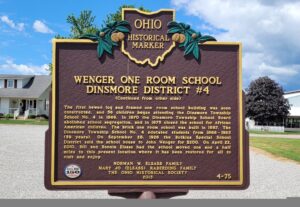
Dinsmore Township School District #4 was formed in 1865following a decision by the township’s board of education that a school would be built in the center of every four sections of land, or every four square miles. This placement of school buildings gave township children the opportunity to attend school close to home and the chance at receiving a public education up to the eighth grade, Nine districts were created for the children of white households, and an additional district was formed to educate the children of the African American families, for a total of ten districts in the township. On June 11, 1866, the Dinsmore Township School Board purchased land from George Wenger to build the District #4 school near the intersection of Ohio Route 274 and Wenger Road. (Continued on other side)