Florence E. Allen (1884-1966) was nicknamed “first lady of the law” for her many firsts as a woman in the legal profession. After graduating from Western Reserve College for Women, she taught at Laurel School from 1906 to 1909. She then became a crusader for women’s rights, and in 1913 received a law degree from New York University. Allen was appointed as an assistant Cuyahoga County prosecutor in 1919, the first woman in the country to hold such a position. In 1920, she was elected to Cleveland’s Court of Common Pleas, advancing, in 1922, to the Ohio Supreme Court, where she served two terms. In 1934, President Franklin D. Roosevelt appointed Allen to the nation’s second highest tribunal, the United States Sixth Circuit Court of Appeals, where she became its first female member. In 1958, she was elevated to Chief Justice of that body and retired in 1965.
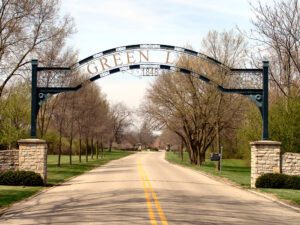
Landscape architect Howard Daniels designed the original portion of Green Lawn Cemetery in 1848. Noted Columbus architect Frank Packard designed Green Lawn’s Chapel mausoleum, the Hayden family mausoleum, and the Packard mausoleum. Spanning over 360 acres, the cemetery’s wooded setting provides a habitat for a variety of birds and other wildlife. The Chapel contains stunning stained glass windows and mosaic artwork by Tiffany & Company of New York. The monuments, obelisks, and memorials throughout the cemetery represent a wealth of artwork and a history of Columbus. As one of the oldest and largest cemeteries in Ohio, Green Lawn is the resting-place of many noted individuals who have made significant contributions to Columbus, Franklin County and the nation.
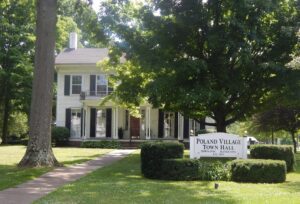
The Village of Poland officially incorporated in August 1866, a year after the end of the Civil War. In April 1867, the citizens elected John Leslie as mayor. As of 1880, Poland’s population exceeded 400. Through its history, the village has consisted of a four-acre village green, churches, schools, hotels, a sawmill, gristmill, post office, tannery, and foundry, as well as carriage, tin, and cabinet shops; drug, dry goods, and hardware stores, and doctors, blacksmiths, and shoemakers. Residents swam in and skated on Yellow Creek. The Poland Municipal Forest was established in 1938 and annexed later as the Village continued to grow. In 1966, the residents held a three day Centennial Celebration, featuring an address by Governor James Rhodes. The centennial year also saw the publication of a history of Poland and the restoration of Centennial Gardens.
Dr. Jacob Rader Marcus (1896-1995), pioneering historian of the American Jew, founded the American Jewish Archives (AJA) in Cincinnati in 1947. In the aftermath of World War II and the brutal destruction of European Jewry, Marcus anticipated the need to establish a central repository dedicated to preserving the history of North American Jewry. The AJA, which began with a few boxes of documents, has become one of the world’s largest catalogued collections of primary source material on the history of American Jewry. An international community of scholars, researchers, and students utilizes the AJA’s vast archival holdings.
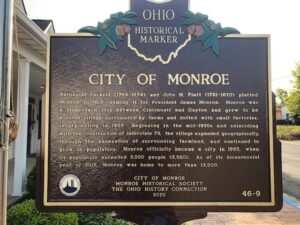
Nathanial Sackett (1768-1854) and John H. Piatt (1781-1820) platted Monroe in 1817, naming it for President James Monroe. Monroe was a stagecoach stop between Cincinnati and Dayton and grew to be a rural village surrounded by farms and dotted with small factories, incorporating in 1907. Beginning in the mid-1950s and coinciding with the construction of Interstate 75, the village expanded geographically, through the annexation of surrounding farmland, and continued to grow in population. Monroe officially became a city in 1995, when its population exceeded 5,000 people (5,380). As of its bicentennial year of 2017, Monroe was home to more than 13,000.
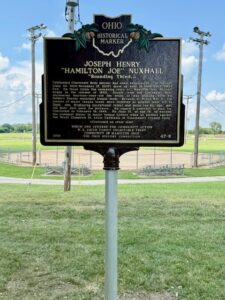
Celebrated Cincinnati Reds pitcher and radio broadcaster, Joe Nuxhall (July 30, 1928 – November 15, 2007) grew up here in Hamilton’s North End. On these fields the endearing story of “Hamilton Joe” Nuxhall began in the summer of 1943. Scouts from the Cincinnati Reds discovered fourteen-year-old Joe while he was playing with his father’s Sunday municipal league team. Because of World War II, the rosters of major league teams were depleted as players went off to fight. Joe, displaying exceptional talent and poise for his age, met the Reds’ dire need for pitchers. He signed a contract to play for Cincinnati on February 18, 1944. On June 10, at age 15, he became the youngest player in major league history when he pitched against the World Champion St. Louis Cardinals at Cincinnati’s Crosley Field. (Continued on other side)
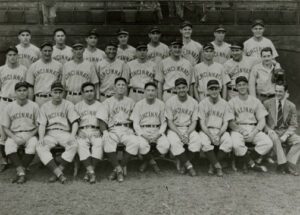
The 1869 Cincinnati Red Stockings made history not only as the most dominant baseball club of its time, but also as the first band of professional ballplayers. Cincinnati’s decision to pay players proved to be a success, and other cities soon began establishing their own professional clubs throughout America. In 1876, the Reds joined the newly formed National League. Baseball soon became one of Cincinnati’s most popular entertainment venues, aided in part by the team’s World Series titles in 1919 and 1940. Cincinnati’s “Big Red Machine,” featuring players such as Johnny Bench, Joe Morgan, and Pete Rose, dominated baseball in the 1970s, picking up additional titles in 1975 and 1976. A surprise wire-to-wire title again in 1990 strengthened the Reds’ legacy and helped ensure future generations of Reds fans.
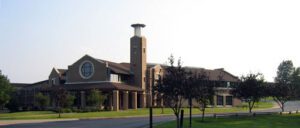
The first women’s college chartered in the state of Ohio, Ursuline College opened in 1871 in downtown Cleveland as part of the educational mission of the Order of St. Ursula (O.S.U.). Founded in Italy in 1535 with an early presence in North America, this order established its first religious teaching community in Cleveland in 1850, led by foundress Mother Mary of the Annunciation Beaumont, O.S.U. The college’s growth prompted four moves in Cleveland and subsequently to the Pepper Pike campus in 1966. Ursuline holds the distinction as one of the first catholic women’s colleges in the United States organized and chartered explicitly for college education.