John “Appleseed” Chapman (b. September 26, 1774—d. March 18, 1845) was the first lessee of this 160 acre tract (NW 1/4, S 20, T 20, R 16), when he secured it for 99 years from the Virginia Military District School Lands on April 10, 1815. This $320 lease complied with the Ordinance of 1785 which stipulated that proceeds from the sale or lease of a 36th of all new land in the Northwest Territory be used to support public education. Perrysville author, Rosella Rice, knew Appleseed. In a history of Ashland County, she wrote, “One of his nurseries is near us and I often go to the secluded spot on the quiet banks of the creek [Blackfork]…with sod never broken since the old man did it.” Attributed as Green Township’s first permanent settler, Abram Baughman’s original 160 acres (c. 1807) adjoined this property to the west.
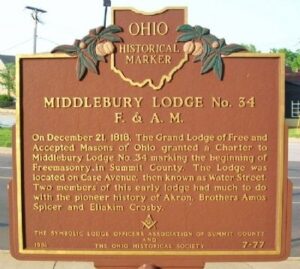
On December 21, 1818, The Grand Lodge of Free and Accepted Masons of Ohio granted a Charter to Middlebury Lodge No. 34 marking the beginning of Freemasonry in Summit County. The Lodge was located on Case Avenue, then known as Water Street. Two members of this early lodge had much to do with the pioneer history of Akron, Brothers Amos Spicer and Eliakim Crosby. [Masonic Emblem]
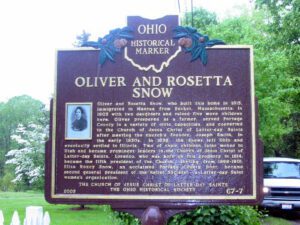
Oliver and Rosetta Snow, who built this home in 1815, immigrated to Mantua from Becket, Massachusetts, in 1805 with two daughters and raised five more children here. Oliver prospered as a farmer, served Portage County in a variety of civic capacities, and converted to the Church of Jesus Christ of Latter-day Saints after meeting the church’s founder, Joseph Smith, in the early 1830s. In 1838, the Snows left Ohio and eventually settled in Illinois. Two of their children later moved to Utah and became prominent leaders in the Church of Jesus Christ of Latter-day Saints. Lorenzo, who was born on this property in 1814, became the fifth president of the Church, serving from 1898-1901. Eliza Roxcy Snow, an acclaimed Portage County poet, became second general president of the Relief Society, a Latter-day Saint women’s organization.
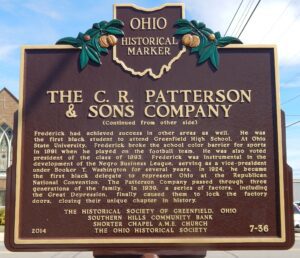
The factory of the C. R. Patterson & Sons Company once stood near here at 138 N. Washington Street. Established in the mid-nineteenth century by the black businessman Charles Richard (C. R.) Patterson and his white partner, J. P. Lowe, the business, originally known as J. P. Lowe & Company, became a successful carriage firm. Patterson became the sole owner in 1893 and changed the name to C. R. Patterson & Sons. After succeeding his father as owner, C. R.’s son, Frederick, became the first known African-American automobile manufacturer. Under his leadership, the company transitioned from building carriages to automobiles, then to trucks and buses to keep up with the changing demands of the transportation industry. (Continued on other side)
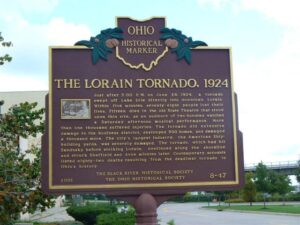
Just after 5:00 P.M on June 28, 1924, a tornado swept off Lake Erie directly into downtown Lorain. Within five minutes, seventy-eight people lost their lives. Fifteen died in the old State Theatre that stood upon this site, as an audience of two hundred watched a Saturday afternoon musical performance. More than one thousand suffered injuries. The tornado did extensive damage to the business district, destroyed 500 homes, and damaged a thousand more. The city’s largest industry, the American Shipbuilding yards, was severely damaged. The tornado, which had hit Sandusky before striking Lorain, continued along the shoreline and struck Sheffield and Avon minutes later. Contemporary accounts listed eighty-two deaths resulting from the deadliest tornado in Ohio’s history.
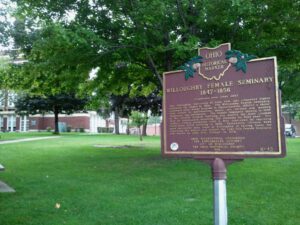
The village of Chagrin, founded in 1798, changed its name in 1834 to honor Dr. Westel Willoughby, a pioneer medical educator. That same year, the Willoughby University of Lake Erie was chartered, and the Willoughby Medical College opened its doors, signaling the beginning of medical education in northern Ohio. The Medical College trained 160 doctors, educated in contemporary methods of medicine, anatomy, chemistry, and surgery. Financial struggles and public outcry against grave-robbing — which supplied cadavers for anatomy classes — hampered the college’s development. The movement of faculty to Cleveland and the transfer of the state charter to Columbus hastened the demise of the Medical College in 1847, and laid the foundation for the establishment of the medical schools of Case Western and Ohio State universities. (Continued on side two)
The Wyandot called the Grand Reserve home nearly a century before Ohio statehood. They built houses, cultivated the land, and grew bountiful groves of fruit trees. They governed from the nearby Wyandot Council House and operated a productive saw and grist mill. Many sent their children to school and worshiped at the limestone church, built in 1824, and recognized as the first Methodist mission in the country. But Ohioans set their sights on Wyandot lands in the fertile Sandusky River Valley. State and federal governments were unwilling to allow the Wyandot to remain on their chosen homelands, despite their participation in American society and friendly relations with neighboring settlers. Following the Indian Removal Act of 1830, the Wyandot were the last tribe removed from the State of Ohio in 1843.
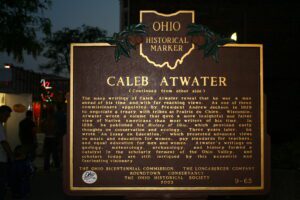
Born in North Adams, Massachusetts on December 23, 1778, Caleb Atwater graduated from Williams College in 1804. He moved to Circleville in about 1814 where he organized the city’s first school board and served as postmaster and prosecuting attorney. His life and work as a teacher, minister, lawyer, legislator, and scholar greatly influenced early 19th-century Ohio. Upon arriving in Circleville, he became interested in local history and the nearby earthworks and in 1820 published his book Descriptions of the Antiquities Discovered in the State of Ohio and Other Western States, the first compilation of prehistoric remains in the Ohio and Mississippi valleys. Elected to the Ohio State Legislature in 1821, Atwater fervently supported canal construction. He also chaired Ohio’s first board of school commissioners and was instrumental in passage of Ohio’s Public School Law. For this, he has been called the “Father of Ohio’s Common Schools.” (continued on other side)