

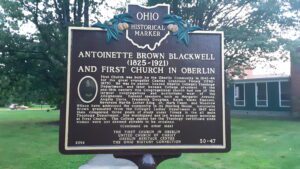
, OH
First Church was built by the Oberlin Community in 1842-44 for the great evangelist Charles Grandison Finney (1792-1875). He was its pastor, headed Oberlin College’s Theology Department, and later became College president. In the mid-19th century this Congregational church had one of the largest congregations and auditoriums west of the Alleghenies. Eminent speakers such as Margaret Atwood, Angela Davis, Frederick Douglass, Ralph Waldo Emerson, Reverend Martin Luther King, Jr., Mark Twain, and Woodrow Wilson have addressed the community in its Meeting House. Antoinette Brown graduated from the College’s Ladies’ Department in 1847 and then completed three years of study under Finney in the all male Theology Department. She worshipped and led women’s prayer meetings at First Church. The College denied her the Theology certificate since women were not deemed suitable to be ordained. (continued on other side)
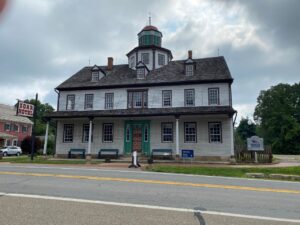
, OH
Zoar Separatists built the hotel in 1833 to accommodate overflow travelers from their original Ohio & Erie Canal inn. The hotel proved an economic boon to the Zoar community, but, by bringing the outside world into Zoar, ultimately became a source of discontent for members. During its heyday, the Zoar Hotel catered to curiosity-seekers, visiting artists, and families escaping the summer heat of nearby cities. Notable guests included Marcus Hanna and President William McKinley. The original structure was enlarged several times, including the now demolished 1892 Queen Anne addition which doubled the accommodations. By the mid-twentieth century, the hotel remained open as a popular restaurant with Rathskeller bar until closing to the public in July 1983. The exterior was restored by the Ohio History Connection in 2001-2002.
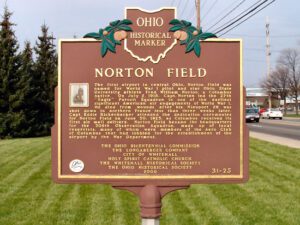
, OH
The first airport in central Ohio, Norton Field was named for World War I pilot and star Ohio State University athlete Fred William Norton, a Columbus native. On July 2, 1918, Capt. Norton led the 27th “Eagle” Pursuit Squadron in one of the earliest significant American air engagements of World War I. He died from wounds after his Nieuport 28 was shot down in northern France less than three weeks later. Capt. Eddie Rickenbacker attended the dedication ceremonies for Norton Field on June 30, 1923, as Columbus received its first air mail delivery. Norton Field became the headquarters for the 308th Observation Squadron, made up of local reservists, many of whom were members of the Aero Club of Columbus that had lobbied for the establishment of the airport by the War Department.
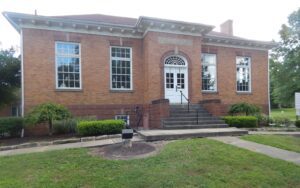
, OH
In 1912, an endowment of $6,000 from Andrew Carnegie made it possible for the Bristol Public Library to become a reality. Four years earlier, the newly organized Bristol Library Association, headed and promoted by retired Judge Norman A. Gilbert, had established a subscription book service at the Congregational Church in Bristolville with books loaned from the state library. The Bristol Board of Education appointed a six-member Library Board of Trustees and a one mill levy provided financial support. Charles C. Thayer and Son designed the building in accordance with Carnegie’s recommendations and the local trustees’ suggestions. With Judge Gilbert’s unexpected death in November 1911, Board Secretary Dr. Edward Brinkerhoff was elected president to complete the vision of Judge N. A. and Mrs. Anna Gilbert for the library. (Continued on other side)
, OH
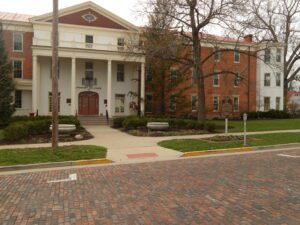
Chartered in 1849, the Institute was the first of three women’s colleges established in Oxford. The original brick building was completed in 1850, and forms the core structure. The Reverend John Witherspoon Scott, a member of Miami University’s early faculty, headed the Institute. In 1867, the Institute merged with Oxford Female College and later became the Oxford College for Women. Miami University acquired the building in 1928; in 1930 the Daughters of the American Revolution rededicated it as the “Caroline Scott Harrison Memorial.” From 1929-1998 it served as a Miami dormitory, nicknamed “Ox College.” Since 2003, the three-story building has housed the Oxford Community Arts Center. The structure is the oldest extant women’s college building in Ohio. It was placed on the National Register of Historic Places in 1976.
, OH
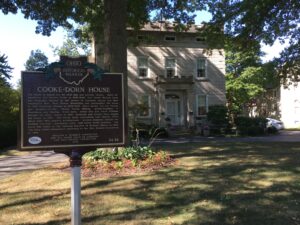
Eleutheros Cooke. The Cooke-Dorn house was the last home of attorney Eleutheros Cooke (1787-1864) who served four years in the Ohio legislature and one term in the 22nd Congress of the United States. An early proponent of railroads, Cooke received one of the first charters granted to a railroad west of the Alleghany Mountains, for the Mad River & Lake Erie line. He and wife Martha had six children, four of whom lived to adulthood. Two rose to prominence in the Civil War era. Jay was a successful banker and became known as the “financier of the Civil War” for his efforts to secure loans from Northern banks to support the Union’s war effort. Henry was appointed as the first governor of the short-lived Territory of the District of Columbia in 1871 (which was replaced in 1874).
, OH
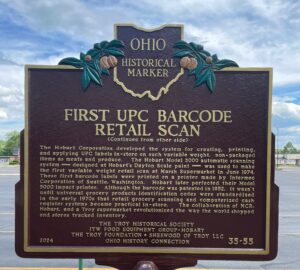
On June 26, 1974, the first retail scan of a product marked with a Universal Product Code (UPC or barcode) was made in the checkout line of Troy’s Marsh Supermarket located at 982 N. Market Street. A ten-pack of Wrigley’s Juicy Fruit chewing gum was scanned to simulate the purchase of a product. The barcode was scanned on the NCR 255 computerized check-out system developed by National Cash Register (NCR). The system featured a Spectra Physics Model A scanner and an NCR 726 in-store computerized cash register. The Troy grocery store, considered a “typical” American grocery, was conveniently located near NCR and Hobart facilities. Spectra Physics and NCR later donated one of the original scanners and cash registers used at Marsh’s to the National Museum of American History, Smithsonian. (Continued on other side)
, OH
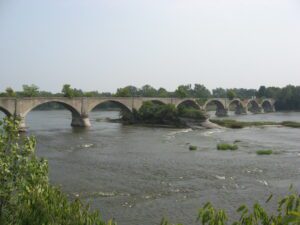
The Lima and Toledo Traction Company Bridge was construted in 1907 by the National Bridge Company of Indianapolis, and it was considered to be a revolutionary type of bridge construction. The Old Electric Bridge, as it was called, was built of steel reinforced concrete and filled with earth. In fact, for this period some considered the bridge to be the longest such railroad bridge in the world. Twelve spans of Roman aqueduct architectural design anchor the 1220-foot bridge in solid river bedrock. The bridge linked Lucas and Wood counties and connected a busy Toledo with points south by means of an electric trolley. This Interurban Bridge was placed on the National Register of Historic Places in 1972.