In 1798, Articles of Confederation Congress provided land to British Canadians who lost property because of loyalty to American revolutionaries during the American War of Independence (1775-1783). This land was part of the Refugee Tract and the present-day Truro Township. In 1850, Henry Stanbery, first Attorney General of Ohio, purchased a portion of this land. In 1923, Charles Johnson bought a section of this land and had it platted as the Eastmoor Addition by the Jennings-Lawrence Company with the polo field at the center. Eastmoor has houses ranging in age from the 1920s to the early 21st century, including Lustron homes built after WWII.
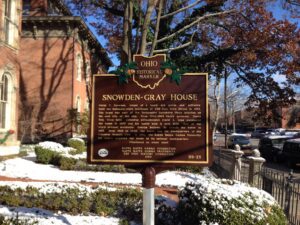
Philip T. Snowden, owner of a fancy dry goods and millinery, built the Italianate-style residence at 530 East Town Street in 1852. The house was part of the fashionable University Place addition on the east side of the city. From 1862-1864 Ohio’s governor, David Tod, lived here. Columbus philanthropist David S. Gray purchased the house in 1870 and his family held it until 1922. One of the city’s premier architects, George Bellows, Sr. rebuilt the house in 1872. From 1923 to 1940, the house was the headquarters of the Columbus Women’s Club. In 1951, the Kappa Kappa Gamma fraternity for women acquired the house as its national headquarters. (Continued on other side)
Dr. Jared Potter Kirtland was a prominent nineteenth century professor, physician, naturalist and horticulturist. In 1837, Kirtland purchased land in Rockport Township that stretched from Madison Avenue to Lake Erie. Kirtland used that land as a natural laboratory and filled it with gardens, greenhouses and an arboretum where he developed fruit and grape varieties best suited for the region. His success with new varieties inspired area farmers to successfully concentrate on fruit and grape growing. In 1839, he built a home at Detroit and Bunts Roads and lived there unitl his death in 1877. (Continued on other side)
Aminah Brenda Lynn Robinson (1940-2015) and her son Sydney moved into this home in 1974. The artist, a visual historian, lived and worked here in the Shepard community until her passing. Raised in Columbus’s Poindexter Village and educated in the local public schools, Robinson also studied at Columbus College of Art and Design and The Ohio State University. Her art reflected stories handed down from her elders, experienced within her community, and the local history she researched while working at the Columbus Metropolitan Library. She received a 2004 MacArthur Award for her celebration of “family, ancestry, and the grandeur of simple objects in drawings, paintings, and large-scale, mixed-media assemblages.” (Continued on the other side)
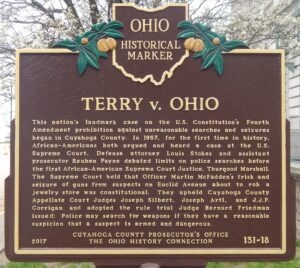
This nation’s landmark case on the U.S. Constitution’s Fourth Amendment prohibition against unreasonable searches and seizures began in Cuyahoga County. In 1967, for the first time in history, African-Americans both argued and heard a case at the U.S. Supreme Court. Defense attorney Louis Stokes and assistant prosecutor Reuben Payne debated limits on police searches before the first African-American Supreme Court Justice, Thurgood Marshall. The Supreme Court held that Officer Martin McFadden’s frisk and seizure of guns from suspects on Euclid Avenue about to rob a jewelry store was constitutional. They upheld Cuyahoga County Appellate Court Judges Joseph Silbert, Joseph Artl, and J.J.P. Corrigan and adopted the rule trial Judge Bernard Friedman issued: Police may search for weapons if they have a reasonable suspicion that a suspect is armed and dangerous.
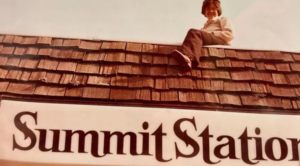
2210 Summit Street once housed one of Ohio’s longest-running lesbian bars. In 1970, a lesbian bartender at Jack’s A Go Go recognized that while Columbus had bars for gay men, it needed one geared toward lesbian clientele. Patrons knew the bar as “Jack’s,” Logan’s Off Broadway, and Summit Station. Staff welcomed women from small towns, women working in trades, women of color, butch/femme lesbians, and transgender people. Regulars recall that stepping through the door felt like finally entering a place of true belonging. Women could dance, “get together,” break up, sing karaoke, party with friends, and celebrate birthdays and holidays. Summit Station remained a safe public space, despite ongoing police harassment of its gender non-conforming regulars. A sign posted outside declared: “Ladies Night, Every Night. Men $5.” (Continued on other side)
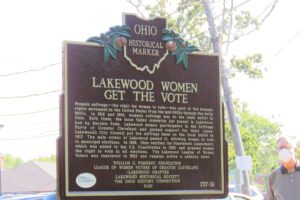
Women’s suffrage–the right for women to vote–was part of the women’s rights movement in the United States from the mid-1800s through the early 1900s. In 1912 and 1914, women’s suffrage was on the state ballot in Ohio. Both times, the issue failed statewide but passed in Lakewood. Led by Bernice Pyke, Lakewood women participated in the Suffrage Party of Greater Cleveland and gained support for their cause. Lakewood’s City Council put the suffrage issue on the local ballot in 1917. The male voters of Lakewood passed it, allowing women to vote in municipal elections. In 1919, Ohio ratified the Nineteenth Amendment, which was added to the U.S. Constitution in 1920 and granted women the right to vote in all elections. The Lakewood League of Women Voters was chartered in 1922 and remains active a century later.
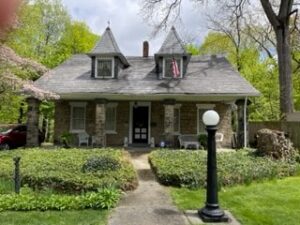
The Curtis-Preyer Stone House takes its name from two families associated with its early history. Richard and Clarissa Dille Curtis purchased 70 acres in the Connecticut Western Reserve from veteran Elias Lee in 1819. The Euclid Township “Turkey Knob” settlement soon thrived around Dugway Brook, springs sites, and an American Indian crossroads. The Curtis, Dille, Lee, and Stillman families, related by marriage, helped each other succeed by harnessing the creek to power their grist and saw mills and selling quarried stone and felled timber. Sometime between 1819 and 1835 Curtis built his stone house using the Berea sandstone quarried on site. The roof was created of ax-hewn “pegged” tree timbers, and the thick stone walls fashioned of uncoursed, chiseled stones. A central chimney fed seven fireplaces and a bake oven.