

, OH
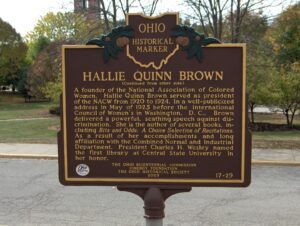
Hallie Quinn Brown (c. 1850) was born in Pittsburgh, Pennsylvania to former slaves. She and her family moved to Wilberforce, Ohio in 1870, where she received a Bachelor of Science degree from Wilberforce University in 1873. Brown taught school in the South until her appointment as professor of elocution at Wilberforce University in 1893. A gifted elocutionist and author, Brown received national and international acclaim not only for her recitals and written works, but also for her passionate belief in civil rights and African American culture. (Continued on other side)
, OH
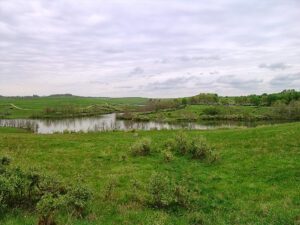
Near this location stood the settlement of African American families known as “The Lett Settlement.” The Lett Settlement was a self-sustaining community of mixed race families, including the Caliman, Guy, and Lett families. The families had formed ties through marriage and common background during the mid-1700s in Virginia and Maryland. These early African American pioneer families came to Ohio as “free people of color,” and began acquiring land in Meigs Township, Muskingum County, and surrounding townships in adjacent counties during the 1820s. They were soon joined by the Brown, Clifford, Earley, Simpson, Tate, and Pointer families. The families of the Lett Settlement were land owners and tax payers in Ohio before the Civil War and challenged the State of Ohio for the right to vote and for access to education during the 1840s, 1850s, and 1860s. (Continued on other side)
, OH
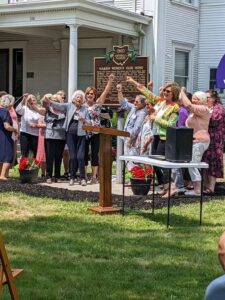
Marion civic leaders Shauck Elah Barlow and Ida Harsh Barlow built “Waldheim,” their Colonial Revival residence, between 1903-1905. Ida Barlow, then president of the Marion Women’s Club, hosted a December 1905 meeting in her new home. Members discussed art, music, literature, and ideas for “civic improvement.” In 1909, this and other Marion clubs reorganized as the Marion County Federation of Women’s Clubs. Federation members soon organized into action: providing college loans to young women; sponsoring visiting city and later school nurses; purchasing trash receptacles; providing dental clinics for low-income residents; and funding railroad crossing safety equipment. Upon her death in 1945, Barlow bequeathed her house to the Federation as the “Women’s Club Home.” The new Federation headquarters offered meeting space for the Executive Board and the many associated clubs. (Continued on other side)
, OH
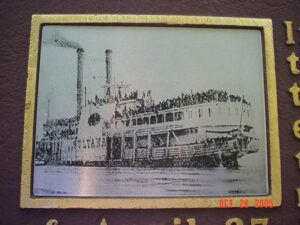
In 1862, less than a mile upriver from this marker, the John Lithoberry Shipyard in Cincinnati constructed the Sultana, a 260-foot, wooden steam transport. At the end of the Civil War, the U.S. Government contracted the Sultana to transport recently freed Federal prisoners north from Confederate stockades. During the night of April 27, 1865, while carrying over 2,300 Union soldiers – over six times its capacity of 376 passengers – a steam boiler aboard the Sultana exploded. The ship erupted in a massive fireball and sank in the cold, flood-swollen Mississippi River ten miles north of Memphis, Tennessee. Over 1,700 individuals died – some 200 more than those lost aboard the Titanic in 1912 – in what remains the worst maritime disaster in American history. Of the total casualties, Ohio lost the most of any state, with 791 dead. Indiana lost 491 persons, with Kentucky suffering 194 dead. It is estimated that, of the Ohio casualties, over fifty were Cincinnatians.

, OH
In April 1784, the Continental Congress adopted the Report of Government for the Western Territory, a broad plan drafted primarily by Thomas Jefferson for organizing the United States’ new western lands that were ceded by the states and purchased from Native Americans. One of the most far-reaching legislative acts in American history, the resulting Land Ordinance of 1785, passed on May 20th, established the public land system by which all federal land was surveyed and distributed. The Ordinance established a rectilinear survey system that divided land into townships of six miles square aligned by north-south and east-west baselines, and set aside certain lands for Revolutionary War veterans and for public schools.
, OH
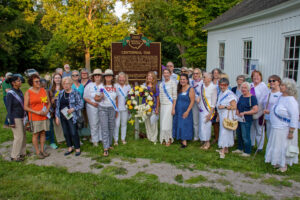
The Newbury Woman Suffrage Political Club, headquartered at Union Chapel, planted the Centennial Oak on July 4, 1876. The White Oak (Quercus alba) was chosen for its endurance, longevity, and beauty. The picnic and planting celebration included speeches, songs, fireworks, and a poem dedicated to the Oak written by local suffragist Anna Green. As the club gained national recognition, it attracted such notable suffragists as Susan B. Anthony and Harriet Taylor Upton as visitors and speakers. A Newbury gathering on August 23, 1919, held to celebrate Ohio’s recent ratification of the 19th Amendment, included suffragists Upton and Frances Jennings Casement. The last living founding member of Newbury’s Woman Suffrage Club, Dr. Julia Porter Green, led a parade from the chapel to Centennial Oak. There she placed a wreath of evergreen and goldenglow upon the tree.
, OH
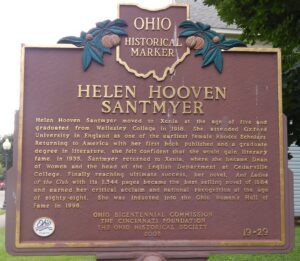
Helen Hooven Santmyer moved to Xenia at the age of five and graduated from Wellesley College in 1918. She attended Oxford University in England as one of the earliest female Rhodes Scholars. Returning to America with her first book published and a graduate degree in literature, she felt confident that she would gain literary fame. In 1935, Santmyer returned to Xenia, where she became Dean of Women and the head of the English Department at Cedarville College. Finally reaching ultimate success, her novel, And Ladies of the Club with its 1,344 pages became the best selling novel of 1984 and earned her critical acclaim and national recognition at the age of eighty-eight. She was inducted into the Ohio Women’s Hall of Fame in 1996.
, OH
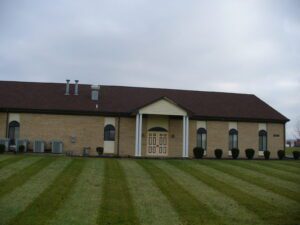
The Jain Center of Cincinnati and Dayton was established on April 22, 1979 as a non-profit tax-exempt organization under the laws of the United States and the State of Ohio. The foundation stone of the Jain temple, the first of its kind in Ohio, was laid down on August 21-22, 1994. The temple was dedicated on September 2 – 4, 1995 when more than one thousand people from all over Ohio and many other states participated in holy rituals to install three idols of Jinas (Gods). The Jain Center is a place for the teaching of non-violence, reverence for life, and compassion for all beings. The center was the home of the twelfth biennial convention for the Federation of Jain Associations in North America, which was held on July 3 – 6, 2003. (Continued on the other side)