

, OH
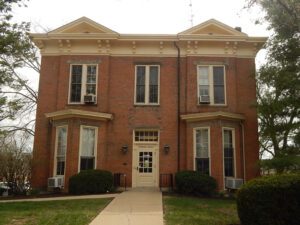
Built by “Old Miami” University President Robert L. Stanton, D.D. (1810-1885) as his private home and president’s office, Stanton’s 1868 Italianate house faced University Square, and welcomed students and guests. The house retains its original symmetrical façade, enclosed portal, grand staircase, double parlors, parlor doors, marbleized slate mantels, and triangular bay windows. Stanton served as president from 1866-1871. Stanton’s son, Robert Brewster Stanton, MU ’71, famed civil engineer, lived here as an undergraduate. His Miami mentor, mathematics professor Robert W. McFarland (1825-1910), purchased the house in 1873. McFarland rented it while distinguishing himself at Ohio State University during Miami’s twelve-year closure, and then resided here while first president of “New Miami” (1885-1888) and until his death. McFarland’s daughter Frances and her husband Llewellyn Bonham sold the home to Miami in 1940.
, OH
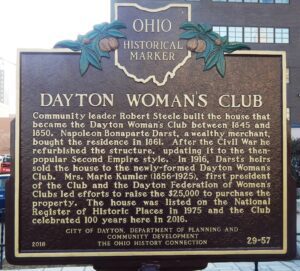
Dayton Woman’s Club. Community leader Robert Steele built the house that became the Dayton Woman’s Club between 1845 and 1850. Napoleon Bonaparte Darst, a wealthy merchant, bought the residence in 1861. After the Civil War he refurbished the structure, updating it to the then-popular Second Empire style. In 1916, Darst’s heirs sold the house to the newly-formed Dayton Woman’s Club. Mrs. Marie Kumler (1856-1925), first president of the Club and the Dayton Federation of Women’s Clubs led efforts to raise the $25,000 to purchase the property. The house was listed on the National Register of Historic Places in 1975 and the Club celebrated 100 years here in 2016.
, OH
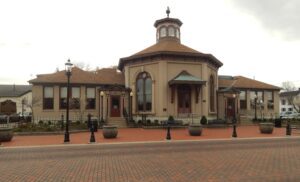
Clark Lane (1823-1907), industrialist and philanthropist, was a son of John Lane (1793-1880) and Rosanah Crum (1795-1877). John came with his family to the Ohio Country when it was still part of the Northwest Territory. As a young man, Clark worked in his family’s blacksmith shop, and eventually helped found Owens, Lane & Dyer Machine Company in 1854. It built agricultural machinery, sawmills, papermaking machines, and other products, initiating Hamilton’s prominence in metals manufacturing. Lane funded the Butler County Children’s Home, an orphanage for over a century, and constructed an octagon house as his residence on Third Street. He built this library in 1866, also as an octagon, and donated it to the people of Hamilton. A 19th century admirer wrote, “The name and generous deeds of Clark Lane will never fade from the memories of a grateful people who have been recipients of his favor.”
, OH
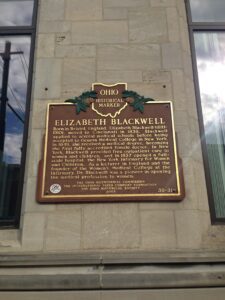
Born in Bristol, England, Elizabeth Blackwell (1821-1910), moved to Cincinnati in 1838. Blackwell applied to several medical schools before being accepted to Geneva Medical College in New York. In 1849, she received a medical degree, becoming the first fully accredited female doctor. In New York, Blackwell provided free outpatient care to women and children, and in 1857 opened a full-scale hospital, the New York Infirmary for Women and Children. As a lecturer in England and the founder of the Women’s Medical College at the Infirmary, Dr. Blackwell was a pioneer in opening the medical profession to women.
, OH
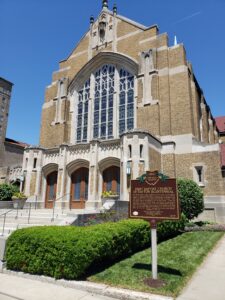
First Baptist Church of Dayton organized on May 29, 1824. A council met on the porch of William Huffman’s home at Third and Jefferson and approved 9 members as a congregation. The next day Lydia Huffman was baptized in the Great Miami River, the first recorded Baptist immersion in the city. Their first church building was erected in 1827 on Main Street. In 1829 the congregation suffered a Campbellite schism. Those resolved to remain Baptist incorporated on February 25, 1837, as The First Regular Baptist Church of Dayton, Ohio. The foundations for the Monument Avenue building were begun prior to the 1913 Dayton flood and the cornerstone was laid May 31, 1914. The building was completed, furnished, and ready for worship on June 26, 1915. (Continued on other side)
, OH
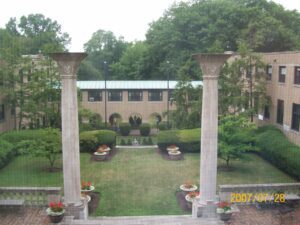
Elm Court, designed by Howard Van Doren Shaw of Illinois, was built in 1912 for Arthur Hudson Marks. The original mansion exemplifies the Italian Renaissance Revival style. Elm Court included the mansion, barn, stables, carriage house, pond, and a variety of trees, especially elms, on 33 acres. Arthur Marks was the inventive genius in chemistry and business who revolutionized the rubber industry in Akron. He was best known for inventing the alkaline-recovery vulcanization process in 1899, the cord tire, the chemical research laboratory system, and placing rubber research on a scientific basis. In World War I he served as director of chemical warfare services. Marks served as vice-president of B.F. Goodrich Company and Curtis Airplane and Engine Company and president of other rubber companies and the Aeolian Skinner Organ Company.
, OH
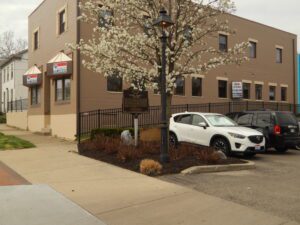
Raised and educated in St. Louis, author Fannie Hurst (1885-1968) was born in Hamilton at 918 Central Avenue, the home of her maternal grandparents. She was the daughter of Rose Koppel and Samuel Hurst. Already a writer as a student at Washington University (Class of 1909), Fannie moved to New York in 1910 to begin her career. Success came after repeated rejection. Stories for popular magazines brought her attention in the mid-1910s; by the mid-1920s she had become a best-selling, highly-regarded, and well-paid author. Between 1912 and 1964, Hurst wrote 18 novels, eight short story collections, and many other pieces. Hurst’s short story “Humoresque” (1919) and the novels Back Street (1931) and Imitation of Life (1933) were three of 32 films based on her writings. The film adaption of Imitation of Life received an Oscar nomination for Best Picture in 1934. (Continued on other side)
, OH
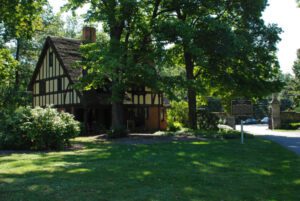
Completed in 1915, the Gate Lodge is one of several service buildings located at Stan Hywet Hall dedicated to the operations of the estate. Located at the front entrance gates, this two-story Tudor Revival structure was designed by the Seiberlings’ architect Charles S. Schneider. Originally, the Gate Lodge served as a residence for the estate’s superintendent. The first to fill this role was William Dennis who moved in with his family to the Gate Lodge after its completion and resided there until his death in 1923. Between 1923 and 1944, Fred, the eldest child of F.A. and Gertrude Seiberling, lived in the Gate Lodge with his wife Henrietta and their three children. In 1935, Henrietta brought here the two men who would formally found Alcoholics Anonymous, Bill Wilson of New York and Dr. Bob Smith of Akron.