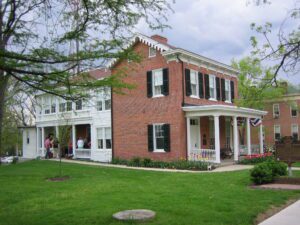
William Holmes McGuffey (1800-1873) was a Miami University faculty member in 1836 when he compiled the first edition of the McGuffey Eclectic Reader in this house. His Reader taught lessons in reading, spelling, and civic education by using memorable stories of honesty, hard work, thrift, personal respect, and moral and ethical standards alongside illustrative selections from literary works. The six-edition series increased in difficulty and was developed with the help of his brother Alexander Hamilton McGuffey. After the Civil War the Readers were the basic schoolbooks in thirty-seven states and by 1920 sold an estimated 122 million copies, reshaping American public school curriculum and becoming one of the nation’s most influential publications. (Continued on other side)
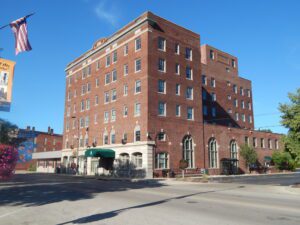
The Hotel Ashtabula was built in 1920 during an economic boom that lasted most of that decade. Architecturally, it represents a combination of Second Renaissance Revival and Georgian Revival styles. The H.L. Stevens and Company of Chicago and New York designed and built the hotel and others like it in Cleveland, Dayton, and Warren, Ohio and throughout the Midwest. The building included a ball room accommodating 300, a dining room that could seat 125, and club meeting and social rooms. A prominent structure of this downtown street, the Hotel Ashtabula was a hub for social activity. (Continued other side)
After embracing the cause of women’s suffrage, Harriet Taylor Upton (1854-1945) devoted her life to the movement. Born in Ravenna, she moved to Warren as a child and lived in this house beginning in 1873. Upton was treasurer of the National American Woman Suffrage Association from 1895 to 1910 and brought its headquarters to Warren in 1903, where it remained until 1910. She served as president of the Ohio Woman Suffrage Association for 18 years. As the first woman vice chair of the National Republican Executive Committee, Upton was instrumental in the passage of child labor laws and securing governmental appointments for women. Her devotion to women’s causes and skills as a public speaker earned her nationwide respect.
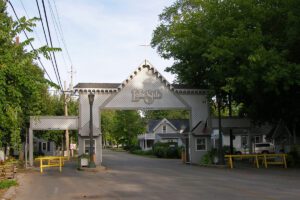
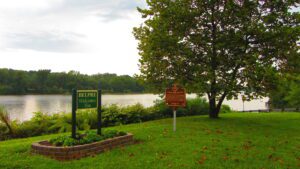
Established in 1873, Lakeside is a pioneer of the American Chautauqua Movement, one of the greatest revival movements in United States history which flourished in the late nineteenth and early twentieth centuries. Founded by the Methodist Church, Lakeside is one of the few existing Chautauqua communities that remain and thrive today. Each summer, the late-Victorian community provides spiritual, cultural, intellectual, and recreational programs designed to nurture the mind, body, and spirit. It draws visitors from across the country and around the world for its Chautauqua program. Lakeside is recognized on the National Register of Historic Places.
6750 Outville Road SW (take entrance road past the offices to township complex (more below)
Pataskala
, OH
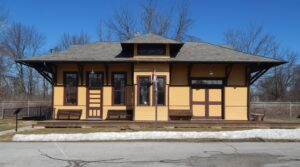
Arriving in 1853, the Central Ohio Railroad called this place “Kirkersville Station,” and it was later changed by stationmaster James Outcalt, who renamed the town Outville after himself. As rail traffic increased in Ohio, a successor company, the Baltimore and Ohio Railroad, built numerous rural depots, this one in 1899. After 1940, the depot was closed and then sold and moved from town in 1963. The Harrison Township Trustees arranged for the return of the depot to Outville in 1993. Today, it stands as the only one of its type remaining on this line, and one of only a handful of original railroad buildings extant between Columbus and Pittsburgh. It serves as a reminder of local railroad and transportation history. The Queen Anne, Stick/Eastlake architectural style depot was listed on the National Register of Historic Places in 1995.
Born in Massachusetts in 1805, Sala Bosworth spent all but nineteen years of his eighty-five years in Washington County. After studying at the Philadelphia Academy of Fine Arts, he returned to the county to paint many full size and miniature portraits of prominent Washington County citizens. His historical drawings were used in Samuel P. Hildreth’s Pioneer History. He is also known for his mural in what is now the Unitarian Universalist Church in Marietta. Bosworth moved to Cincinnati late in life and started to paint with watercolors. He died there in 1890. Charles Sullivan also studied at the Philadelphia Academy and became a fast friend of Bosworth after coming to Washington County in 1833. While he also painted portraits, he excelled in his landscapes, including views of Blennerhassett Island, the Blennerhassett mansion, and the mounds at Marietta. Sullivan died in Marietta in 1867.
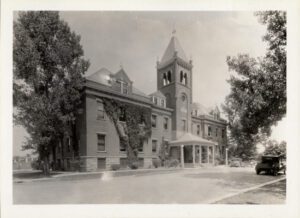
Central State University originated on March 19, 1887, when the Ohio General Assembly passed an act establishing a Combined Normal and Industrial (CN&I) Department at Wilberforce University. Through various transitional changes, it emerged as an independent, state university. In 1941, the General Assembly expanded the CN&I, which offered two-year courses, into the College of Education and Industrial Arts, with four-year programs. In 1947, it separated from Wilberforce University. The history of Central State University tells the history of higher education and advancement for African Americans in Ohio. It is within the walls of these structures, and others unfortunately demolished or destroyed by the 1974 tornado, that thousands of African Americans received valuable training for successful and rewarding careers. Thus, many of the contributions of African Americans to the promotion and betterment of education, medicine, law, social justice, technology, and the arts in Ohio have their roots here on the campus of Central State University.
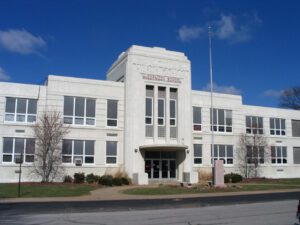
Ohio’s oldest continuing summer theatre, the Huron Playhouse has been housed at McCormick Middle School for its entire history. Dr. Frederick G. Walsh (1915-1999) of the Bowling Green State University (BGSU) Speech Department founded the theatre in 1949. Huron met Walsh’s expectations for an attractive site for the playhouse, and Huron Schools Superintendent R.L. McCormick (1904-1978) offered the use of this school. The curtain opened on the first Huron Playhouse production, Norman Krasna’s hit Broadway comedy John Loves Mary, on June 29, 1949. With persisting support from BGSU, actors and alumni, and the local community, the acclaimed Playhouse has provided theatrical experience for thousands of students and entertainment for generations of Huron residents.