

, OH
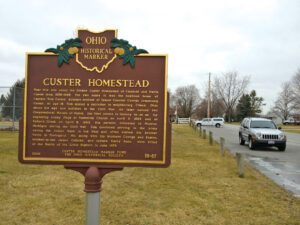
Near this site stood the former Custer Homestead of Emanuel and Maria Custer from 1856-1865. For two years it was the boyhood home of Captain Tom Custer, younger brother of famed General George Armstrong Custer. At age 16, Tom misled a recruiter in neighboring Gilead, Ohio about his age and enlisted in the Civil War. He later earned two Congressional Medals of Honor, the first person in history to do so, for capturing enemy flags at Namozine Church on April 3, 1865 and at Sailor’s Creek on April 6, 1865. His parents relocated to Monroe, Michigan during the Civil War. Tom continued serving in the Army during the Indian Wars in the West and often visited his brother Nevin in Tontogany. He, along with his brothers George and Boston, brother-in-law James Calhoun, and nephew Harry Reed, were killed at the Battle of the Little Bighorn in June 1876.
, OH
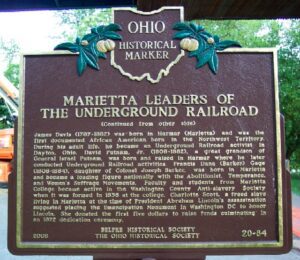
People living in Marietta and along the Muskingum River shared a history of slavery opposition. Manasseh Cutler, from Massachusetts and an Ohio Land Company agent, helped draft the Ordinance of 1787 that prohibited slavery in the Northwest Territory. General Rufus Putnam, Captain Jonathan Stone, and other Ohio Land Company Revolutionary War veterans, founded Marietta at the mouth of the Muskingum River in 1788 bringing with them their anti-slavery sentiments. A proposal to legalize slavery in the proposed state of Ohio was vetoed largely due to the efforts of Marietta’s Ephraim Cutler and General Putnam at the 1802 Ohio Constitutional Convention. These conditions were precursors toward the formation of the Underground Railroad as fugitive slaves crossed the Ohio River seeking freedom. From 1812 through 1861, large numbers of fugitive slaves fleeing toward Canada, were aided by descendants of early settlers who operated Underground Railroad Stations along the Muskingum River. (Continued on other side)
, OH
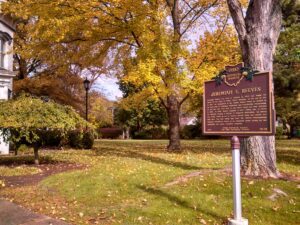
Jeremiah Reeves was born in England in 1845 and began his career in the mills of Wales, United Kingdom, at the age of ten. In 1867, he immigrated to the United States where he worked in the steel mills of Cleveland, Pittsburgh, and Connellsville, Pennsylvania. He met his wife Jane Rees in the latter place and they married in 1869. In 1883, Reeves acquired a steel rolling mill in Dover for $14,000. Despite a history of financial difficulties, the Reeves Iron Works would go on to expand several times and employ over 800 men. The iron works and later the Reeves Manufacturing Company established Dover as an industrial center during the late nineteenth and early twentieth centuries.
, OH
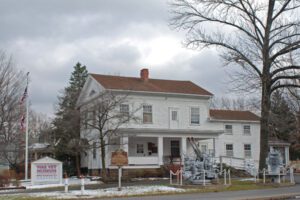
The Canfield War Vet Museum was chartered in 1988 by American Legion Post 177 and Ladies Auxiliary to collect and preserve items and history from American wars. The building that houses the museum was built in 1809 by Comfort S. Mygatt, a Revolutionary War veteran, and later, passed through several generations of the Church family. Colonel James Madison Nash, a Civil War officer, lived here for a time, giving the house its nickname, “The Colonel’s House.” The structure stands as the oldest building in Canfield on its original site. The carding barn on the rear of the property was built in 1810 to process sheep wool. The Wall of Honor at this site honors war veterans, in particular, the Revolutionary War veterans interred in Canfield cemeteries and the 18 Canfield men who lost their lives in World War II.
, OH
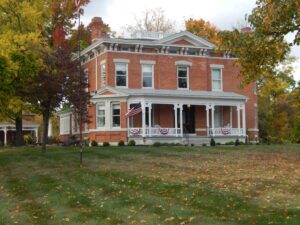
Built of bricks of clay from the Little Miami River, the King Mansion has stood majestically overlooking the town of Kings Mills since 1885. The home of industrialist Ahimaaz King and the first house in Kings Mills, this 12-room, three-story Italianate-style house is crowned with a widow’s walk and features stained-glass windows, distinctive fireplaces, and a tack room. The carriage house included a milking operation for cows on the lower level, stables on the main level, and carriage storage on the upper level. A cast iron fountain in the yard gave the name “Fountain Square” to the area. Occupied by three generations of Kings until 1988, the mansion was added to the National Register of Historic Places in 2008 and is a reminder of Ahimaaz King’s importance to the history of Kings Mills.
, OH
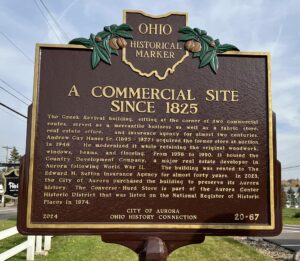
James Willard Converse (1806-1892) opened his store in 1825 at 10 South Chillicothe Road. Serving residents, merchants, and travelers, the store proved central to Aurora’s early commercial development. Converse’s Daybook survives as a glimpse into the habits of early citizens, who, along with household items, regularly purchased whiskey. Surprisingly, such sales surged on George Washington’s February 22 birthday. Converse deeded the business to employee Seth A. Gillett in 1834. Hopson Hurd Sr. (1793-1869) purchased it from Gillett in 1845. Hurd’s store was popular with local farmers who used their home made cheese as legal tender and enjoyed the barrel of whiskey kept in Hurd’s basement for customers who paid their bills. Hurd added a cheese warehouse to his store and, as a major exporter of cheese to Cleveland, Warren, and Pittsburgh, amassed a sizeable fortune.
, OH
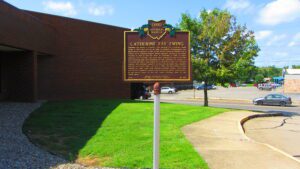
Frances Dana (Barker) Gage was born on October 12, 1808, in Marietta. She married James L. Gage in 1829 and they raised eight children, including four sons who served with Union forces during the Civil War. Throughout much of her life, Frances was deeply involved with the Temperance and Anti-Slavery movements and Women’s Rights issues. Presiding over the Women’s Rights Convention in Akron in 1851, she invited Sojourner Truth to give her famous “Ain’t I a Woman” speech. The Gage family moved in 1853 to St. Louis, the western extension of the Mason-Dixon Line, where her life was threatened whenever she spoke out against slavery. During the Civil War, she traveled south to aid Union soldiers and teach freed slaves. Though crippled and permanently disabled by a stroke, she continued to lecture on social issues until 1867. Frances Dana Gage died on November 10, 1884, in Greenwich, Connecticut.
, OH
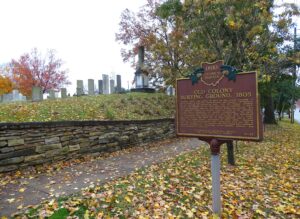
Granville, Ohio, was settled in 1805 by the Licking Company, a group formed in Granville, Massachusetts, and Granby, Connecticut, for the purpose of emigrating west. The Old Colony Burying Ground was defined on the first town plat of Granville in 1805. Many of Granville’s pioneers are interred within this ground, and the cemetery retains its original form and most of its westward facing rows of sandstone and marble gravestones. The early settlers buried here helped to lay out this town and determined the appearance and development of the village as it is today. The first burial, the infant son of Ethan Bancroft, was in April 1806. The oldest extant gravestone is dated 1808. Eighteen veterans of the Revolutionary War, thirty-nine from the War of 1812, and sixteen Civil War veterans rest here along with ministers, farmers, industrialists, physicians, young mothers, children, and other citizens of Granville.