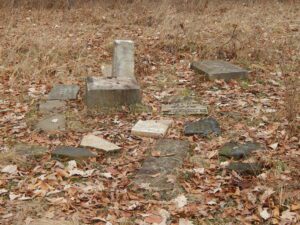
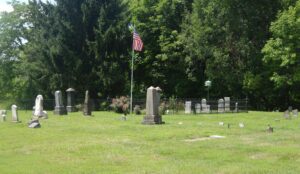
There are 48 known members of the Postle family buried in the cemetery. Their stories are interwoven with the history of Prairie Township, Franklin County, and Ohio. In 1810, Shadrach and Anna Stacia Postle were among the first settlers of Prairie Township. Their son Job was a veteran of the War of 1812 and later owned the Checker Inn, a popular stopping place on the National Road. In the 1860s, Smith Postle and his son, William Sylvester Postle, were some of the first manufacturers of clay drainage tile in Ohio. Their products improved drainage in farm fields and fostered the growth of the tile industry in the state. Gabriel Postle was the first Postle buried in the cemetery in 1829. Twelve graves are of children under the age of six, which testifies to the hardships endured by the area’s early residents. Other graves include those of John Whitehurst, a freed slave who lived with the family of the Job Postle and John Tracy, a veteran of the Civil War. In 1870, Nancy Postle was the last person buried in the cemetery.
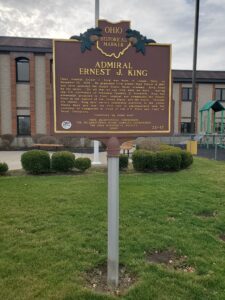
Fleet Admiral Ernest J. King was born in Lorain, Ohio, on November 23, 1878. He graduated from Lorain High School in 1897 and later attended the United States Naval Academy. King lived by his motto, “Do all that we can with what we have.” Having the full confidence of President Franklin D. Roosevelt, King was eventually promoted to Fleet Admiral and commanded the largest fleet in the history of the United States and the world. Through his career, King held various leadership positions in the United States Navy and was the first man to simultaneously hold the positions of Commander in Chief of the U.S. Fleet and Chief of Naval Operations. (continued on other side)
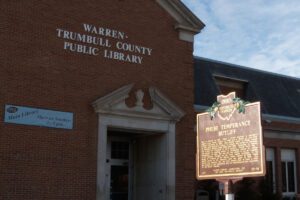
Warren-Trumbull County Public Library, 444 Mahoning Avenue
Warren
, OH
Born in Warren in 1859, Phebe T. Sutliff received a Bachelor’s degree from Vassar College in 1880 and a Master of Arts from Cornell University in 1890. Miss Sutliff taught at Hiram College in Ohio and Rockford College in Illinois and served as President of Rockford College from 1896 until 1901. Returning to Warren, she turned her attention to civic matters. During World War I, she started an evening school of citizenship classes for foreign immigrants. In 1924, she was the first woman to run for Congress in her district. Elected as the first woman president of the Board of Trustees of the Warren Public Library in 1938, Phebe Sutliff served in this capacity until her death in 1955. Miss Sutliff was inducted into the Ohio Women’s Hall of Fame in 1990. Her legacy to the community was the establishment and endowment of the Sutliff Museum.
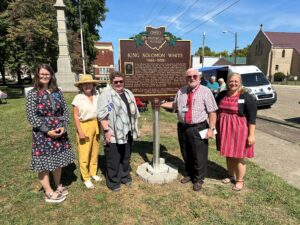
King Solomon “Sol” White was born in Bellaire on June 12, 1868. A Baseball legend, he was an all-around player, manager, and organizer in the Pre-Negro Leagues (1887-1912) and the Negro Leagues (1920-1926). White first played with integrated baseball clubs the Bellaire Globes (1884-1886) and Wheeling Green Stockings (1887). After 1887-1888 color barriers were imposed on baseball, White played on segregated minor league teams. They included: the Pittsburgh Keystones, Cuban Giants, York Colored Monarchs, Cuban X-Giants, Page Fence Giants, and Chicago Columbia Giants. As a coach, he helped organize and lead the powerhouse Philadelphia Giants to their 1904-1907 championships. White died on August 26, 1955, and was buried in an unmarked grave in Staten Island’s Frederick Douglas Memorial Cemetery. In 2006, “Sol” White was posthumously inducted into the Baseball Hall of Fame.
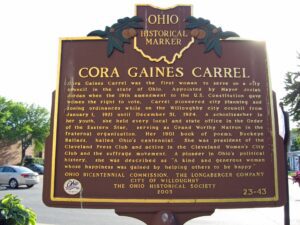
Cora Gaines Carrel was the first woman to serve on a city council in the state of Ohio. Appointed by Mayor Josiah Jordan when the 19th amendment to the U.S. Constitution gave women the right to vote, Carrel pioneered city planning and zoning ordinances while on the Willoughby city council from January 1, 1921 until December 31, 1924. A schoolteacher in her youth, she held every local and state office in the Order of the Eastern Star, serving as Grand Worthy Matron in the fraternal organization. Her 1901 book of poems, Buckeye Ballads, hailed Ohio’s centennial. She was president of the Cleveland Press Club and active in the Cleveland Women’s City Club and the suffrage movement. A pioneer in Ohio’s political history, she was described as “A kind and generous woman whose happiness was gained by helping others to be happy.”
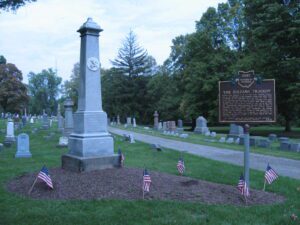
Soldiers from Company F of the 115th Ohio Volunteer Infantry died in the explosion of the steamboat Sultana seven miles north of Memphis on the Mississippi River on April 27, 1865. The Sultana reportedly carried more than 2,400 passengers–six times its capacity of 376. The vast majority were Union soldiers recently freed from Southern prisons at the end of the Civil War. Approximately 1,800 passengers and crew died in what is considered the worst maritime disaster in American history. Company F was organized in Stark, Columbiana, and Portage Counties and was mustered into service at Camp Massillon in the fall of 1862. This marker is a memorial to the soldiers of Company F who died as a result of the Sultana tragedy and other war-related causes.
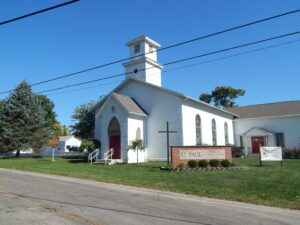
On July 30, 1816, the year before the establishment of Butler Township, a group of farmers of German background founded the Stillwater Church. The log structure with adjoining cemetery was located on three acres between Dog Leg Road and Frederick Pike. In 1842, the congregation replaced the log building with a brick one. In 1873, they moved the building to the northeast corner of Dog Leg and Little York Roads and renamed it St. Paul Lutheran Church. With a fruitful history of sharing God’s love, St. Paul celebrated it’s 200th anniversary on Sunday, July 31, 2016.
Originally part of the Casterline farm, this cemetery was once the site of the 1824 Bazetta Presbyterian Church, the first church in Bazetta Township. Ziba Casterline deeded .75 acres for the cemetery to the church in 1829 for five dollars. When the small log structured church was relocated to Lot 55 in the township, the cemetery remained. Buried in the cemetery are several early settlers, including Moses Hampton, Joseph Headley, Joseph Pruden, and John Hulse, the first white child born in the township. [continued on other side]