

, OH
In 1834, ministers gathered at Providence Church in Berlin Crossroads and organized the Providence Anti-Slavery Baptist Association; believed to be both the first African American Baptist Association in Ohio and among the earliest in the country. The Association’s name boldly reflected its stance: opposition to slavery and a commitment to freedom. Several affiliated churches and their members were known Underground Railroad safe houses and conductors. Providence Association grew to include member churches across Ohio—including Athens, Bidwell, Beaver, Blackfork, Burlington, Gallipolis, Glouster, Ironton, Middleport, Nelsonville, Rutland—as well as congregations in West Virginia, Kentucky, and Michigan.
, OH
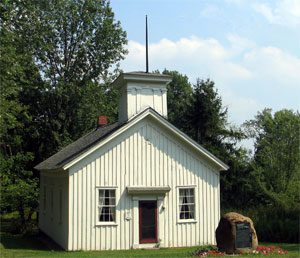
Called the “Cradle of Equal Suffrage” and “Free Speech Chapel,” Union Chapel was to be “…open and free for all denominations, but to be monopolized by no one or to the exclusion of anyone.” Built in 1858 or 1859 on land donated by Anson Matthews, the chapel reputedly exists in response to incident triggered by James A. Garfield, then principal of the Western Reserve Eclectic Institute (now Hiram College) and later president of the United States. He was scheduled to speak at the Congregationists’ “Brick Church” in December 1857. Because of the supposed controversial nature of Garfield’s speech, however, the invitation was withdrawn. (Continued on other side)
, OH
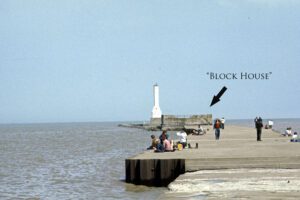
Lake Erie commerce has played a central role in the development of Huron. Important among Huron’s maritime industries were shipbuilding and commercial fishing. The city’s shipbuilding industry dates to the first decades of the nineteenth century. Shipyards were located on the Huron River’s west bank, slightly north of this marker, and also upstream at Fries Landing. Among the vessels built at Huron were the Great Western, constructed in 1838 and the first lake ship to have above-deck cabins, and the Golden Age, which, at 286 feet, was the largest craft on the Great Lakes when built in 1886. Huron shipbuilding declined as the nineteenth century drew to a close. Commercial fishing emerged thereafter, serving as Huron’s economic cornerstone for over fifty years. Huron’s fishing enterprises included the Huron, Kishman, Scott, and Zimmerman fish companies. By 1950, however, polluted lake waters ravished the once-lucrative industry. Although shipbuilding and commercial fishing are no longer a part of Huron’s daily life, they each had a profound effect upon the community’s growth for nearly two centuries.
, OH
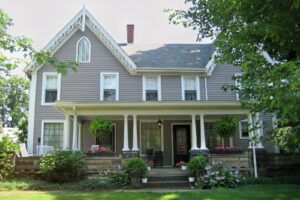
Unserheim, meaning “Our Home” in German, is the name of this ante-bellum Queen Anne style home, which was placed on the National Register of Historic Places in 1998. From 1857-1878, it was home to Daniel Howell Hise, a Quaker and ardent abolitionist. On April 8, 1849, Hise wrote, “Welcome! Welcome to the protection I can give, with or without the law.” A major stop on the Underground Railroad, Unserheim’s secret rooms and tunnel provided shelter to slaves on their flight to freedom. Hise’s belief in abolitionism was so strong that following John Brown’s Raid at Harper’s Ferry, he was instrumental in erecting the Edwin Coppock Monument at Hope Cemetery. Coppock had been executed for his participation in the raid. Hise also supported the Women’s Rights Movement and opened Unserheim to such notable guests as famed suffragists Susan B. Anthony and Sojourner Truth.
, OH
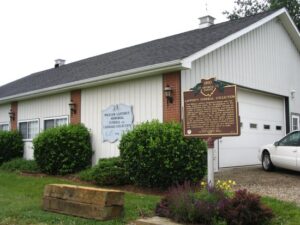
The William Lafferty Memorial Funeral and Carriage Collection shows the development of the funeral business since the mid-1800s through an exhibit of caskets, funeral clothing, and hearses collected and preserved by James William Lafferty (1912 – 1987). William was a member the fourth generation of Laffertys to serve West Union and Adams County. Characteristic of the early history of the profession, William Voris (W.V.) Lafferty (1830-1922) founded the business in 1848 to meet the demand for caskets, which he, as a furniture and cabinetmaker, was often asked to build. (Continued on other side)
, OH
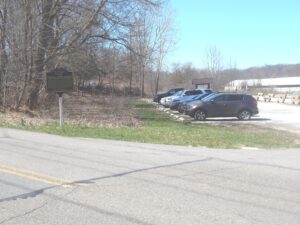
“I thought of the great bandits of the old West [like] the James Brothers…They knocked over trains, and I was going to pull the same stunt,” exclaimed notorious gangster Alvin “Creepy” Karpis. On November 7, 1935, Karpis and his bandits held up Erie Train #626 at this former location of the Garrettsville Train Depot, escaping with over $46,000 in cash and securities. Because of this last great train heist in American history, FBI Director J. Edgar Hoover and his Government Men (G-Men) improved their surveillance methods to capture Karpis. Once labeled “Public Enemy Number One,” Alvin Karpis became Hoover’s first arrest on May 1, 1936. Local legend holds that FBI agents flooded this town searching for Karpis and his accomplices, and this led the James A. Garfield School District to adopt the G-Men as the mascot for its athletic teams.
, OH
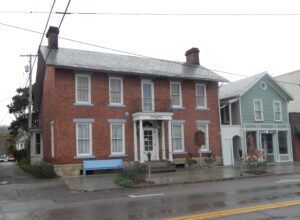
This brick, Federal-style house was built in 1836. Helen Moore, the grand daughter of General Robert McConnel, officer during the War of 1812 and founder of McConnelsville, married Dr. Hiram L. True and made their home here. Dr. True practiced medicine in the area and was widely known for his interest in science, serving as president of the local Scientific Society. Their daughter Evelyn True Button was born in the house in 1875. A graduate of Ohio Wesleyan University, Evelyn traveled to the Philippines in 1898 on a missionary trip to train teachers. A teacher, principal, community leader, and ardent worker for women’s rights, she died in the place of her birth in 1975. She bequeathed the house to the Morgan County Historical Society to serve as a depository of furnishings and artifacts of Morgan County heritage.
, OH
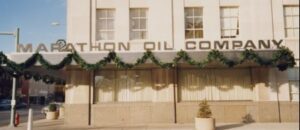
Site of the first Findlay Field Office for what was to become a world-wide oil company, formerly locally owned and operated. 1887: The Ohio Oil Company was incorporated by five independent oil producers in the Lima field. 1901: J.C. Donnell elected President of the Ohio Oil Company. Company’s ‘big well,’ the “Hugh McMurray,” comes in. 1929: Construction begins on new office building at South Main Street and Hardin Streets. 1962: Name changed to Marathon Oil Company to reflect international operations.