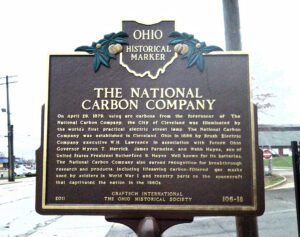
On April 29, 1879, using arc carbons from the forerunner of The National Carbon Company, the City of Cleveland was illuminated by the world’s first practical electric street lamp. The National Carbon Company was established in Cleveland, Ohio in 1886 by Brush Electric Company executive W.H. Lawrence in association with future Ohio Governor Myron T. Herrick, James Parmelee, and Webb Hayes, son of United States President Rutherford B. Hayes. Well known for its batteries, The National Carbon Company also earned recognition for breakthrough research and products, including lifesaving carbon-filtered gas masks used by soldiers in World War I and reentry parts on the spacecraft that captivated the nation in the 1960s.
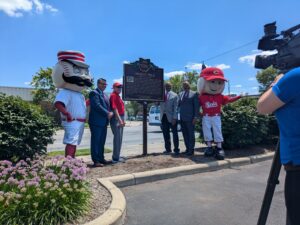
Crosley Field was the home of the Cincinnati Reds for almost 58 years. Opened in 1912 as Redland Field, the ballpark was renamed in 1934 when famed Cincinnati industrialist Powel Crosley Jr. purchased the team. Over its years of service, Crosley Field was home to Reds teams that won National League Championships in 1919, 1939, 1940, and 1961, and World Series titles in 1919 and 1940. The park also played host to the Major League Baseball All-Star Game in 1938 and 1953. Crosley Field famously held what was then acknowledged as the first night game under lights on May 24, 1935. Such visiting legends as “Shoeless” Joe Jackson, Babe Ruth, Joe DiMaggio, Willie Mays, and Jackie Robinson played at Crosley Field. (Continued on other side)
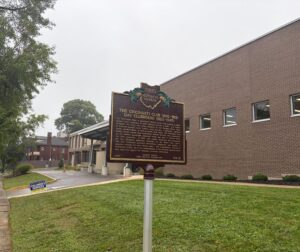
The Cincinnati Club, a prominent Jewish social club founded in 1889, opened their clubhouse at 2840 Melrose Avenue in 1894. A.E. Elzner designed the brick and stone building in the Norman-Gothic style. It featured massive round towers, wide porches, a ballroom, billiard rooms, bowling alley, as well as ornate club rooms. The Cincinnati Club hosted lavish events that celebrated Jewish identity and community. As the Jewish population migrated north and east of Walnut Hills, the club dissolved. In 1922, the vacant clubhouse was purchased by the Disabled American Veterans of the World War (DAV). The DAV Clubhouse provided recreation, resources, and shelter to disabled veterans for over twenty years. The organization, founded in Cincinnati in 1920, led to the establishment of the Veterans Administration and improved support for wounded veterans nationwide.
Market Square, home to the Pearl Street Market, was located on the corner of Pearl and Lorain Streets (now West 25th St. and Lorain Ave.) in what was then known as the City of Ohio. The land that Market Square occupies was donated by local businessmen Josiah Barber and Richard Lord in 1840 for the public’s use. Farmers and food vendors gathered to sell their wares after a public market moved here in 1859. In 1868, an enclosed wood-framed Pearl Street Market building was erected.
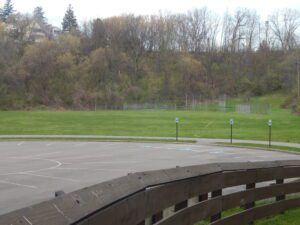
For more than 120 years, the natural amphitheater of Brookside Stadium has been a place of recreation for visitors to enjoy community events, festivals, and even a concert by John Philip Sousa. Engineered by William Stinchcomb, chief architect of the Cleveland Metroparks, Brookside Stadium officially opened as a premier space for sandlot baseball in May 1909. As amateur baseball found increased esteem, both locally and nationally, Brookside Stadium regularly became popular with thousands of spectators. On Sunday, October 10, 1915, it was host to the National Inter-City Amateur Championship, during which a crowd of an estimated 115,000 people witnessed the White Autos beat the Omaha Luxus 11 to 6. Although there was no formal ticketing system to verify the exact attendance, photographs taken that day strongly suggest that Brookside Stadium hosted the largest crowd in amateur baseball history.
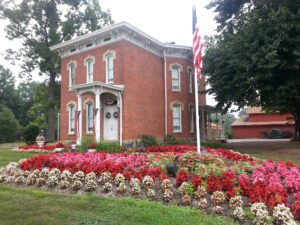
The Clague House and barn serve the community as a museum, history library, and a community theater. It is also a reminder of the area’s agrarian past and is a memorial to the philanthropic generosity of the Clagues. Robert Clague first came to Dover Township from the Isle of Man in 1829. Clague briefly returned to his native land; in 1837 he arrived back in Dover with his wife and infant. The couple raised nine children on the 78 acre farm. The Italianate structure, built in 1876, is the third home constructed on the Clague property. In 1926, surviving children Walter and Sophronia donated the farm to Dover Township for the creation of Clague Memorial Park.
The Clague House and barn serve the community as a museum, history library, and a community theater. It is also a reminder of the area’s agrarian past and is a memorial to the philanthropic generosity of the Clagues. Robert Clague first came to Dover Township from the Isle of Man in 1829. Clague briefly returned to his native land; in 1837 he arrived back in Dover with his wife and infant. The couple raised nine children on the 78 acre farm. The Italianate structure, built in 1876, is the third home constructed on the Clague property. In 1926, surviving children Walter and Sophronia donated the farm to Dover Township for the creation of Clague Memorial Park.
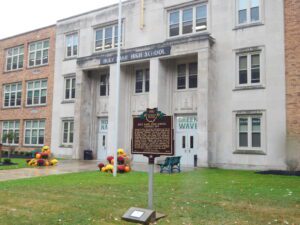
Founded in 1914, Holy Name High School was one of the first co-educational Roman Catholic high schools in Cleveland. Originally located at Harvard and Broadway Avenues, the school opened under the direction of Holy Name Parish with educational leadership of the Sisters of Charity from Cincinnati. In 1978, Holy Name High School moved to its present location in Parma Heights, the former home of Nazareth Academy. Throughout its history, Holy Name High School has served the community by providing a Catholic, college-preparatory education. The Holy Name spirit lives on through its alumni, who have made a difference around the world.