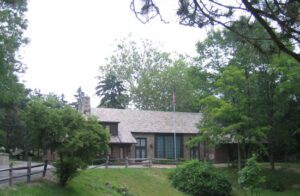
Envisioned by Fairview Village Mayor, David R. Bain, this community center was originally completed in 1937 as a project of the Works Progress Administration (WPA), a Depression-era work relief program initiated by the Federal Government in 1935. A fire destroyed the original log cabin on December 14, 1937, just four days before the planned dedication. With the support of the community, Mayor Bain turned again to the WPA for funding and labor to rebuild the structure. This cabin, constructed of bricks on the original foundation, features an 8’x12′ mural painted by artists of the WPA’s Federal Art Project and which depicts Fairview’s history through the 1930s. The new cabin was dedicated on January 15, 1940, and was named in honor of Mayor Bain in 1957, four years after his death.
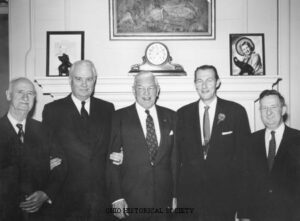
Ohio’s fifty-ninth governor, Marietta native C. William O’Neill was the only Ohioan to head all three branches of state government. An honor graduate of both Marietta High School and Marietta College, O’Neill won election to the Ohio House of Representatives in 1938, serving there until 1950 but interrupted from 1943-1946 when he was with General George Patton’s Third Army in Europe during World War II. In 1947 he became the youngest Speaker of the House in Ohio history. Elected Attorney General in 1950, he won the governorship in 1956, modernizing the highway and mental health departments during his tenure. His election to the State Supreme Court in 1960 and elevation to Chief Justice in 1970, noted by landmark judicial reforms, capped his exemplary career of public service to Ohio.
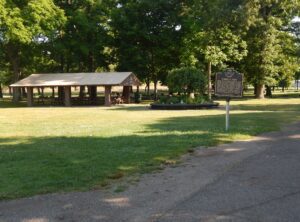
Nimisilla Park was established in 1894. Prior to its founding, the site was the location of the county fair from 1859 to 1893. Throughout its history, Nimisilla Park hosted horse races, live music, soldier reunions, and a zoo, among other events. Prominent political figures, such as Rutherford B. Hayes, James A. Garfield, William McKinley, and Eugene V. Debs, made speeches at the park. In 1918, Debs delivered a famous anti-war speech for which he was arrested and jailed. As of 2016, the park continues to serve as a gathering place for the community.
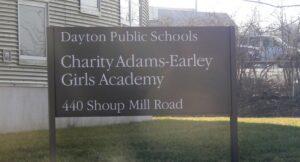
In 1942, Charity Adams Earley (1918-2002) became the first African American woman to receive a commission in what became the Women’s Army Corps (WACs). She rose through the ranks to command the 6888th Central Postal Directory Battalion in Europe, the only unit of African American women to serve overseas in World War II. Upon leaving the service in 1946, she was the WAC’s highest-ranking African American officer, a lieutenant colonel. Raised in Columbia, South Carolina, Earley moved to Ohio to attend Wilberforce University and later The Ohio State University. She married Stanley Earley, Jr., M.D. in 1949 and they later moved to Dayton. She became active in civic affairs, including serving on the Sinclair Community College Board of Trustees.
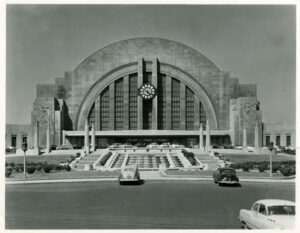
Cincinnati Museum Center at Union Terminal, 1301 Western Avenue
Cincinnati
, OH
The Cincinnati Union Terminal opened in March 1933 and integrated rail travel in the city, which previously operated from five separate passenger terminals. Built when rail travel was already in decline, Union Terminal stopped operating as a passenger railroad station in 1972. Only during WWII was the terminal used to capacity with as many as 34,000 people travelling through the building daily in 1944. As part of preservation efforts, 14 mosaics depicting Cincinnati industry of the 1930s by Winold Reiss were saved from the concourse and moved to the Greater Cincinnati Airport. The restored Union Terminal became a Museum Center in November 1990 with the opening of the renovated Cincinnati Museum of Natural History and new Cincinnati History Museum. Cincinnati Union Terminal has been described as one of the most outstanding examples of Art Deco train stations in the nation and was listed on National Register of Historic Places in 1972.
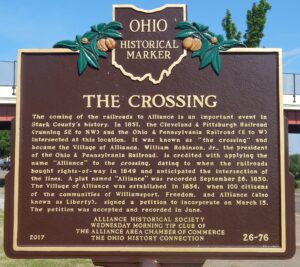
The coming of the railroads to Alliance is an important event in Stark County’s history. In 1851, the Cleveland & Pittsburgh Railroad (running SE to NW) and the Ohio & Pennsylvania Railroad (E to W) intersected at this location. It was known as “the crossing” and became the Village of Alliance. William Robinson, Jr., the president of the Ohio & Pennsylvania Railroad, is credited with applying the name “Alliance” to the crossing, dating to when the railroads bought rights-of-way in 1849 and anticipated the intersection of the lines. A plat named “Alliance” was recorded September 26, 1850. The Village of Alliance was established in 1854, when 100 citizens of the communities of Williamsport, Freedom, and Alliance (also known as Liberty), signed a petition to incorporate on March 15. The petition was accepted and recorded in June.
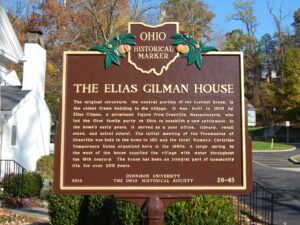
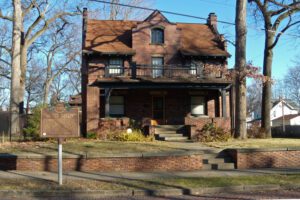
The original structure, the central portion of the current house, is the oldest frame building in the village. It was built in 1808 by Elias Gilman, a prominent figure from Granville Massachusetts, who led the first family party to Ohio to establish a new settlement . In the home’s early years, it served as a post office, library, retail store, and select school. The initial meeting of the Freemasons of Granville was held in the home in 1811 and the local Women’s Christian Temperance Union organized here in the 1880s . A large spring to the west of the house supplied the village with water throughout the 19th century . The house has been an integral part of community life for over 200 years.
Akron, an industrial boomtown in the early twentieth century, grew in population nearly fivefold between 1900 and 1920. As the city industrialized, middle class residents sought homes on West Hill, away from the smoke and soot of heavy industry on the East Side. The Hall Park Allotment Historic District in West Hill represents a notable early twentieth century neighborhood. Developed by Philander Hall between 1902 and 1919 during the height of Akron’s “rubber boom,” it consists of several houses representing the picturesque styles of the period, including the American Foursquare, Craftsman, Colonial, and Medieval Revival Styles. With its gently curving brick streets, hilly topography, and mature trees, the Hall Park Allotment Historic District evokes the feeling of a distinct period of time in Akron’s history and constitutes a neighborhood of distinctive historical character and architectural merit.