In 1764, Colonel Henry Bouquet established the site of what is now Coshocton. In 1811, the county was founded and the town incorporated as the county seat. The Coshocton County Courthouse, the third on this site, was built between 1873 and 1875 by contractors Carpenter and Williams of Meadville, Pennsylvania. The Second Empire structure features a five-story tower containing a four-faced clock and the bell from the previous 1824 courthouse. The courthouse contains a notable mural by artist Arthur William Woelfle depicting the signing of Bouquet’s treaty with the Indians near the Walhonding River in November 1764. The Coshocton County Courthouse was added to the National Register of Historic Places in 1973.
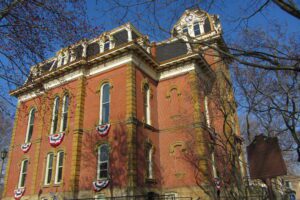
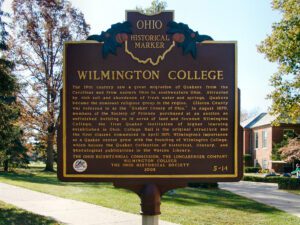
The 19th century saw a great migration of Quakers from the Carolinas and from eastern Ohio to southwestern Ohio. Attracted by rich soil and abundance of fresh water and springs, Quakers became the dominant religious group in the region. Clinton County was referred to as the “Quaker County of Ohio.” In August 1870, members of the Society of Friends purchased at an auction an unfinished building on 14 acres of land and founded Wilmington College, the first Quaker institution of higher learning established in Ohio. College Hall is the original structure and the first classes commenced in April 1871. Wilmington’s importance as a Quaker center grew with the founding of Wilmington College, which houses the Quaker Collection of historical, literary, and genealogical publications in the Watson Library.
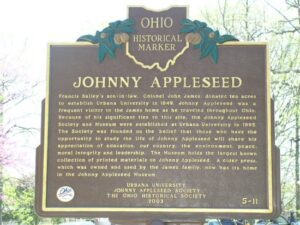
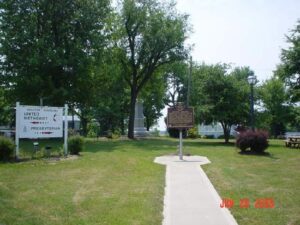
Urbana University was established by the Swedenborgian Church in 1850. Bailey Hall (1853), named after Francis Bailey (1735-1815), was designed by W. Russell West, architect of the Statehouse of Ohio. Bailey was an American Revolutionary War hero, official printer of the Continental Congress and printer of The Freeman’s Journal or the North American Intelligencer. He also printed The True Christian Religion papers. John (Johnny Appleseed) Chapman (1774-1845) distributed The True Christian Religion papers along with his famous apple trees throughout Ohio as a missionary for the Swedenborgian Church. Barclay Hall (1883) was named after Hester Barclay, a ward of Francis Bailey. It was Hester Barclay’s brother-in-law, John Young, who converted Chapman to the Swedenborg faith. Francis Bailey and Hester Barclay were the first male and female Swedenborgian converts in North America. Both Bailey and Barclay halls appear on the National Register of Historic Places.
Originally called St. Clairsville and platted in 1801, Decatur was named for early 19th century naval hero Stephen Decatur. It is among the oldest villages in Brown County, which before 1817 was a part of Adams County. Among its notable early residents were Nathaniel Beasley (1774-1835), the first surveyor of Adams County, and Sarah Boone Montgomery (1763-1848), a heroine of the border wars in Kentucky. Decatur and Byrd Township supported at least four known stations on the Underground Railroad. Many area residents helped conduct escaping slaves northward to freedom.
Hubbard House Underground Railroad Museum, 1603 Walnut Blvd
Ashtabula
, OH
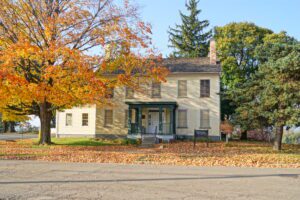
Built in the 1840s by William and Catharine Hubbard and known as “Mother Hubbard’s Cupboard” or “The Great Emporium” by fugitive slaves, the Hubbard House was an important terminus on the fabled Underground Railroad in the years before the Civil War. The Hubbard House sheltered escaped slaves who had risked life and limb after crossing the Ohio River into the North. From the Hubbard home, slaves walked one-quarter mile to the Hubbard and Company warehouse on the Ashtabula River, where friendly boat captains awaited to ferry their passengers to Canada and freedom. The U.S. Department of the Interior listed the Hubbard House on its National Register of Historic Places in 1973.
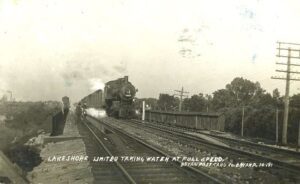
Like many nineteenth century communities in Ohio, Stryker owes its birth and early growth to the railroad industry. Stryker, named for Rome, New York, attorney and railroad executive John Stryker, was surveyed on September 19, 1853, beside the proposed Northern Indiana Railroad. For more than fifty years, “track pans” at Stryker allowed steam locomotives to take on 5,000 gallons of water while traveling at forty to fifty miles per hour, saving valuable time, “the principal enemy of railroad schedules.” On July 23, 1966, the U.S. rail speed record of 183.85 miles per hour was set through Williams County, including through Stryker. The Stryker depot was constructed in 1900 and placed on the National Register of Historic Places on August 7, 1989. (continued on other side)
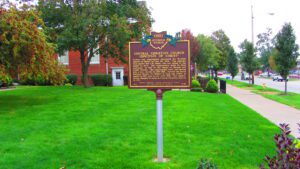
Harvey Howard, a local druggist, built the house at 407 North Market Street around 1860. After many owners, Captain James B. Taylor bought the home in 1893. Taylor commanded Company H of the 120th Ohio Volunteer Infantry during the Civil War. He studied law after the war and moved his practice to Wooster in 1882. Taylor’s wife Emelie died in 1905 and in 1906 Taylor sold the property to become Wooster’s first city hospital. Many of the town’s noted physicians practiced here and the facility was eventually enlarged to accommodate 30 beds. The house was a hospital until 1943, when Central Christian Church purchased it. The church used the building for education programs and restored much of its decor, including four fireplaces, inlaid floors, and bronze door hardware.
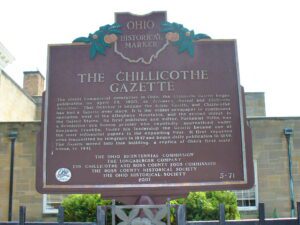
The oldest commercial enterprise in Ohio, the Chillicothe Gazette began publication on April 25, 1800, as Freeman’s Journal and Chillicothe Advertiser. That October it became the Scioto Gazette, and Chillicothe has had a Gazette ever since. It is the oldest newspaper in continuous operation west of the Allegheny Mountains, and the second oldest in the United States. Its first publisher and editor, Nathaniel Willis, was a Revolution-era Boston printer who reputedly apprenticed under Benjamin Franklin. Under his leadership the Gazette became one of the most influential papers in the expanding West. It first reported news transmitted by telegraph in 1847 and began daily publication in 1849. The Gazette moved into this building, a replica of Ohio’s first statehouse, in 1941.