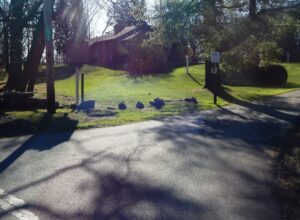
Due to what is known as the Sharon Conglomerate or pebbly sandstone, these ledges have played an important role in the daily life of local residents and the economy. The porousness of this rock, which underlies much of Geauga County, supplies most of the county’s drinking water. Thompson Ledges also provided building stone with stone cutters working in quarries turning out doorsteps, watering troughs, gateposts, culverts, and bridges from mid-1800 to 1911 for use in Thompson, Geauga County and occasionally beyond. After 1900, cement became the preferred building material, but still used silica pebbles from the Ledges for gravel and cement. The Ledges have an unusual ecosystem containing several distinctive forests. A chestnut oak forest is pervasive on the top while a northern hemlock forest exists in the exposed creaks and crevices of the upper rim and ledges.
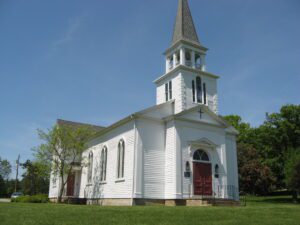
The first home of the oldest Episcopal parish in the Connecticut Western Reserve, the St. James Episcopal Church was built between 1827 and 1828. Philander Chase, first Bishop of the Diocese of Ohio, consecrated it in 1829. The belfry and steeple were added in 1881. It was moved to this site from its original Market Street location in 1972 after the parish built a new church. Renamed the St. James Meeting House, it is the anchor of a community of historic buildings that includes the Beardsley-Walter-Diehm House (circa 1828), the Oswald Detchon House (circa 1840), and the Schiller-Chuey Summer Kitchen. The oldest known structure in Boardman, the St. James Meeting House was added to the National Register of Historic Places in 1979.
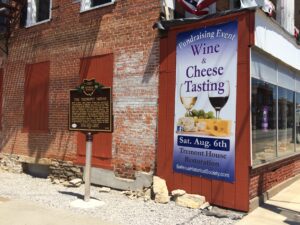
Built in 1846, the Tremont House was opened by Loel and Samuel B. Chandler to serve stagecoach traffic on the Maumee Pike (U.S. Route 20). Briefly a hotel, this Bellevue landmark has housed grocery and hardware stores, a pharmacy, and even a cigar factory. The third floor ballroom hosted community events and fraternal organizations such as the Independent Order of Odd Fellows (IOOF). The building’s west side is on the western boundary of the Firelands region of the Connecticut Western Reserve. An example of Greek Revival architecture, the Tremont House was listed on the National Register of Historic Places in 2006.
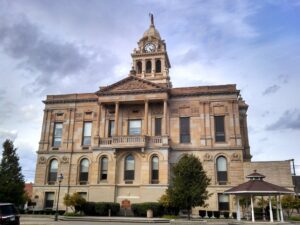
This is Marion County’s fourth courthouse and the second at this site. The cornerstone was laid on July 4, 1884. Costing $115, 00, it was completed in 1885 by contractors Leffler and Bland. In 1973 the courthouse was placed on the National Register of Historic Places. In 1975 the interior was remodeled at a cost of over $900,000.
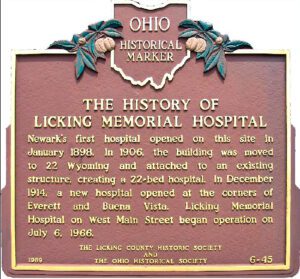
Newark’s first hospital opened on this site in January 1898. In 1906, the building was moved to 22 Wyoming and attached to an existing structure, creating a 22-bed hospital. In December 1914, a new hospital opened at the corners of Everett and Buena Vista. Licking Memorial Hospital on West Main Street began operation on July 6, 1966.
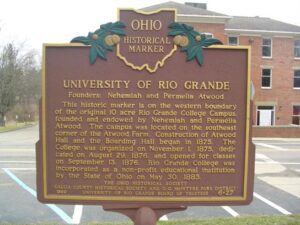
This historic marker is on the western boundary of the original 10 acre Rio Grande College Campus, founded and endowed by Nehemiah and Permelia Atwood. The campus was located on the southeast corner of the Atwood Farm. Construction of Atwood Hall and the Boarding Hall began in 1875. The College was organized on November 1, 1875, dedicated on August 29, 1876, and opened for classes on September 13, 1876. Rio Grande College was incorporated as a non-profit educational institution by the State of Ohio on May 30, 1883.
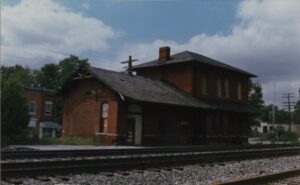
By the mid 1830s, Ohio had developed a canal system that linked Lake Erie in the north to the Ohio River in the south. Despite the success of the canals, transportation companies searched for other methods to traverse the state. They found their answer in the railroad industry, which proved to be much faster, cheaper, and more reliable than canals. Located on Lake Erie, Sandusky, Ohio was a major trading depot in the area. Plans were made to connect Sandusky to Cincinnati’s port on the Ohio River. On September 4, 1835, construction began in Sandusky on the Mad River and Lake Erie Railroad line, forming the first railroad line located entirely in Ohio. The railroad reached Tiffin by 1841 and Springfield by 1848, where it merged with the Little Miami Railroad line, connecting Lake Erie to the Ohio River.
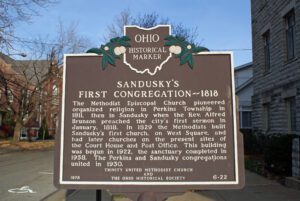
The Methodist Episcopal Church pioneered organized religion in Perkins Township in 1811, then in Sandusky when the Rev. Alfred Brunson preached the city’s first sermon in January, 1818. In 1829 the Methodists built Sandusky’s first church, on West Square, and had later churches on the present sites of the Court House and Post Office. This building was begun in 1922, the sanctuary completed in 1958. The Perkins and Sandusky congregations united in 1930.